| IMO | 9152959 |
|---|---|
| Gross tonnage | 23,439 GT |
| Length | 159.6 m |
| Beam | 30.0 m |
| Service speed | 21.4 knots |
| Builder | Baltic Shipyard |
| Hull number | 705 |
| Launched | 1993 |
| Maiden voyage | 2007 |
| Class | Arktika-class icebreaker |
| Operator | various owners |
| Status | Active |
| All names | 50 Let Pobedy; Ural |
Overview
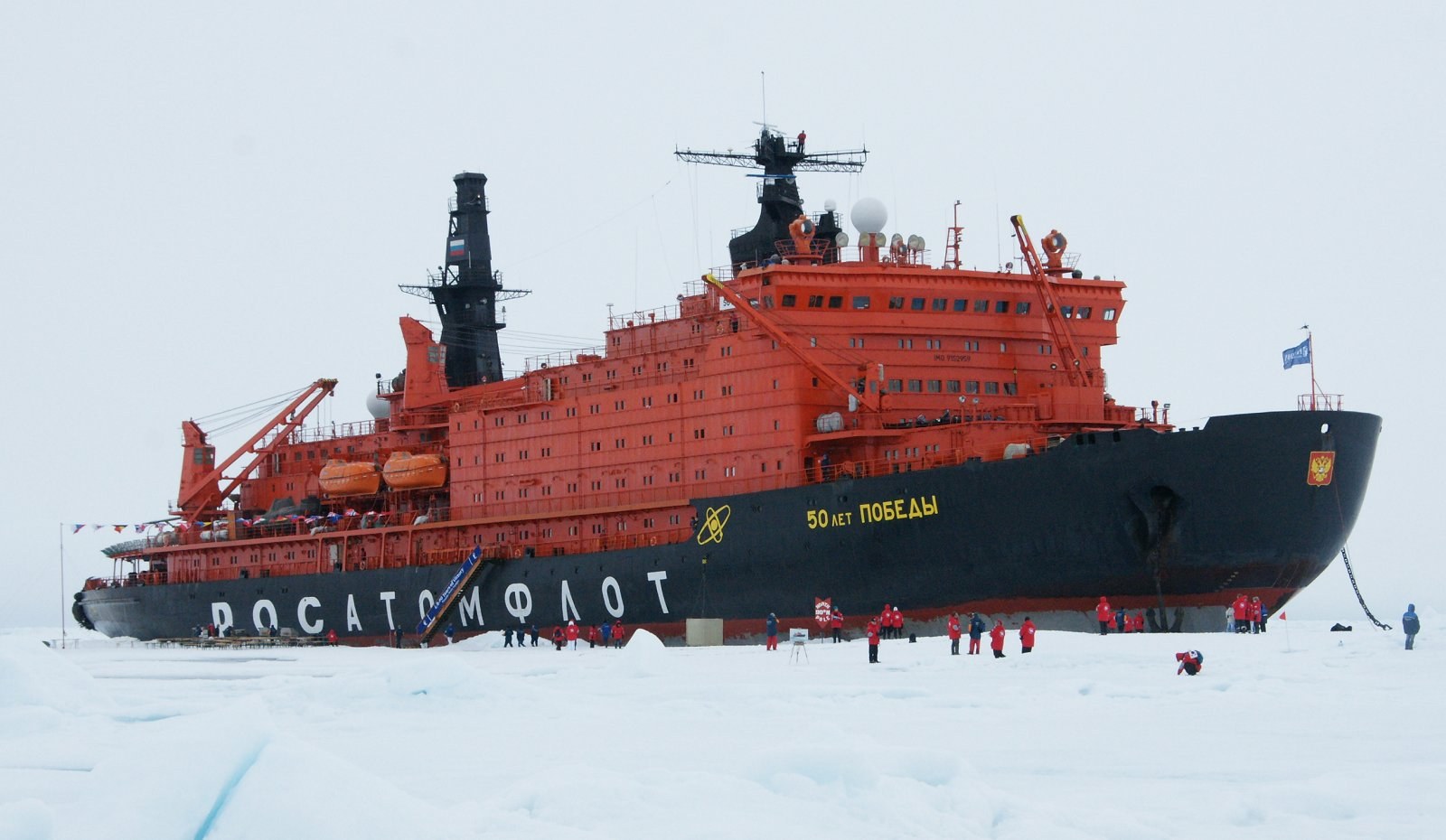
50 Let Pobedy — Russian for "50 Years of Victory," marking the 50th anniversary of the end of the Great Patriotic War in 1945 — is a Russian Arktika-class nuclear-powered icebreaker operated by Atomflot. She is the odd hull out in any cruise directory, and the most powerful one here: not a cruise ship by design, but an expedition ship by use, chartered for years to carry paying passengers to the North Pole. She is also the largest and last-completed of the Soviet-designed Arktika class, and her building history spans the end of one state and the beginning of another. Laid down in Leningrad in 1989, abandoned in the 1990s, and not commissioned until 2007, she is as much a record of post-Soviet shipbuilding finance as of polar navigation. Her dataset entry, with operator listed as "various owners; Atomflot," captures that dual life: a state icebreaker first, a tourist ship by charter.
Key specifications
The dataset records 23,439 GT, a length of 159.6 m, a beam of 30.0 m, a speed of 21.4 knots, Baltic Shipyard hull 705, and IMO 9152959. Two dataset figures need correction. The dataset lists her as launched in 2009, which cannot stand alongside a maiden voyage in 2007; her own article records her laid down on 4 October 1989 and launched on 29 December 1993, as Ural, with commissioning on 23 March 2007. The dataset leaves capacity and crew blank; her article gives a crew of 140 and tourist accommodation for 128 passengers, figures this guide uses in the narrative only. Tonnage here is GT. Her draught is given in her article as 11 m, and her propulsion — two OK-900A nuclear reactors driving a nuclear-turbo-electric plant on three shafts — is what separates her from every diesel ship in this directory.
Design and construction
50 Let Pobedy is Project 10521, an enlarged development of the Arktika design. The class idea was a nuclear icebreaker able to work independently in heavy Arctic ice, escorting cargo ships along the Northern Sea Route and, in this ship's case, carrying a tourist deck. She introduced a spoon-shaped bow, used for the first time on a Russian icebreaker, intended to improve icebreaking efficiency by riding up onto and fracturing the ice more effectively. She was also fitted with an air-bubbling system, with jets below the waterline to ease movement through broken ice, a modernised biological shielding complex around her reactors, a new ecological compartment — which accounts for part of her extra length over earlier sisters — and, on completion, a new digital automated control system. Construction began at the Baltic Works in Leningrad, now Saint Petersburg, in 1989. Work halted in 1994 for lack of funds after the dissolution of the Soviet Union, leaving the hull in an abandoned state through the actual 50th anniversary in 1995 that she was named for. Construction restarted in 2003.
Naming, launch and maiden voyage
The hull was originally named Ural, after the mountain range — a name the dataset's names list omits. She was launched on 29 December 1993 under that name and renamed for the victory anniversary before completion. After the long stoppage and restart, a fire broke out on board on 30 November 2004, during the completion work; workers were evacuated and fire crews fought the fire for some 20 hours before bringing it under control, with one worker taken to hospital. She finally began two weeks of sea trials in the Gulf of Finland on 1 February 2007, showing, in contemporary reporting quoted in her article, exceptional manoeuvrability for an icebreaker and her 21.4-knot maximum speed. She was commissioned on 23 March 2007 and arrived at her home port of Murmansk on 11 April 2007 — twelve years after the anniversary she commemorates.
Career by operator
The hull has had one owner — the Russian state — and one operator of record, Atomflot, the Murmansk-based operator of Russia's nuclear icebreaker fleet. Her passenger career has been by charter to expedition companies, notably Quark Expeditions and Poseidon Expeditions, rather than by a change of operator.
| Name | Operator | Period |
|---|---|---|
| Ural (under construction) | Baltic Shipyard / Atomflot programme | 1989–c.1996 |
| 50 Let Pobedy | Atomflot | 2007–present |
Within that single-operator career she has done two jobs. The first is state icebreaking in the Russian Arctic. The second is North Pole tourism: nuclear icebreakers had carried tourists since 1989, and 50 Let Pobedy, with a dedicated tourist accommodation deck, a helicopter deck and Zodiac boats, became the flagship of that trade. Quark Expeditions chartered her for North Pole expeditions from 2008, and by February 2013 both Quark and Poseidon Expeditions were offering Pole cruises on her. On 30 July 2013 she reached the North Pole for the 100th time in icebreaker history, during a Poseidon cruise.
Onboard character
Her onboard character is defined by the fact that she is a working icebreaker with tourists fitted into her, not a cruise ship with ice class added. The tourist layer described in her article is functional and expeditionary: an accommodation deck customised for tourists, a helicopter deck for Mil Mi-2, Mi-8 or Ka-27 helicopters used for flights over remote islands, Zodiac inflatables for landings, and a modest set of shared spaces — an exercise facility, a swimming pool, a library, a restaurant, a massage facility and a music salon. There is no promenade deck, no theatre district and no balcony cascade; the spectacle is outside the ship, in the ice, the light and the Pole itself. That austerity, combined with a nuclear plant and a crew of 140 serving about 128 passengers, is precisely what made her the definitive polar expedition platform of her era — the ship people booked not for the ship, but for where only she could reliably take them.
Major refits and incidents
Her long completion, rather than a later refit, dominates her technical history: the 1994–2003 stoppage, the November 2004 fire during outfitting, and the modernisation of her shielding, ecological systems and control systems before delivery were, in effect, a rebuilding before she ever entered service. In service, two events stand out in published reporting. In October 2013 she carried the Olympic flame to the North Pole as part of the relay before the 2014 Sochi Winter Olympics — a publicity voyage, but a documented one in her record. In August 2017 she set a record transit time from Murmansk to the North Pole, arriving on 17 August 2017 after a journey reported at 79 hours. On 26 January 2025 she collided with the dry bulk carrier Yamal Krechet in the Kara Sea; reporting cited in her article records damage to the port-side bow plating, with no injuries, no effect on her operational capability and no compromise to reactor safety.
Sister ships and class
The Arktika class (Projects 10520/10521) was the Soviet Union's heavy nuclear icebreaker class: Arktika herself (1975), Sibir (1977), Rossiya (1985), Sovetskiy Soyuz (1990) and Yamal (1993) preceded her, with the smaller, Finnish-built Taymyr class as a shallow-draught companion design. 50 Let Pobedy was the final ship of the class and the largest, her extra length partly accounted for by the added ecological compartment. The class has since been succeeded in Russian service by the Project 22220 ships — a new Arktika, Sibir and Ural among them — which reuse the famous names, including, pointedly, this ship's own construction name. None of her sisters developed a comparable tourist career; Yamal was the other Arktika-class ship most associated with North Pole passenger voyages before her.
Fate and where she is now
The dataset records her as active, with the fate note "Nuclear powered expedition ship. In service," and that remains her documented position: a state-owned, Atomflot-operated nuclear icebreaker based at Murmansk, combining Northern Sea Route work with the expedition-charter role that puts her in a cruise directory at all. She has never been sold, renamed in service or laid up since her eventual commissioning in 2007 — a stable ending, so far, to the most unstable building programme in this batch. Her significance is already fixed: the last Arktika, the largest nuclear icebreaker of her generation, and the ship that made reaching the North Pole by surface vessel a repeatable, bookable expedition rather than a one-off feat.
Sources: https://en.wikipedia.org/wiki/List_of_cruise_ships, https://en.wikipedia.org/wiki/50_Let_Pobedy