| IMO | 9398888 |
|---|---|
| Gross tonnage | 71,304 GT |
| Length | 253.33 m |
| Beam | 32.2 m |
| Passenger capacity (max) | 2030 |
| Service speed | 21.8 knots |
| Builder | Meyer Werft |
| Hull number | S. 680 |
| Launched | 2009 |
| Maiden voyage | 2010 |
| Class | Sphinx-class cruise ship |
| Operator | AIDA Cruises |
| Status | Active |
Overview
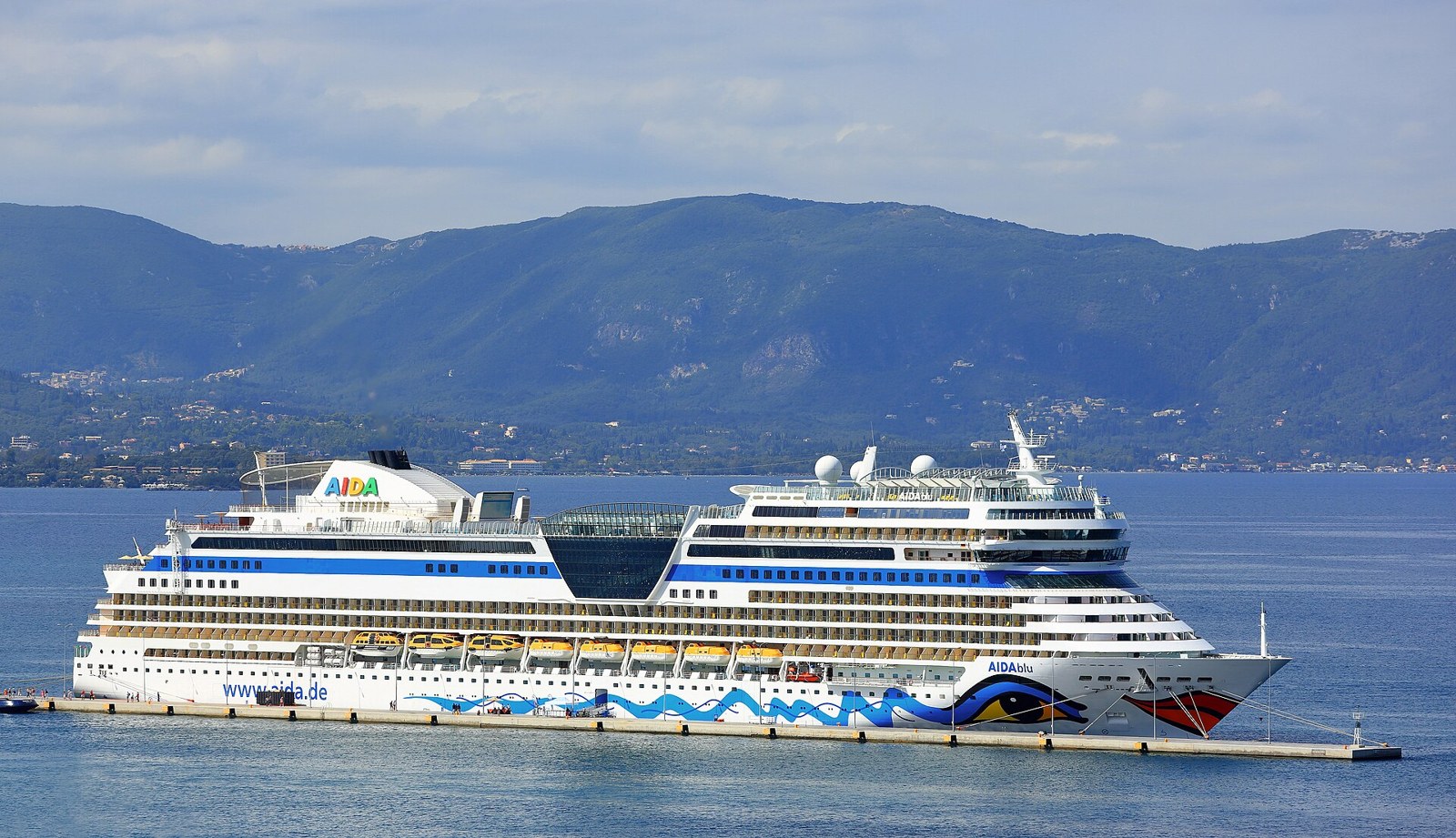
AIDAblu is a Sphinx-class cruise ship operated by the German line AIDA Cruises, a Carnival Corporation brand aimed squarely at the German-speaking market. Delivered by Meyer Werft at Papenburg on 4 February 2010, she was the seventh ship in AIDA's fleet and the first of the enlarged second series of Sphinx ships — the group sometimes distinguished as the Ikarus class — with an extra half-deck over the original trio. Her name was not new: an earlier AIDA ship had carried AIDAblu from 2004 to 2007 before leaving the fleet, and the new ship revived it for a larger generation. At 71,304 GT she was, on delivery, the largest ship AIDA had operated. Her historical footnote is a genuine first: she carried the first brewery installed on a cruise ship, a small but much-copied statement of AIDA's informal, German-market "club ship" idea.
Key specifications
The dataset records 71,304 GT, a length of 253.33 m, a beam of 32.2 m, a speed of 21.8 knots, a maximum capacity figure of 2,030, Meyer Werft hull S. 680, and IMO 9398888. Her article largely confirms those figures, with two refinements. First, the dataset's launched year of 2010 is her delivery year; she was in fact launched on 11 July 2009. Second, published capacity figures vary by basis: her article's infobox gives 2,192 passengers and a crew of 607, while its text gives a capacity of 2,050 — the dataset's 2,030 sits close to the latter and should be read as a normal-occupancy figure rather than an absolute maximum. She has 15 decks, a draught of 7.3 m, and diesel-electric propulsion from four Caterpillar MaK engines at about 36,000 kW. Tonnage here is GT, a measure of enclosed volume.
Design and construction
The Sphinx design was AIDA's third-generation club ship: a mid-sized, informal vessel built around open deck space, a central interior gathering space and buffet-led dining rather than formal cruising rituals. AIDAblu stretched that formula. Her article records 8,120 square metres of outer deck area and a 3,000-square-metre Theatrium — the glass-roofed atrium-theatre that is the Sphinx class's signature space, combining circulation, daytime lounging and evening performance in one volume. She has 1,096 cabins, 374 inside and 722 outside, in the figures given at delivery. Construction at Papenburg followed Meyer Werft's standard practice for AIDA: the ship was built under cover, floated out, and then conveyed down the River Ems to the sea — the passage that defines every Papenburg cruise ship's birth. Ordered on 1 July 2006 in the chronology given in her article, at a cost reported as $420 million, she was delivered on 4 February 2010, five days before her christening.
Naming, launch and maiden voyage
There was no renaming drama with this hull: she was built, launched and delivered as AIDAblu, reviving a fleet name vacated three years earlier. Launched on 11 July 2009, she was christened on 9 February 2010 in Hamburg, on an ice-covered Elbe, by the designer Jette Joop, and her maiden voyage — dated 9 February 2010 in both the dataset and her article — sailed that day for Palma, Majorca. The sequence matters for reading the dataset: its "launched 2010" compresses launch, delivery, christening and maiden voyage into a single year, when in fact only the last three belong to 2010. The christening itself was staged as an AIDA winter spectacle rather than a traditional yard ceremony, consistent with a brand that sold informality as its identity.
Career by operator
AIDAblu has had a single name and a single operator throughout her career to date. Her registered owner in published records is Costa Crociere S.p.A., the Carnival group company that legally holds much of the AIDA fleet, with AIDA Cruises as operator throughout.
| Name | Operator | Period |
|---|---|---|
| AIDAblu | AIDA Cruises | 2010–present |
That single-line table is the point: unlike the second-hand tonnage elsewhere in this batch, AIDAblu was purpose-built for one brand and has never been transferred, chartered out or renamed. Her career is therefore a story of deployment within one market — German-language cruising — rather than of reinvention. One performance footnote from her early career is often repeated in profiles of the ship: in 2011 she was credited with the fastest English Channel crossing by a cruise ship, between Le Havre and Southampton, in 6 hours 45 minutes.
Onboard character
The era-defining character of AIDAblu is the mature AIDA club-ship formula at its largest Sphinx scale. The Theatrium replaced both the traditional show lounge and the traditional atrium with a single three-deck, glass-roofed social core. Dining was led by large buffet and market-style restaurants — six restaurants and ten bars are the delivery figures in her article — with speciality venues around the edges, rather than by a single formal dining room with set seatings. The headline novelty, the first brewery on a cruise ship, brewed the beer served on board and has since become a standard talking point for German-market ships. Wellness was the other pillar: profiles of the ship at delivery emphasised one of the largest spa areas then at sea, plus a bicycle station supplying bikes for shore excursions — a distinctly AIDA, active-holiday touch. None of this should be read as a current amenity list; venues change. It is the 2010 design statement that matters here.
Major refits and incidents
No major structural refit is recorded in her own article, and none is claimed here; her career has been one of continuous AIDA service with routine drydockings. Two incidents are documented. In 2010, Costa Atlantica, another Carnival Corporation ship, entered Warnemünde at too high a speed under Captain Francesco Schettino — later the captain of Costa Concordia — and allegedly caused damage to AIDAblu in the port; the allegation surfaced in reporting after the Concordia disaster and is recorded in AIDAblu's article on that basis. On 18 May 2020, during the COVID-19 suspension of cruising, a Filipino galley crew member was found dead in his cabin while the ship was docked in Hamburg; reporting cited in her article states he was not suspected to have died of COVID-19. Both entries are recorded here as reported events, not as findings about liability or cause beyond what those reports state.
Sister ships and class
The Sphinx class began with AIDAdiva (2007), AIDAbella (2008) and AIDAluna (2009), at a slightly smaller size. AIDAblu (2010) led the enlarged second series, followed by AIDAsol (2011), AIDAmar (2012) and AIDAstella (2013), which share her extra half-deck. Some sources treat the enlarged four as a separate Ikarus class; the dataset, following the ship's article, records her simply as Sphinx class, and this guide follows the dataset on that point. Together the seven ships took AIDA from a small German start-up fleet to one of the largest European cruise brands by capacity, and they established Meyer Werft as AIDA's builder before the line's next, much larger generation was ordered from Mitsubishi in Japan — the generation represented in this batch by AIDAperla.
Fate and where she is now
The dataset records her as active, with the single-word fate "Operating," and her article confirms her as in service with AIDA Cruises, registered at Genoa, Italy — the standard legal home for the AIDA fleet despite her German market and Papenburg birth. There is no sale, transfer or renaming on record for this hull. Her place in the fleet has naturally shifted as larger Hyperion- and Helios-class ships have arrived above her, but the Sphinx ships remain the backbone tonnage of AIDA's middle market. Any future beyond that recorded status — eventual transfer within or beyond the Carnival group is the usual fate of ships of her age and size — would be speculation, and this directory does not speculate.
Sources: https://en.wikipedia.org/wiki/List_of_cruise_ships, https://en.wikipedia.org/wiki/AIDAblu