| IMO | 5048485 |
|---|---|
| Gross tonnage | 4,295 GT |
| Length | 99.83 m |
| Beam | 15.28 m |
| Passenger capacity (max) | 245 |
| Service speed | 16.0 knots |
| Builder | Oskarshamn Shipyard |
| Hull number | 353 |
| Launched | 1959 |
| Maiden voyage | 1960 |
| Operator | Steamship Company Bore |
| Status | Preserved |
| Preserved at | Turku, Finland |
| All names | Bore; Borea; Kristina Regina; changed back to Bore |
Overview
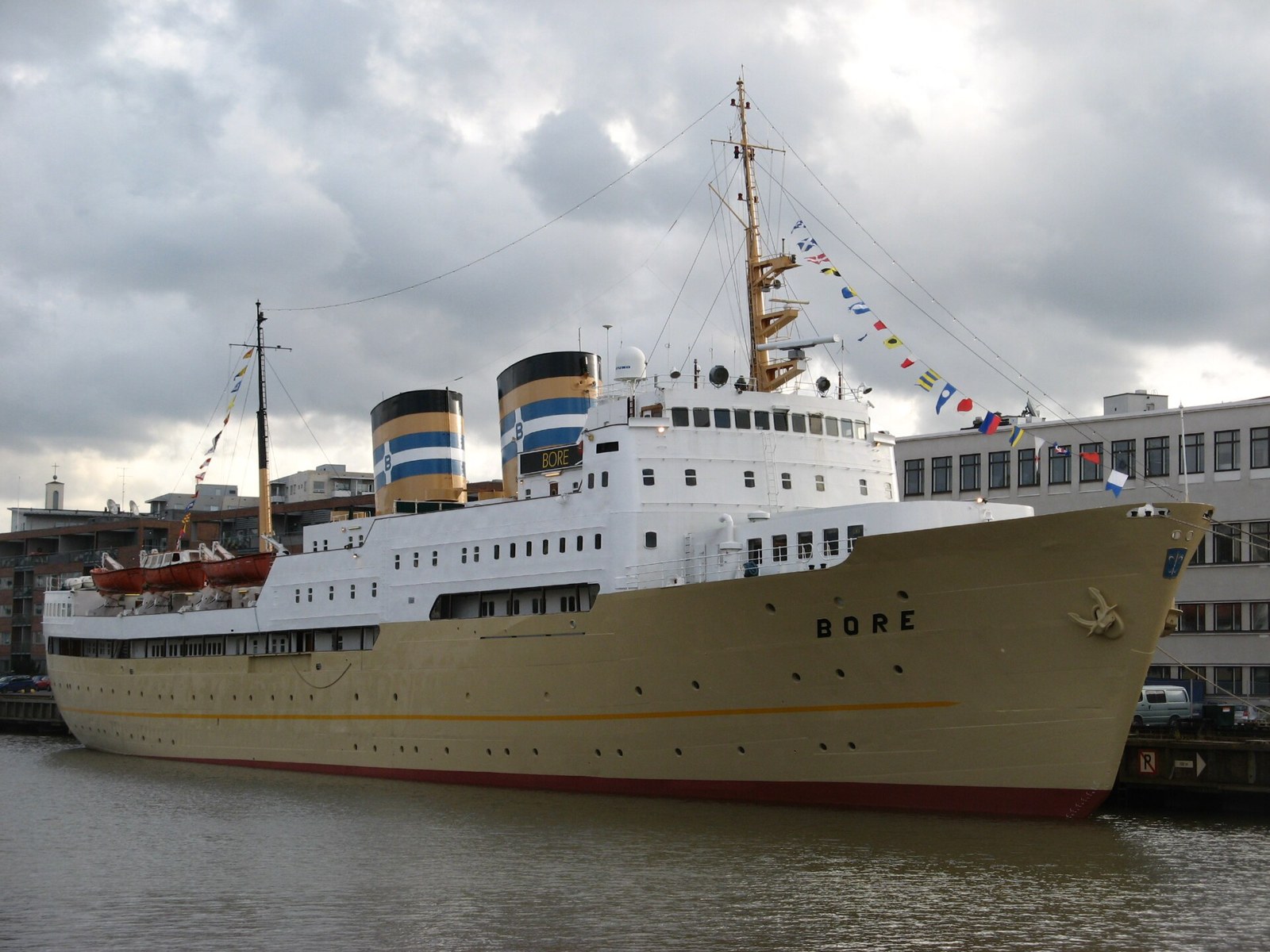
Bore is a Finnish passenger ship of 1960 that holds two distinctions. As built, as the steamship Bore, she was the last commercial steamship built in Scandinavia, and the first ferry on the Finland–Sweden route on which cars could drive aboard. Half a century later, after careers as the ferry Borea and the cruise ship Kristina Regina, she returned to her home port of Turku, took back her original name, and opened as a hotel, restaurant and museum ship — still afloat, in her original livery, beside the Forum Marinum maritime museum.
Her preservation was neither accidental nor state-led: when new safety rules forced her withdrawal from cruising in 2010, enthusiasts and a purpose-formed company moved quickly to save her, and she was back in Turku, renamed and repainted, within months of her final cruise.
Key specifications
The dataset records Bore at 4,295 GT — the tonnage of her 1988 cruise-ship rebuild; as built in 1960 she measured 3,492 GRT. Her length is given as 99.38 metres and her beam as 15.28 metres; her Wikipedia article gives slightly different dimensions, 99.83 metres by 15.25 metres, a small discrepancy logged in the batch notes.
Her dataset capacity of 1,028 passengers is her original two-class ferry capacity, with 333 berths and space for about 65 cars. Rebuilt as a cruise ship in 1988 she carried 245 passengers in one class, with 249 beds. As built she was steam-powered — four Babcock & Wilcox boilers supplying two steam engines driving twin screws, for a maximum of 16 knots, the dataset's speed figure. The 1988 rebuild replaced the steam plant with two Wärtsilä diesel engines, raising her maximum speed to about 17.5 knots.
Design and construction
Bore was built by the Oskarshamn Shipyard in Sweden, as hull 353, for the Bore Steamship Company of Turku. The dataset gives her launch year as 1960, the year of her completion and entry into service; Wikipedia dates her actual launching to 19 March 1959, with completion in 1960 — a distinction logged in the batch notes.
For 1960 she was a forward-looking ferry: a drive-through car ferry at a time when many Baltic ferries still loaded cars by crane, arranged for two classes of passenger with 333 berths, and — anachronistically but gloriously — steam-powered, the last commercial steamer built in Scandinavia. Her steam plant was supplied by four water-tube boilers and she carried the handsome, upright profile of the classic Baltic ferry, which her current restoration deliberately revives.
Naming, launch and maiden voyage
She was named simply for her owners, the Bore Steamship Company — Bore being itself a name with deep Finnish shipping history. She entered service in 1960 on the Turku–Stockholm route, the service for which she was built.
Her subsequent names marked her changes of life: Borea from 1977 under Jakob Lines, and Kristina Regina from 1988, when Kristina Cruises rebuilt her as a cruise ship. The final renaming, in October 2010, was a restoration: on the 10th of that month she was re-presented at Turku under her original name Bore, in her original owner's livery, for her new stationary career.
Career by operator
| Name | Operator | Years |
|---|---|---|
| Bore | Bore Steamship Company; from 1970 within Silja Line | 1960–1977 |
| Borea | Jakob Lines | 1977–1984 |
| Borea | Aura Line | 1984 |
| Borea (laid up) | Helsingfors Steamship Company (ownership) | 1984–1987 |
| Kristina Regina | Kristina Cruises | 1988–2010 |
| Bore | Oy S/S Borea Ab (hotel/museum ship) | 2010–present |
She worked the Turku–Mariehamn–Stockholm ferry route for Bore and then, from 1970, in the Silja Line pool. Sold in 1977 to Jakob Lines, she became Borea and worked largely seasonal services from Jakobstad. In 1984 she passed to Aura Line's attempt to restart Turku–Stockholm steamship traffic as a tourist venture; Aura Line went bankrupt within months and the ship was laid up, then sold to a Canadian buyer whose luxury cruise conversion was never carried out. Delivered from that limbo in January 1987 by Rannikkolinjat — later Kristina Cruises — she was extensively rebuilt: steam out, diesels in, and re-emerged in 1988 as the cruise ship Kristina Regina, cruising from Finland around the Baltic, the North Sea, the Mediterranean and even West Africa, for a time Finland's only cruise ship.
Onboard character
As built, her character was that of the classic Baltic ferry in two classes — public rooms, cabins for 333, and a car deck that made her a working link between Finland and Sweden rather than a pleasure ship. The 1988 conversion transformed her into a small, one-class cruise ship of 245 passengers, a scale and a Finnish-crewed informality that became Kristina Cruises' trademark.
In preservation, her character is deliberately double: externally she is Bore again, in Bore Steamship colours; internally she remains substantially the Kristina Regina, so that, as one account put it, her whole history can be found in her new disguise. Her cabins serve as hotel rooms, her public rooms as restaurant, event and museum spaces.
Major refits and incidents
The great refit of her life was the 1987–88 Kristina Cruises conversion: complete re-engining from steam to diesel, removal of ferry functions and creation of a purpose-fitted small cruise ship — the change that bought her a further 22 years of service. It was regulation, not condition, that ended that career: in her rebuilt form she could not meet the SOLAS 2010 requirements, and withdrawal became unavoidable.
No major casualty is recorded against her in the sources consulted. Her narrowest escapes were commercial: the Aura Line bankruptcy of 1984, three years of lay-up, and the failed Canadian conversion scheme — each of which could easily have ended with sale for scrap.
Sister ships and class
The dataset assigns her no class, and she was built as a single ship for the Bore company's Turku–Stockholm service rather than as one of a class. She has no sister. Her peer group is the post-war generation of Baltic passenger ferries; her distinction within it — last Scandinavian-built commercial steamer, first drive-aboard ferry on her route — belongs to her alone.
Fate and where she is now
Her final cruise as Kristina Regina sailed in August 2010. The preservation company Oy S/S Borea Ab, formed around Johnny Sid — who had earlier tried to save the Finnjet — acquired her, and she was repainted in Bore colours, renamed Bore, and formally re-opened at Turku on 10 October 2010, opening fully to the public in 2011 once a permanent berth was settled. The dataset records her status as preserved, a hotel and museum ship at Turku, Finland.
Visit her today
Bore lies permanently at Forum Marinum, the national maritime museum on the Aura River at Turku, Finland, alongside the museum's other historic vessels. She operates as a combination museum ship, hotel and restaurant: visitors can go aboard to see the ship, stay overnight in her cabins, and eat in her restaurant spaces, in a ship that presents her 1960 Bore Line appearance outside and her Kristina Regina cruise-ship interiors within. As a working piece of Turku's waterfront rather than a roped-off relic, she is among the most accessible preserved passenger ships in Scandinavia — check Forum Marinum for opening arrangements before travelling.
Sources: https://en.wikipedia.org/wiki/List_of_cruise_ships; https://en.wikipedia.org/wiki/MS_Bore