| IMO | 9237357 |
|---|---|
| Gross tonnage | 88,500 GT |
| Length | 293.5 m |
| Beam | 32.3 m |
| Passenger capacity (max) | 2124 |
| Service speed | 22.0 knots |
| Builder | Kvaerner Masa-Yards |
| Yard | Hietalahti shipyard |
| Hull number | 503 |
| Launched | 2003 |
| Maiden voyage | 2004-02-27 |
| Class | Spirit-class cruise ship |
| Operator | Carnival Cruise Line |
| Status | Active |
Overview
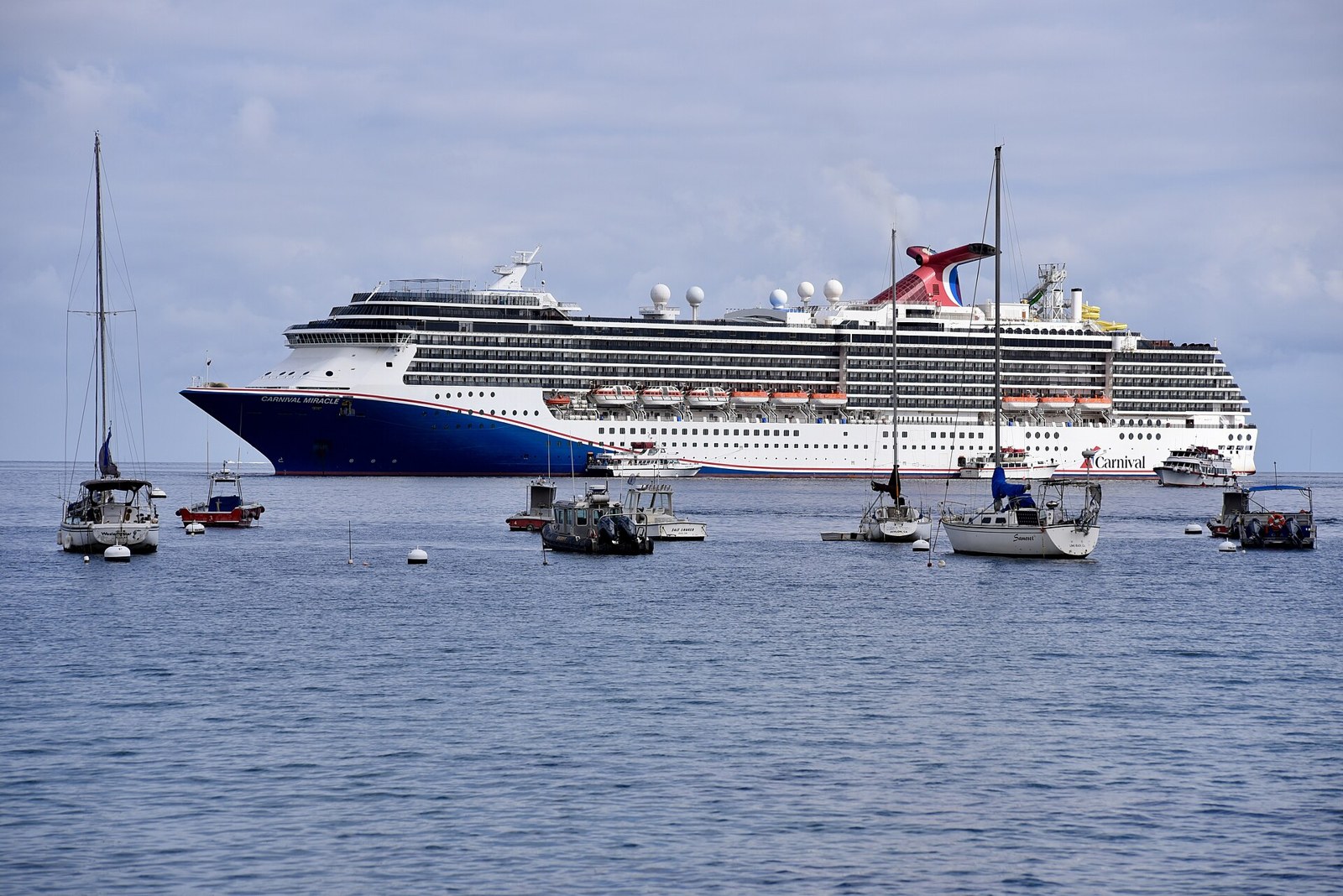
Carnival Miracle is a Spirit-class cruise ship built in Helsinki, Finland, for Carnival Cruise Line, and the last of the four Spirit-class ships built for the Carnival brand. She entered service in February 2004, christened at Jacksonville, Florida, by the American soldier Jessica Lynch, and she embodies the final flowering of designer Joe Farcus's themed-interior era at Carnival: an entire ship decorated around famous fictional characters, from a Metropolis atrium for Superman to a Gotham lounge for Batman.
The Spirit class was Carnival's Panamax design — long, narrow and Azipod-driven, built to pass through the original Panama Canal locks and to open longer, more varied itineraries to the fleet. Miracle, at 88,500 GT and just over 2,100 passengers, sits a full size bracket below Carnival's later mega-ships, and that relative intimacy has been central to her employment ever since.
Key specifications
The dataset records Carnival Miracle at 88,500 GT, 293.5 metres long and 32.3 metres in beam, with capacity 2,124 passengers, service speed 22 knots and hull number 503 from Kvaerner Masa-Yards' Hietalahti yard in Helsinki. Wikipedia's figures agree in substance — 88,500 GT, 294 metres, 2,124 passengers — and add a crew of about 930, 12 decks, six diesel engines totalling 62,370 kW, and propulsion by two ABB Azipods of 17.6 MW each.
A notable Spirit-class statistic: about 80 per cent of her staterooms have ocean views, and about 80 per cent of those have private balconies — an exceptionally high balcony ratio for a ship of 2004, and one reason the class remained competitive for two decades.
Design and construction
The Spirit class was built by Kvaerner Masa-Yards at Helsinki — the yard the dataset lists as Hietalahti, Helsinki's historic shipyard district, and which ship records describe as the Helsinki New Shipyard at Hietalahti. The class was a Finnish-built anomaly in a Carnival fleet otherwise dominated by Italian construction, and its design brief was flexibility: Panamax beam for canal transits, Azipod propulsion for manoeuvrability and efficiency, and a long, low hull.
Carnival Miracle was floated out on 5 June 2003. The dataset gives her launch year as 2004 — her completion and entry-into-service year — and the difference is logged in the batch notes. She was completed in early 2004 at a reported cost of about US$375 million and delivered across the Atlantic for her American debut.
Naming, launch and maiden voyage
The name Miracle completed the Spirit class's set of uplift-brand names — Spirit, Pride, Legend, Miracle. Her christening, on 27 February 2004 at Jacksonville, was given to Jessica Lynch, the United States Army soldier whose capture and rescue in Iraq in 2003 had made her a national figure; still recovering from her injuries and walking with a cane, she broke the champagne bottle over the bow in an emotional ceremony widely covered at the time.
Immediately after the ceremony she sailed on her maiden voyage — the three-day cruise to the Bahamas recorded in the dataset's maiden-voyage date of 2004-02-27 — becoming at a stroke Jacksonville's first major homeported cruise ship.
Career by operator
Carnival Miracle has served one operator under one name.
| Name | Operator | Years |
|---|---|---|
| Carnival Miracle | Carnival Cruise Line | 2004–present |
Her early seasons followed the class pattern of Florida and New York deployments: Caribbean and Bahamas cruising in winter, New York-based summer seasons. In March 2013 she transited the Panama Canal — the passage her class was designed for — to the West Coast, and from 2013 onward her career has been a Pacific one: Mexican Riviera and Hawaii cruising from Long Beach, with Alaska seasons in the mix, a deployment her Panamax hull and moderate size suit well. No renaming or transfer interrupts the record.
Onboard character
No ship in this batch wears her theme more completely. Joe Farcus designed Miracle's interiors as an anthology of fiction: beside every cabin door hangs a large picture of a famous fictional character — Long John Silver, Sherlock Holmes and dozens more. The eleven-storey atrium is Metropolis, Superman's city, rising to a ruby-red glass dome that forms part of the ship's whale-tail funnel. The Gotham Lounge evokes Batman's city; the Mad Hatter's Ball and Bacchus dining room — the last famously decorated with grapes — continue the literary conceit through the public rooms.
The effect, much debated at the time, was of a ship that revealed itself like a novel as passengers moved through it. It made Miracle the most quoted example of the Farcus philosophy: that a cruise ship's interiors should be a destination in themselves, built on a single, totalising idea.
Major refits and incidents
In March 2015, at BAE Systems' Pier 70 dry dock in San Francisco, she received the fleet's Fun Ship 2.0 package — the programme that added venues such as the RedFrog Pub, Alchemy Bar, a sports bar and new entertainment formats across the Carnival fleet. A further major dry docking followed in February–March 2020 at Freeport, which added more of the programme's standard features, including Guy's Burger Joint, a WaterWorks aqua park, the RedFrog Rum Bar and BlueIguana Cantina; the library and chapel gave way in that era to new uses. Further refurbishment work in the mid-2020s has kept the ship current.
No major casualty — fire, collision or grounding — is recorded against Carnival Miracle in the sources consulted for this guide.
Sister ships and class
The Spirit class was built in two brand groups at Helsinki. For Carnival: Carnival Spirit (2001), Carnival Pride (2001), Carnival Legend (2002) and Carnival Miracle (2004), the last of the line. For Costa Cruises the same design produced Costa Atlantica (2000) and Costa Mediterranea (2003) at slightly lower tonnage; Carnival Luminosa, originally Costa's, is also marketed within the class family. Miracle was the final Spirit-class ship built for Carnival, closing the class in 2004 before the larger Conquest and Dream classes took the fleet in a different direction.
Fate and where she is now
The dataset records her status as active. Carnival Miracle remains in Carnival Cruise Line service under her original name, more than twenty years after her Jacksonville christening — the last-built and one of the longest-serving members of the Spirit class, her fictional-character interiors still the most distinctive of any ship in the fleet.
Sources: https://en.wikipedia.org/wiki/List_of_cruise_ships; https://en.wikipedia.org/wiki/Carnival_Miracle