| IMO | 9120877 |
|---|---|
| Gross tonnage | 71,925 GT |
| Length | 260.6 m |
| Beam | 31.3 m |
| Passenger capacity (max) | 2124 |
| Service speed | 21.0 knots |
| Builder | Kvaerner Masa-Yards |
| Yard | Hietalahti shipyard |
| Hull number | 494 |
| Launched | 1998 |
| Maiden voyage | 1998-12-06 |
| Class | Fantasy-class cruise ship |
| Operator | Carnival Cruise Line |
| Status | Active |
| All names | Carnival Paradise; Paradise |
Overview
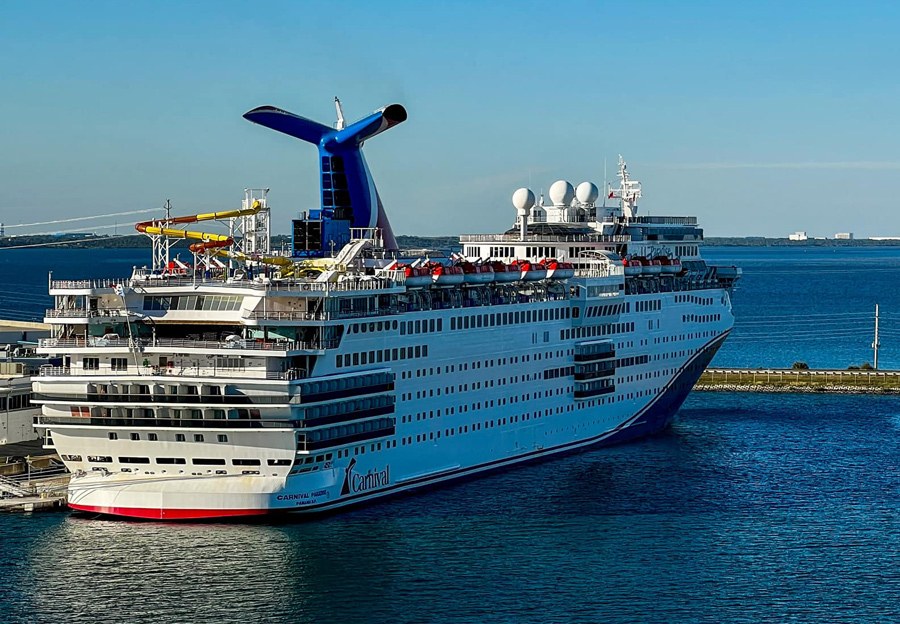
Carnival Paradise is a Fantasy-class cruise ship operated by Carnival Cruise Line, and the eighth and last ship of her class. Built in Helsinki and delivered in 1998 as simply Paradise, she holds a unique place in cruise history: she was built and launched as the world's first completely non-smoking cruise ship, a much-publicised experiment that lasted five years. The Carnival prefix was added to her name in 2007, in line with the rest of the class.
Of the eight Fantasy-class ships, she and Carnival Elation were the only survivors in the Carnival fleet after the class was largely sold and scrapped during the 2020–2022 industry shutdown — making Paradise, somewhat improbably, one of the last representatives of the design that defined Carnival in the 1990s.
Key specifications
The dataset records Carnival Paradise at 70,367 GT as built, 260.6 m long and 31.3 m in beam, with a maximum capacity of 2,124 passengers and a speed of 21.0 knots. Her as-built capacity was about 2,040–2,052 passengers; the 2,124 figure reflects her enlarged capacity after the 2018 refit, which also raised her measured tonnage to 71,925 GT. Power comes from six Wärtsilä engines totalling 47,520 kW. Together with her sister Elation, she differs from the earlier Fantasy-class ships in having two ABB Azipod propulsion units instead of conventional propellers — the pair were among the first cruise ships fitted with Azipods.
Design and construction
Paradise was built by Kvaerner Masa-Yards at its Helsinki New Shipyard in Finland as hull number 494, at a reported cost of about US$300 million. She was laid down in 1996 and floated out on 29 January 1998. The Fantasy class used a "modern ocean liner" arrangement with cabins concentrated in the hull and only a handful of suites in the superstructure, and Paradise and Elation were the last cruise ships built with lifeboats carried only on the upper deck.
The non-smoking concept extended to her construction: shipyard workers were expected to observe the ban while building her, and large no-smoking signs were fitted on both sides of the hull and on the stern beneath her name — welded on, as later events would show.
Naming, launch and maiden voyage
She was christened as Paradise in 1998 by her godmother, the American journalist and television presenter Paula Zahn, and was delivered to Carnival on 29 October 1998. Her maiden voyage is recorded in the dataset as 6 December 1998, the start of her regular service; some sources describe her entry into service more loosely as November 1998. She entered service supported by anti-smoking and cancer-prevention organisations, with the no-smoking rule strictly enforced: passengers found with smoking materials faced a fine and removal at the next port.
Career by operator
The ship has had one operator and two forms of her name:
| Years | Name | Operator |
|---|---|---|
| 1998–2007 | Paradise | Carnival Cruise Line |
| 2007–present | Carnival Paradise | Carnival Cruise Line |
The defining episode of her early career was commercial rather than nautical. In December 2003 Carnival ended the smoke-free experiment, concluding that non-smoking passengers drank and gambled less than smokers, and when the ship repositioned to Long Beach, California, in 2004 the hull signs were painted over — though their welded relief could still be made out in the right light. In June 2017 she became the first Carnival ship to dock in Cuba, another small place in the record books.
Onboard character
As built, Paradise's character was defined by an absence: no cigarette smoke anywhere aboard, in an era when smoking was woven into casino and bar life at sea. In every other respect she was a classic late Fantasy-class ship — Joe Farcus-era themed interiors, a multi-deck atrium, and the class's compact, hull-heavy silhouette. Her later refits gradually overlaid the standard Carnival resort formula of the 2010s on that 1990s frame, but the underlying ship — moderate size, 10 passenger decks as built, and a notably high proportion of inside and ocean-view cabins in the hull — remains a product of her decade.
Major refits and incidents
Her most consequential "refit" was a policy reversal: the end of the smoking ban in December 2003 and the painting-over of the signs in 2004. The major physical transformation came in a month-long drydock at Grand Bahama Shipyard in March 2018, which added 38 new cabins — including two Grand Vista suites with floor-to-ceiling windows — fitted balconies to 98 existing staterooms, redecorated all accommodation, and added a WaterWorks aqua park with a 300-foot Twister slide, plus new poolside bars and dining venues. A further, lighter drydock in Freeport in 2023 refreshed interiors and the adults-only Serenity area. She has no major casualty in her record; her career incidents are notable chiefly for how few there have been for a ship of her age.
Sister ships and class
The Fantasy class comprised eight Helsinki-built ships: Carnival Fantasy (1990), Carnival Ecstasy (1991), Carnival Sensation (1993), Carnival Fascination (1994), Carnival Imagination (1995), Carnival Inspiration (1996), Carnival Elation (1998) and Carnival Paradise (1998). Six of the eight left the fleet and were scrapped in 2020–2022; Elation and Paradise, the two Azipod-equipped sisters, remain.
Fate and where she is now
Carnival Paradise remains in active service with Carnival Cruise Line, wearing the line's modern livery — the last-built and one of only two surviving ships of the class that carried Carnival through the 1990s.
Sources: https://en.wikipedia.org/wiki/List_of_cruise_ships, https://en.wikipedia.org/wiki/Carnival_Paradise