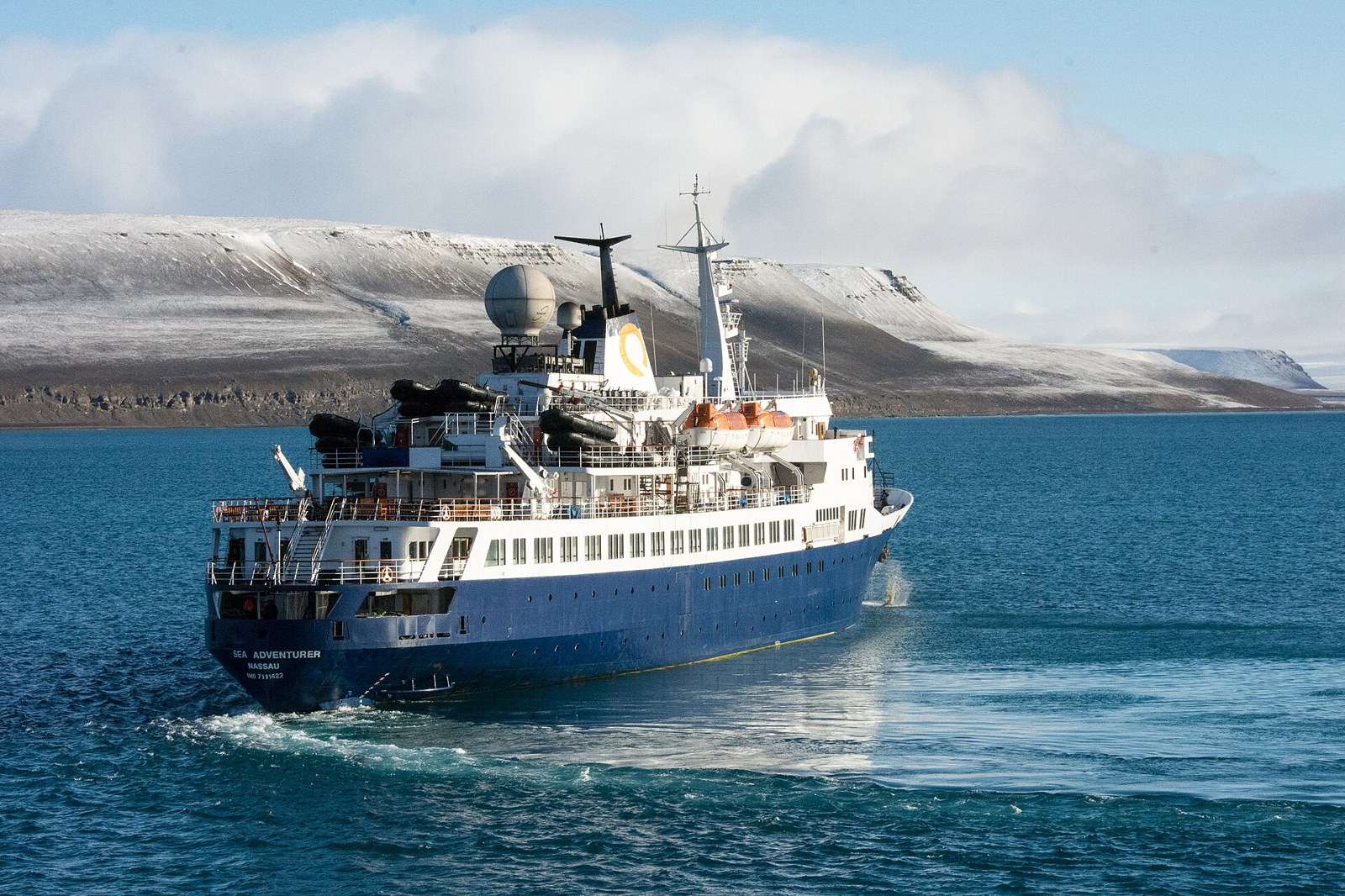
| IMO | 7391422 |
|---|---|
| Gross tonnage | 4,376 GT |
| Length | 100.58 m |
| Beam | 16.31 m |
| Passenger capacity (max) | 128 |
| Crew | 87 |
| Service speed | 12 knots |
| Builder | Brodogradilište Titovo |
| Hull number | 408 |
| Launched | 1975 |
| Maiden voyage | 1975 |
| Operator | SunStone Ships |
| Status | Active |
| All names | Ocean Adventurer; Sea Adventurer; Clipper Adventurer; Alla Tarasova |
Overview
The ship listed in the dataset as Clipper Adventurer is one of the longest-lived expedition hulls of the modern era — a small, ice-capable passenger ship built in Yugoslavia in 1975 for Soviet service as Alla Tarasova, converted in the late 1990s into a Western expedition cruise ship, and renamed repeatedly thereafter. Under her Clipper Adventurer name she became familiar in both polar regions, carrying roughly 120 passengers through the Northwest Passage, to Greenland and the Canadian Arctic in northern summer, and to Antarctica in southern summer.
That Clipper Adventurer chapter, from 1997 to 2012, is only the middle of her story. She was renamed Sea Adventurer on 1 October 2012 and Ocean Adventurer in 2017, names under which she continued expedition work for many more years. The dataset preserves her at the Clipper Adventurer stage — operator listed as Clipper Group, a single name, no builder — and this guide follows her own article for the fuller chain, flagging every point where the dataset is incomplete. A task note describes her as “now with Adventure Canada”; the sources used here show Adventure Canada chartering her, notably for a Northwest Passage transit in summer 2009, rather than owning or permanently operating her.
At 4,617 GT in the dataset and about 100 metres long, she belongs to a different world from the large cruise ships elsewhere in this directory: a working Soviet-era passenger hull adapted, successfully and for decades, to expedition cruising.
Key specifications
The dataset records 4,617 GT, 100.01 m length, 16.2 m beam, 17.0 knots speed and hull number 408, with no builder, capacity or crew fields. Her own Wikipedia article, describing the ship as refitted in 2017, gives 4,376 tons, 100.58 m length, 16.31 m beam, ice class 1A, a capacity of 128 passengers and 87 crew, and a speed of 12 knots.
The article also records propulsion by two Bergen diesel engines with a combined 5,400 hp, a bow thruster and controllable-pitch propellers. Six decks are listed. Those machinery figures are published-source figures, not dataset figures.
The important specification for this ship is not speed but ice capability and size. A hull of about 100 metres with ice class 1A could work in polar waters, enter small anchorages, and land passengers by inflatable boat in places no large cruise ship could attempt.
Design and construction
She was built by Brodogradilište Titovo at Kraljevica, in what was then Yugoslavia — now Croatia — as yard number 408, the number preserved in the dataset. Wikipedia gives her class as the Maria Yermolova class of Soviet passenger ships. She was launched on 19 April 1975, within the dataset's launch year of 1975, and entered service that year as Alla Tarasova, named for the Soviet actress Alla Tarasova.
The class was built for Soviet regional work from Murmansk — her registry port, first Soviet, then Russian. They were sturdy, practical ships, and that robustness later made two of them attractive for expedition conversion.
Naming, launch and maiden voyage
She was launched on 19 April 1975 as Alla Tarasova and entered Soviet service in 1975, the dataset's maiden-voyage year. No separate Western-style naming ceremony is recorded in the sources used, and none is described here.
Her later names mark her commercial rebirths. In 1997, after purchase for Western expedition service, she became Clipper Adventurer. On 1 October 2012 she was renamed Sea Adventurer. In 2017, after a further refit, she became Ocean Adventurer. Later reporting in 2025 describes further expedition employment under additional charter names.
The dataset's single-name list therefore captures only the name under which she was best known to North American expedition passengers in the 2000s, not her birth name or her later names.
Career by operator
Her career divides cleanly into a Soviet/Russian first life and a Western expedition second life, the latter itself divided by name and charterer rather than by fundamental change of work.
| Name | Operator / service | Period |
|---|---|---|
| Alla Tarasova | Murmansk Shipping Company — Soviet, then Russian service | 1975–1997 |
| Clipper Adventurer | Clipper Cruise Line and charterers, including Adventure Canada | 1997–2012 |
| Sea Adventurer | Expedition charter service, including Quark Expeditions | 2012–2017 |
| Ocean Adventurer | Quark Expeditions and later expedition charterers | 2017–present |
The table follows her own Wikipedia article for names and dates; operator detail for the charter years is necessarily summarised, because expedition ships of this size typically work for a ship manager and are chartered seasonally to tour operators — the dataset's “Clipper Group” entry reflects one stage of that arrangement.
Under Clipper, a $13 million refit in 1998 (Master Mariner AB, Sweden; other reporting gives $13–14.8 million and a Danish yard) converted her for about 122 passengers. Adventure Canada's 2009 Northwest Passage voyage is specifically recorded. Under Quark she spent many years on Antarctic work, ending with Quark's October 2024 fleet-exit announcement and a 2025 return with a new operator.
Onboard character
Her character was that of the first comfortable expedition generation: small enough to land everyone at once by Zodiac, with a lecture lounge, a single dining room seating all guests together, a library and open deck for wildlife watching. Cabins after conversion were practical, outside and en suite — deliberately not large-ship luxury.
That format — expedition staff, lectures, rubber-boot landings, an open bridge in suitable conditions — became a template for polar cruising. She was among its most durable examples. Current amenities, changed across refits, are not listed.
Major refits and incidents
The defining refit was the 1998 conversion, discussed above, which fitted her for Western expedition service. A second major refit in 2017, coinciding with the renaming to Ocean Adventurer, is recorded in secondary sources as a multi-million-dollar programme that refreshed cabins and public rooms, added cabins and suites, and included major technical work including new Rolls-Royce engines.
On 27 August 2010, as Clipper Adventurer, she grounded on a rock in Coronation Gulf, Nunavut. Wikipedia records damage to ballast and fuel tanks, a pollution release, and 128 passengers and 69 crew rescued by CCGS Amundsen. The rock proved to be a known, charted hazard. Resolve Marine Group refloated her on 18 September 2010 to Cambridge Bay, and she was repaired and returned to service.
Sister ships and class
She is a Maria Yermolova-class ship, a Soviet series built in Yugoslavia. Her most famous sister is Lyubov Orlova, built as a near sister, converted for expedition cruising in parallel, and lost in 2013 while under tow to a scrapyard — a contrasting fate that underlines how unusual this ship's longevity has been. Other class members remained largely in Russian regional service and are far less documented in English-language sources.
Fate and where she is now
The dataset records her as active, a charter vessel to several tour companies — in substance her pattern half a century after launch, renamed Sea Adventurer then Ocean Adventurer and still in polar service in the mid-2020s sources used here. Her present name and charterer are the least stable facts in her record; treat the dataset name as a historic chapter, not a current brand. No scrapping is recorded.
Sources: https://en.wikipedia.org/wiki/List_of_cruise_ships, https://en.wikipedia.org/wiki/MV_Clipper_Adventurer