| IMO | 9334856 |
|---|---|
| Gross tonnage | 68,500 GT |
| Length | 251.0 m |
| Beam | 32.2 m |
| Passenger capacity (max) | 2500 |
| Service speed | 22.5 knots |
| Builder | Meyer Werft |
| Hull number | 659 |
| Launched | 2007 |
| Maiden voyage | 2007 |
| Class | Sphinx-class cruise ship |
| Operator | AIDA Cruises |
| Status | Active |
Overview
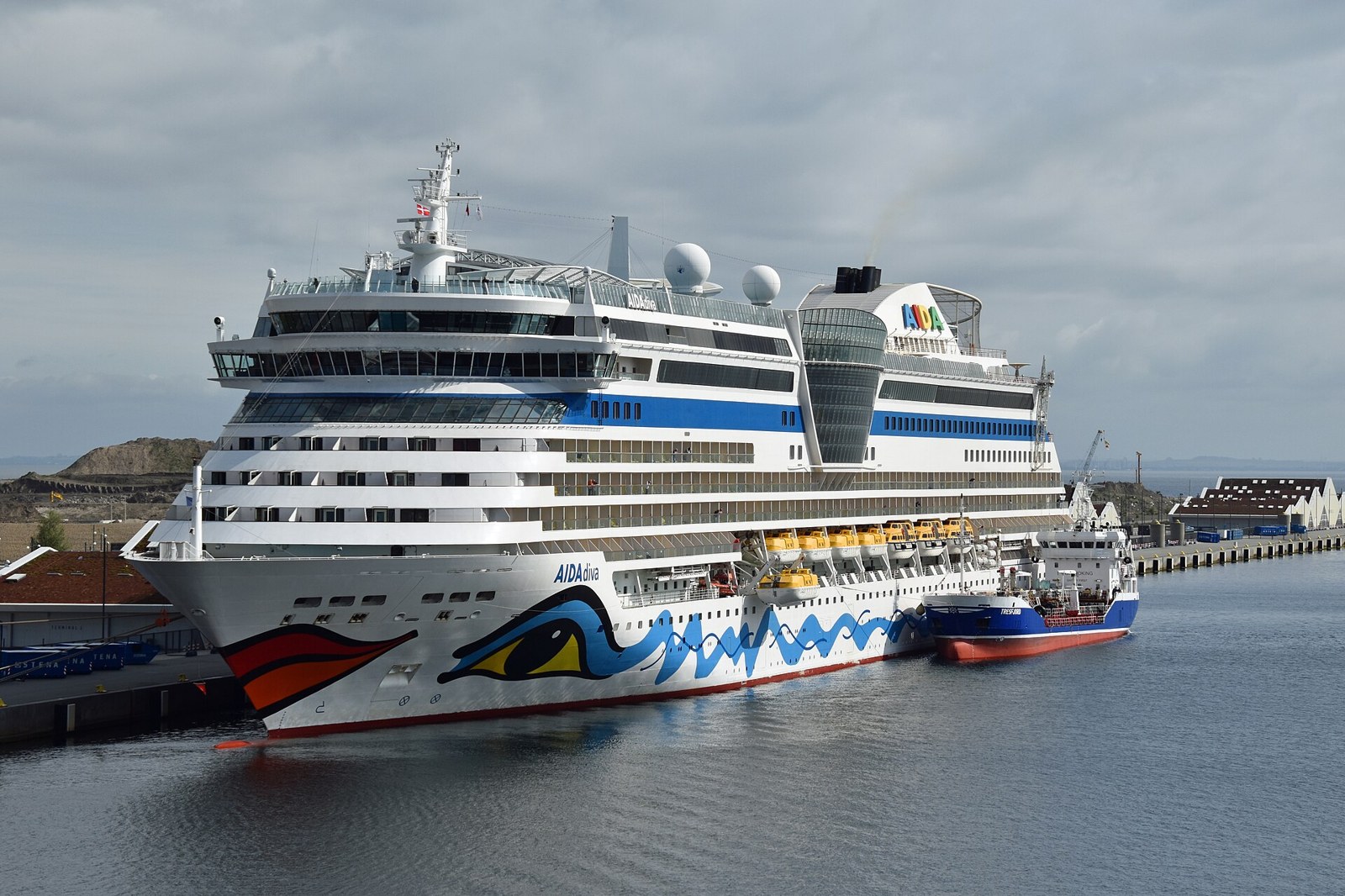
AIDAdiva is the lead ship of AIDA Cruises' Sphinx class and the ship that set the template for the German line's modern fleet. Delivered by Meyer Werft at Papenburg in 2007, she was the largest ship yet built for AIDA and the first of a seven-ship series that carried the brand through a decade of growth. Her importance is architectural as much as commercial: she introduced the Theatrium, the combined theatre-atrium that replaced the conventional show lounge and entrance hall in one gesture, and she wore the line's smiling-lips-and-eye bow art — the Kussmund — at a new scale. She remains in service under her original name for her original operator.
Key specifications
The dataset records 68,500 GT, a length of 251.0 m, a waterline beam of 32.2 m, a maximum capacity of 2,500 passengers and a speed of 22.5 knots. The ship's own reference article gives measured figures of 69,203 GT and 251.89 m, with a double-occupancy capacity of 2,050 passengers and a crew of 646. Four Caterpillar MaK 9M43C diesel engines give a combined 36,000 kW in a diesel-electric plant. Draught is shallow for a ship of this size, at about 7.3 m — a deliberate feature for a fleet built around varied, often smaller ports.
Design and construction
AIDAdiva was built by Meyer Werft at Papenburg as yard number 659; her keel was laid on 3 March 2006 and she was floated out on 4 March 2007. She was the first ship of a Carnival Corporation order initially framed as a multi-ship programme for the AIDA brand, at a reported cost of about €315 million. The design brief was different from that of the American mega-ships: AIDA sells a club-style, German-language product with open-seating buffet dining, no dress code and no fixed dinner sittings, so the general arrangement gives unusual weight to casual restaurants, bars and deck space, and to the central Theatrium — a glass-walled, three-deck space combining atrium, theatre and lounge, lit by daylight rather than buried inside the hull.
Naming, launch and maiden voyage
The ship was floated out at Papenburg on 4 March 2007 and christened on 20 April 2007; her godmother, Maria Galleski, was selected by lot from among AIDA's guests and staff applicants, in keeping with the brand's informal style. She entered service later that month — the dataset records launch and maiden voyage simply as 2007. Like all Meyer Werft ships built at inland Papenburg, delivery involved the conveyance down the River Ems to the sea, a passage that is itself a public spectacle in northern Germany.
Career by operator
| Period | Name | Operator |
|---|---|---|
| 2007–present | AIDAdiva | AIDA Cruises |
Ownership, as distinct from operation, sat with Carnival's Italian arm, Costa Crociere, until 2023 and thereafter with Carnival Corporation & plc directly — the standard AIDA arrangement, under which the ships are Italian-flagged and registered at Genoa while being marketed and crewed as a German product. Operationally nothing has changed since 2007: one name, one operator, one brand. Her deployment history covers the line's core European programmes — the Mediterranean, Northern Europe and the Canaries — with transatlantic and Caribbean seasons in later years; these are career patterns, not a current itinerary.
Onboard character
The Sphinx-class design is defined by the Theatrium: instead of a dark theatre at one end of the ship and a separate atrium amidships, AIDAdiva merges both into a single glass-domed social centre, with performance space, bars and cafés around it. Around that core the ship carries the AIDA formula established by the earlier club ships — large buffet restaurants rather than a single formal dining room, a substantial wellness area of about 2,300 m², and extensive open deck. Externally she is unmistakable: the red smiling lips and blue eye painted across the bow, introduced on the first AIDA in 1996, were scaled up for this larger hull and became the visual signature of the whole German fleet.
Major refits and incidents
The ship has been maintained through regular dry dockings, and in 2025 she was reported as receiving the fleet's "AIDA Evolution" refurbishment treatment — the modernisation programme AIDA is applying to its Sphinx-class ships, covering public spaces, cabins and technical systems. No fire, grounding, collision or other major casualty is recorded for this hull in the sources consulted; her record is one of uninterrupted commercial service since 2007, interrupted only by the industry-wide COVID-19 shutdown of 2020–21, which affected the whole AIDA fleet.
Sister ships and class
The Sphinx class runs to seven Meyer Werft ships. The first three — AIDAdiva (2007), AIDAbella (2008) and AIDAluna (2009) — were built to the original roughly 69,000 GT design. The later four — AIDAblu (2010), AIDAsol (2011), AIDAmar (2012) and AIDAstella (2013) — are enlarged derivatives at about 71,300 GT with an additional deck, sometimes grouped separately as the Ikarus or modified Sphinx design. All seven were built at Papenburg for AIDA Cruises and all entered service under the names they still carry.
Fate and where she is now
The dataset lists AIDAdiva as active and operating for AIDA Cruises, still under her construction name — an unusually static record for a ship approaching twenty years old, and a sign of how completely the Sphinx design fitted the brand it was built for. She is a Phase 1 (active fleet) page in this directory.
Sources: https://en.wikipedia.org/wiki/List_of_cruise_ships; AIDAdiva, Wikipedia (ship article); CruiseMapper, AIDAdiva ship profile; Isover reference project note, "AIDAdiva" (Sphinx-class programme, Meyer Werft).