| IMO | 9490052 |
|---|---|
| Gross tonnage | 71,304 GT |
| Length | 253.22 m |
| Beam | 32.2 m |
| Passenger capacity (max) | 2500 |
| Service speed | 21.8 knots |
| Builder | Meyer Werft |
| Hull number | S.690 |
| Launched | 2011 |
| Maiden voyage | 2012 |
| Class | Sphinx-class cruise ship |
| Operator | AIDA Cruises |
| Status | Active |
Overview
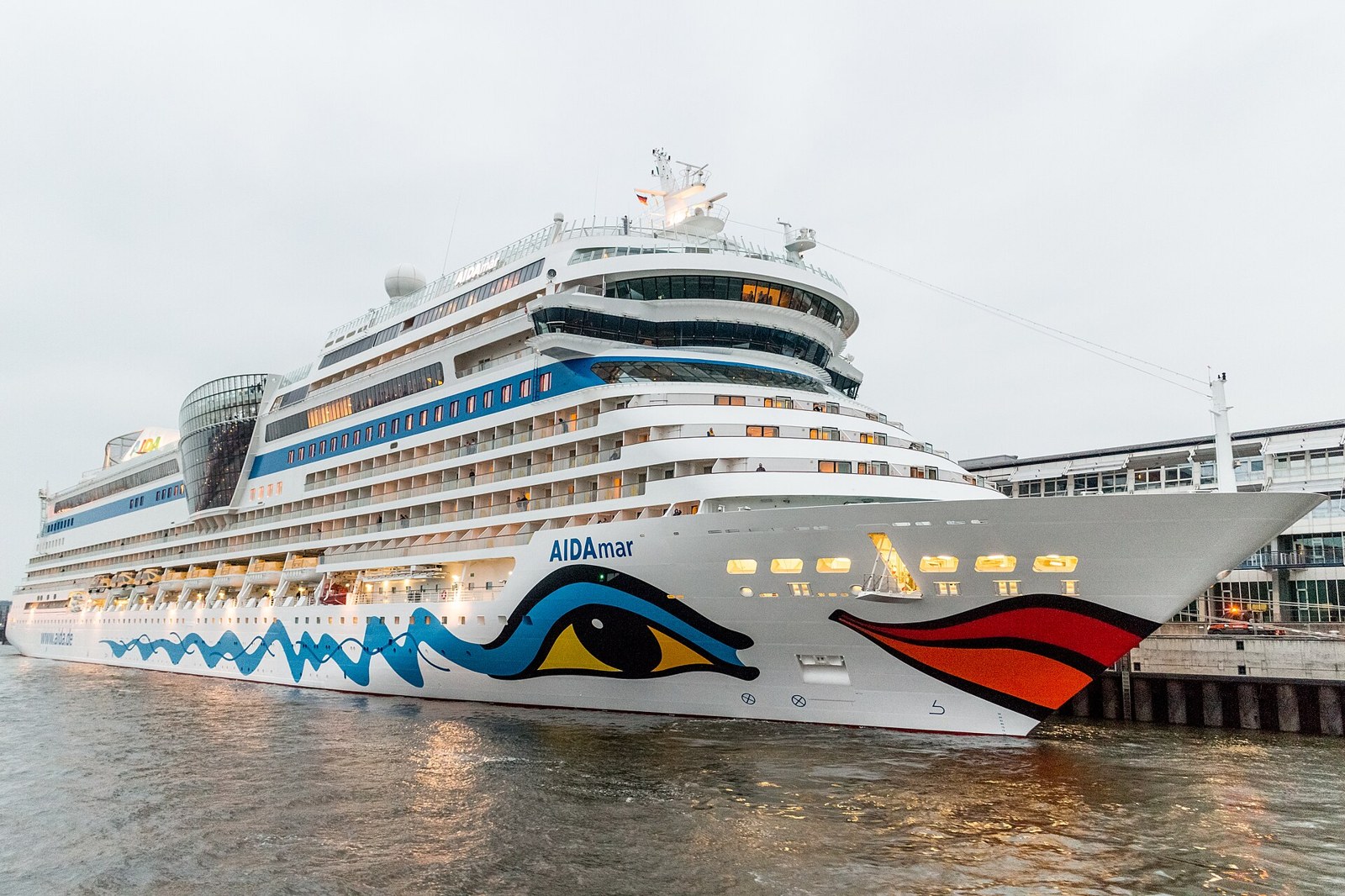
AIDAmar is a Sphinx-class cruise ship built by Meyer Werft at Papenburg, Germany, for AIDA Cruises, the German-market brand of the Carnival group. Delivered in May 2012, she was the sixth of the seven-ship Sphinx series and the ninth ship in the AIDA fleet. Her importance is less as an individual novelty than as a mature example of the design that standardised AIDA's growth in the 2000s and 2010s: a mid-size, German-language "club ship" of about 71,000 GT, built around informal resort-style cruising rather than formal liner traditions. Ships like AIDAmar are the backbone of the modern European market — large enough for a full resort programme, small enough to remain a repeatable, economical series build.
Key specifications
The dataset records 71,100 GT, a length of 252.0 m, a beam of 32.2 m, a maximum capacity of 2,500, a speed of 21.8 knots, builder Meyer Werft and hull number S.690. Published sources differ slightly on several figures: Wikipedia's infobox gives 71,304 GT, a length of 253.22 m, a capacity of 2,192 passengers and a crew of 620, with speed listed at 21 knots. The dataset gives no crew figure. The class name also varies by source: the dataset says Sphinx class, while Wikipedia's infobox uses Icarus class for the same Sphinx-series ships. None of these differences changes the ship's identity or scale; they reflect rounding, measurement basis and naming convention rather than disagreement about the ship herself.
Design and construction
AIDAmar was ordered on 19 December 2007 as part of a two-ship contract Carnival Corporation placed with Meyer Werft for AIDAsol and AIDAmar. Her keel was laid on 20 October 2008, and she was floated out of the Papenburg building hall on 1 April 2012. She belongs to the modified later group of the Sphinx series: like AIDAblu and AIDAsol before her, she received an additional half-deck compared with the original trio of the class, which accounts for her slightly higher tonnage than the first ships of the series. Her machinery is diesel-electric, with Caterpillar MaK engines generating for twin electric propulsion motors, in line with the standardised technical platform Meyer Werft delivered across the series. She was completed and delivered to AIDA Cruises on 3 May 2012.
Naming, launch and maiden voyage
The ship was christened at Hamburg on 12 May 2012, during the Hamburg Port Anniversary celebrations, in a multiple-ship event at which her sisters AIDAsol, AIDAluna and AIDAblu were also present — a piece of fleet theatre that underlined how completely the Sphinx series had become AIDA's identity. She has carried the name AIDAmar throughout her career; the "mar" element follows AIDA's practice of giving its ships names evoking the sea in different languages. The dataset records both launch and maiden voyage simply as 2012, without a month for the first passenger sailing, and this guide does not invent one.
Career by operator
AIDAmar has had one name and one operator for her entire career to date.
| Name | Operator | Period |
|---|---|---|
| AIDAmar | AIDA Cruises | 2012–present |
Her registered ownership sits within the Carnival group structure — Wikipedia lists Costa Crociere as owner, with AIDA Cruises as operator and Genoa as her port of registry — an arrangement common across the group's European brands, under which ships are owned by one group company and operated by another. Operationally, her career has been the steady, unspectacular pattern of a series ship in a growing national-market fleet: seasonal deployment between northern Europe and warmer-water cruising, interrupted, like the whole industry, by the 2020–21 pandemic shutdown, after which she returned to AIDA service. The dataset records her simply as operating, which remains the position.
Onboard character
The defining idea of the Sphinx class is AIDA's "club ship" concept: a cruise run like an informal land-based club resort, aimed principally at German-speaking guests and designed to attract younger, more active passengers than the traditional cruise market. Trade descriptions of AIDAmar and her sisters emphasise the features that expressed that concept at the time of building: a glass-walled Theatrium at the ship's centre combining atrium, theatre and lounge in one space; a micro-brewery producing the ship's own beer; and, on the later Sphinx ships, novelties such as a 4D cinema. One detail specific to this group of sisters was the fitting of screens in inside cabins showing a live sea view, so that an interior room could have a virtual window. This guide describes that era-defining design character only; it does not list her current restaurants or amenities, which change with refits.
Major refits and incidents
No major casualty, fire or grounding involving AIDAmar is documented in the sources used for this guide, and none is claimed. Secondary travel coverage refers to a refurbishment in 2022, consistent with the routine drydock cycle of a ship of her age, during which hotel areas are refreshed and technical maintenance is carried out. Her most significant service interruption was not ship-specific at all: the industry-wide suspension of cruising in 2020–21, which idled the entire AIDA fleet. That absence of a dramatic incident record is itself typical of the Sphinx class, a series that has traded quietly and reliably for its single operator.
Sister ships and class
The Sphinx series, built by Meyer Werft between 2007 and 2013, comprises seven ships: AIDAdiva (2007), AIDAbella (2008), AIDAluna (2009), AIDAblu (2010), AIDAsol (2011), AIDAmar (2012) and AIDAstella (2013). The first three ships established the design; the later four, including AIDAmar, added a half-deck and slightly increased tonnage. Together the seven ships transformed AIDA from a small specialist into one of Europe's largest cruise brands by capacity, and they remain the reference design against which AIDA's later, larger Hyperion-class (AIDAprima, AIDAperla) and Helios-class (AIDAnova and sisters) ships are measured. All seven Sphinx ships were built for AIDA and, at the time of writing of the underlying sources, remained associated with the brand that ordered them.
Fate and where she is now
The dataset records AIDAmar as active and operating for AIDA Cruises, and no sale, renaming or withdrawal has been reported in the sources used. She is a mid-life series ship in her original operator's hands — the least dramatic fate in this directory, and the most common one for a successful modern class. Her long-term significance is collective rather than individual: with her six sisters, she proved that a standardised, nationally focused club-ship design could sustain a seven-ship production run at a single yard, a model the Carnival group repeated across several of its European brands in the same period.
Sources: https://en.wikipedia.org/wiki/List_of_cruise_ships, https://en.wikipedia.org/wiki/AIDAmar, https://www.ship-technology.com/projects/aidamar-cruise-ship/