| IMO | 8913162 |
|---|---|
| Gross tonnage | 28,856 GT |
| Length | 192.82 m |
| Beam | 24.7 m |
| Passenger capacity (max) | 624 |
| Service speed | 21.0 knots |
| Builder | Mitsubishi Heavy Industries |
| Hull number | 2050 |
| Launched | 1991 |
| Maiden voyage | 1991 |
| Operator | Phoenix Reisen |
| Status | Active |
| All names | Amadea; Asuka |
Overview
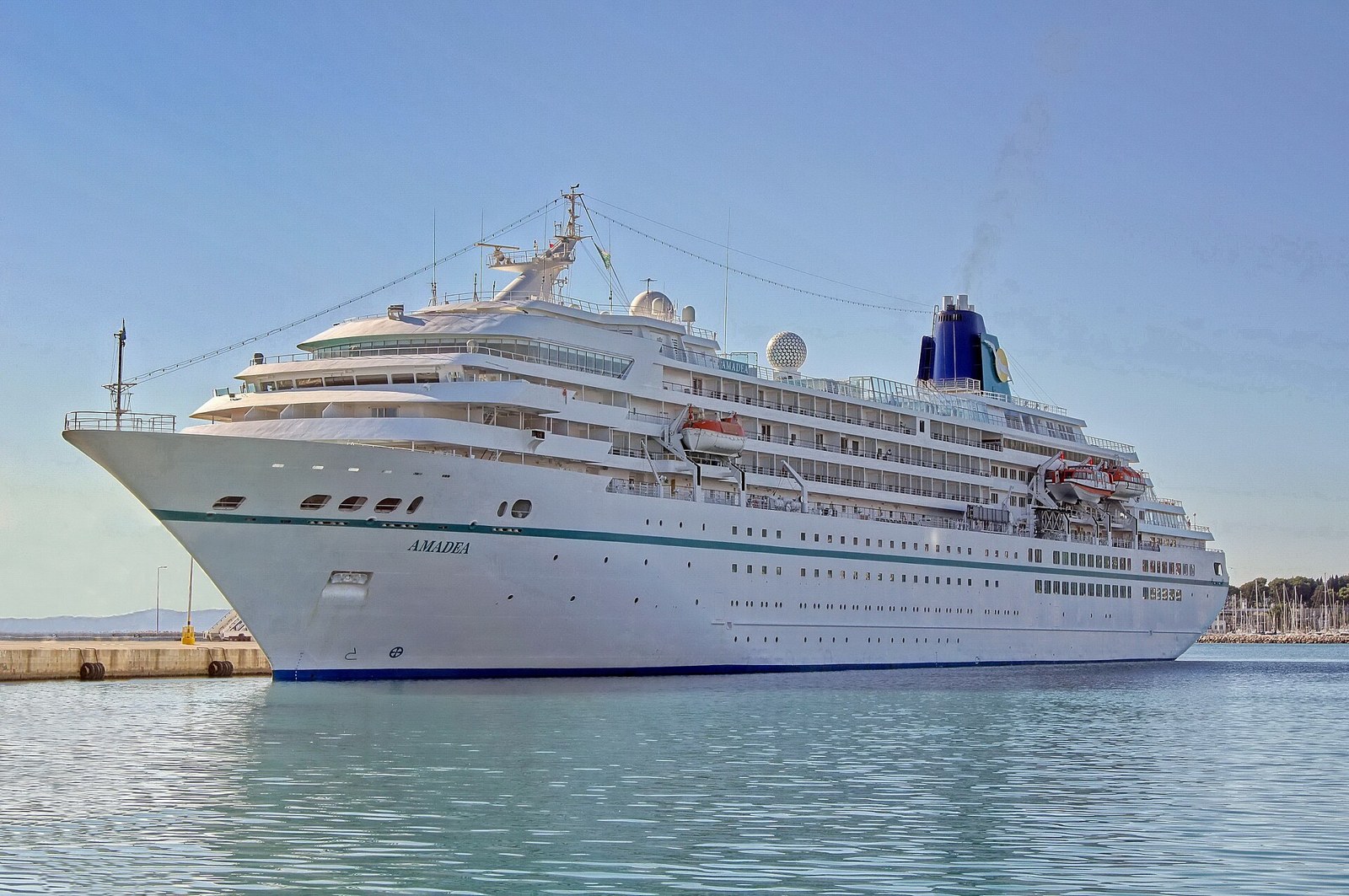
Amadea is a small, elegant cruise ship with a career split neatly in two. Built in Japan in 1991 as Asuka, the flagship of Nippon Yusen Kaisha's domestic cruise operation, she spent fifteen years sailing for the Japanese market before NYK replaced her with a larger ship. Sold in 2006 to Amadea Shipping Company and chartered to the German operator Phoenix Reisen, she was renamed Amadea and began a second, equally long career for German-speaking guests — one that made her famous in Germany as the setting of the television series Das Traumschiff.
At 28,856 GT and just under 193 metres, she is a one-off design with no sister ship, built by Mitsubishi Heavy Industries at Nagasaki to a standard of finish intended to show that a Japanese yard and a Japanese owner could produce a luxury cruise ship equal to European products. That quality is the simplest explanation for her longevity: she has now served her second owner for roughly as long as she served her first.
Key specifications
The dataset records 28,856 GT, a length of 192.82 m, a beam of 24.7 m and a speed of 21 knots. Her own article gives a draught of 6.2 m and machinery of two MAN-Mitsubishi 7L58/64 engines with a combined 17,300 kW driving two propellers — a conventional twin-screw plant, in keeping with her early-1990s design. She was built at a reported cost of $150 million.
Capacity needs a note on names. The dataset's figure of 604 passengers is her capacity as Asuka, the figure her article quotes for the Japanese configuration; after her 2006 conversion for Phoenix Reisen, with additional inside and balcony cabins worked into the ship, her article gives 624 passengers. Her article describes 254 cabins plus 40 suites and two royal suites, 106 of the cabins with private balconies, and a crew of 292.
Design and construction
Amadea was laid down on 16 April 1990 at Mitsubishi Heavy Industries' Nagasaki yard as hull 2050, launched on 6 April 1991 and completed on 23 October 1991. She was a product of a particular moment: Japanese shipping groups, NYK among them, were investing in cruising for a wealthy domestic market at the end of the 1980s, and NYK ordered her as a purpose-built luxury ship for that market rather than adapting a Western design.
The result was a ship of classical early-1990s proportions — a long, low hull, a single funnel, extensive open deck and an interior planned around a small guest complement, giving her a space ratio that larger contemporary ships could not match. Because she was designed for Japanese service patterns, with a high proportion of suites and generous public rooms for about 600 guests, she translated readily to the European premium market when Phoenix Reisen took her on: the German operator's changes in 2006 were adjustments to cabin mix rather than a redesign.
Naming, launch and maiden voyage
She was launched at Nagasaki on 6 April 1991 under the name Asuka — the name NYK gave its Japanese cruise brand, and the reason the operating division is still known as Asuka Cruise. She was delivered in December 1991, registered at Tokyo, and made her maiden voyage on 24 December 1991.
The name Amadea dates from her second career. When she was sold in 2006 and chartered to Phoenix Reisen, she took the feminine form of Amadeus as her new name, in line with the German line's practice of giving its ships classical names. Her registry changed at the same time from Tokyo to Nassau, Bahamas.
Career by operator
The dataset's names and operator fields record only her current identity; her article documents a two-name, two-operator history, which is the one followed here and logged in the batch notes.
| Period | Name | Operator | Notes |
|---|---|---|---|
| 1991–2006 | Asuka | Nippon Yusen Kaisha (NYK Cruises / Asuka Cruise) | Japanese-market flagship; replaced by Asuka II in 2006 |
| 2006–present | Amadea | Phoenix Reisen (charter from Amadea Shipping Company) | German-market service; registry Nassau |
As Asuka she was for most of her Japanese career the only ship of NYK's domestic cruise division, sailing from Japanese ports. When NYK transferred the larger Crystal Harmony from its Crystal Cruises subsidiary in 2006 and renamed her Asuka II, the original Asuka became surplus and was sold to Amadea Shipping Company. She entered service for Phoenix Reisen in March 2006 — one secondary account dates her first Phoenix sailing to 12 March 2006 — and has remained on charter to the Bonn-based operator ever since, sailing worldwide itineraries for a notably loyal, largely repeat clientele. In 2015 she took on an additional public identity when she became the featured ship of Das Traumschiff, the long-running ZDF television series previously filmed aboard other German cruise ships; episodes are filmed on board during ordinary cruises.
Onboard character
Amadea's onboard character is that of a traditional, small premium ship: German-language service, a single-sitting style of sociable dining rather than resort-scale choice, and public rooms sized for 600 rather than 6,000. Her original Japanese luxury brief left her with high space per guest, a large share of suite accommodation and quiet, wood-toned interiors, which Phoenix Reisen retained rather than rebranded when she changed markets.
That continuity is her selling point. Phoenix Reisen's fleet strategy has long rested on classic ships with faithful followings, and Amadea fits it exactly: a ship whose guests book the vessel as much as the itinerary, and whose television exposure on Das Traumschiff turned her lounges and decks into familiar sets for a German audience.
Major refits and incidents
The significant refit of her career was the conversion that accompanied her 2006 transfer: before entering Phoenix service she was rebuilt to add inside cabins and balcony cabins, raising her capacity from 604 to about 624 guests and adapting her to European expectations. Beyond that work, the sources used record routine maintenance drydockings only, and no casualty — no fire, grounding or collision appears in her article or the operator material consulted. The details of any later refurbishment programme are.
Sister ships and class
Amadea has no sister ship. She was a one-off build for NYK, and no second hull was ordered to her design. Her closest relatives are relationships of service rather than of steel: she is linked to Asuka II, the ex-Crystal Harmony that replaced her in the Asuka role in 2006, and to the rest of the Phoenix Reisen fleet of classic second-hand ships — Artania, Amera and Deutschland among them — with which she shares an operating philosophy rather than a design.
Fate and where she is now
Amadea remains in active service under charter to Phoenix Reisen, status "Operating" in the dataset and "In service" in her own article. She is among the oldest ships in regular European cruise service and among the most recognisable, thanks to Das Traumschiff — a 1991 Japanese flagship that found a second career, and a television audience, in Germany.
Sources: https://en.wikipedia.org/wiki/List_of_cruise_ships, https://en.wikipedia.org/wiki/MS_Amadea