| IMO | 5015957 |
|---|---|
| Gross tonnage | 14,225 GT |
| Length | 167.95 m |
| Beam | 22.0 m |
| Passenger capacity (max) | 756 |
| Crew | 173 |
| Service speed | 22.5 knots |
| Builder | Chantiers de l'Atlantique |
| Hull number | M21 |
| Launched | 1962 |
| Maiden voyage | 1962 |
| Status | Preserved |
| Preserved at | Shenzhen, China |
| All names | Ancerville; Minghua |
Overview
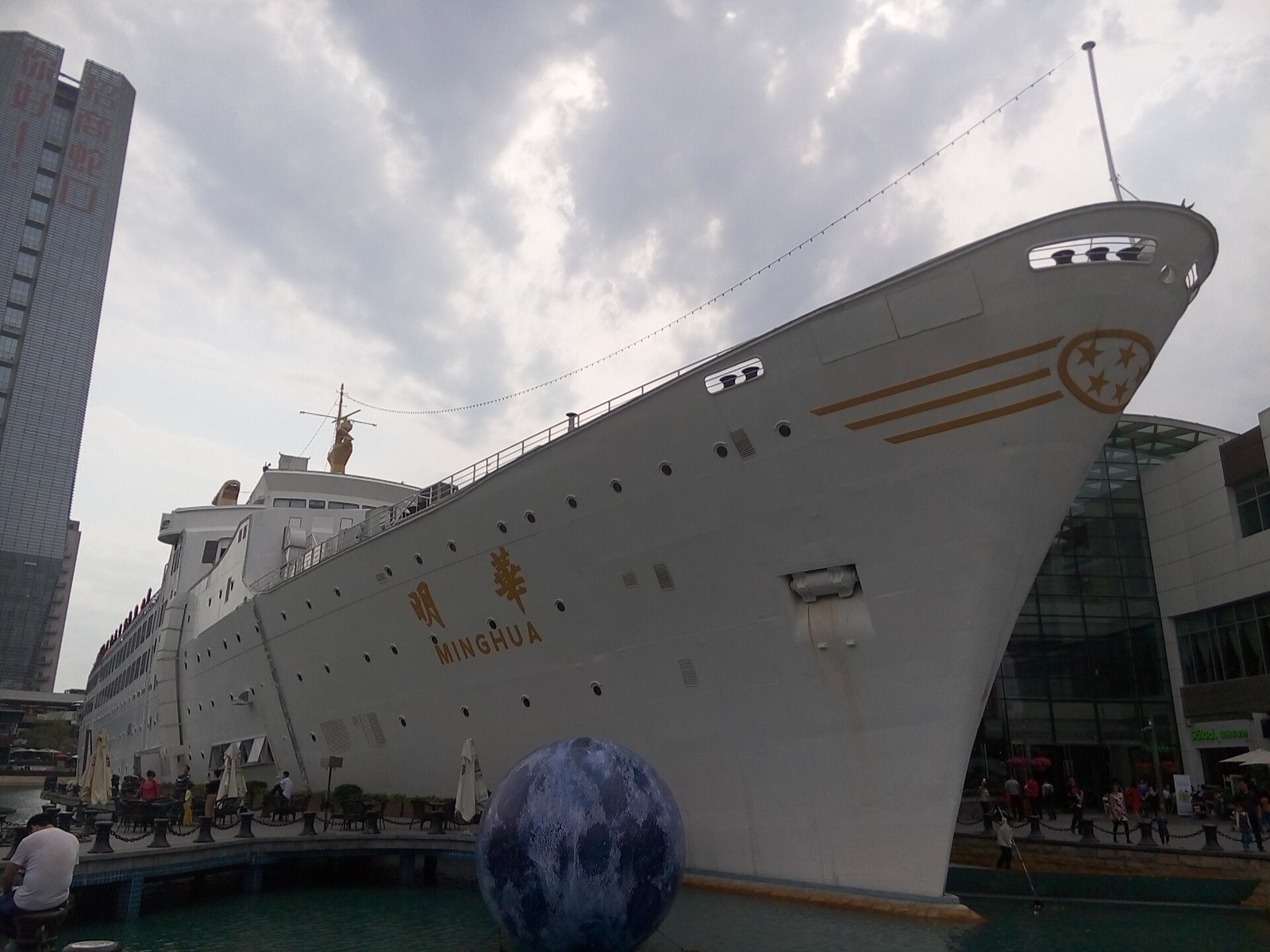
Ancerville is a French passenger liner of 1962 that survives today in one of the most unusual forms of preservation in this directory: she is landlocked. Built for the Compagnie de Navigation Paquet's Marseille–Dakar service in the last years of the classic liner era, she was sold to China in 1973 and renamed Minghua, and in 1983 she was moved to Shekou, Shenzhen, to become the centrepiece of the Sea World entertainment development. The land around her berth was later reclaimed, leaving a complete ocean liner sitting, permanently, on dry land in the middle of a modern Chinese city.
Her career touches three worlds: French liner routes to West Africa, China's early ocean-going passenger services, and the reinvention of a retired liner as a hotel complex in the city that symbolised China's economic opening.
Key specifications
The dataset gives Ancerville at 167.95 metres in length and 22.0 metres in beam, with hull number M21 from Chantiers de l'Atlantique. It leaves her tonnage blank; Wikipedia records her at 14,225 gross register tons (GRT) — a liner-era measurement, as her 1962 build date would suggest.
Two dataset figures differ from Wikipedia's account and are flagged here and in the batch notes. The dataset lists a service speed of 20.0 knots, while Wikipedia gives a service speed of 22.5 knots, with 25 knots reached on trials. And her capacity, blank in the dataset, is given by Wikipedia as 756 passengers with a crew of 173, arranged at build in three classes: 171 first class, 342 second class and 243 third class, the last in dormitories of four to ten berths.
Design and construction
Ancerville was designed for the Marseille to Dakar, Senegal route and built by Chantiers de l'Atlantique at Saint-Nazaire. She had, in Wikipedia's description, a yacht-like streamlined profile and an unusual internal arrangement: cabins placed mostly forward and the public rooms aft, reversing the usual liner layout.
All cabins and dormitories faced outboard, so every berth had a porthole or window. Public facilities were generous for a ship of her size and era: open and enclosed promenades, bars, restaurants, a smoking room, library, children's playroom, photographic laboratory, laundry and a theatre, plus two swimming pools aft and a small one forward. She was air-conditioned throughout and fitted with anti-roll stabilisers — modern equipment for 1962.
Her machinery consisted of two Burmeister & Wain twelve-cylinder two-stroke diesel engines, each rated at about 12,000 bhp, driving twin propellers. That plant gave her the high service speed the Dakar run demanded.
Naming, launch and maiden voyage
The name Ancerville honoured the town of Ancerville in the Meuse, in north-eastern France — the birthplace of Nicolas Paquet, founder of the Compagnie de Navigation Paquet. She was launched on 5 April 1962, with the launching performed in the presence of, and by the account in her Wikipedia article carried out by, French President Charles de Gaulle — a measure of the prestige still attached to a new French liner in 1962.
She entered service on 5 September 1962, her first voyage being a cruise to the Canary Islands, before settling into her intended Marseille–Dakar line service, calling at ports including Casablanca, Madeira, Alicante and Tangier.
Career by operator
| Name | Operator / owner | Years |
|---|---|---|
| Ancerville | Compagnie de Navigation Paquet (CNP) | 1962–1970 |
| Ancerville | Nouvelle Compagnie de Paquebots (NCP) | 1970–1973 |
| Minghua | China Ocean Shipping Co. (COSCO) | 1973–1983 |
| Minghua (Sea World) | China Merchants Group | 1983–present |
In 1970 her ownership passed from CNP to the Nouvelle Compagnie de Paquebots, but she continued on her usual routes. That same year, in July 1970, she performed the most famous act of her French career, rescuing all passengers and crew of the burning liner Fulvia in the Canary Islands.
By 1973, competition from air services had made the Dakar liner trade untenable, and she was sold to the People's Republic of China. Renamed Minghua — "Spirit of China" — she operated from China, principally on services to East Africa, for the last decade of her sea-going life, and in May 1979 she made a four-week goodwill voyage to Japan with a Chinese delegation of about 600 people aboard.
Onboard character
As built, Ancerville was a three-class liner of the final generation: a ship in which class division still structured the accommodation — cabin classes forward, third class in dormitories — but in which the equipment was thoroughly modern, with full air-conditioning, stabilisers, three pools and a theatre. The reversed layout, cabins forward and public rooms aft, gave her an arrangement unlike any contemporary British or Italian liner and is the design feature most often remarked on in accounts of the ship.
Her second character, as Minghua at Sea World, was created in the 1983 conversion and the major refurbishment of 2001–2004: hotel rooms within the hull, Chinese and Western restaurants, bars, a dance hall, a swimming pool, a cinema and exhibition space, wrapped around the surviving form of the 1962 liner.
Major refits and incidents
The outstanding incident of her career was one in which she was the rescuer, not the casualty: the July 1970 rescue of everyone aboard the burning and sinking Fulvia near the Canary Islands.
Her stationary years brought their own troubles. She closed in 1998 following a fire and management problems; although the Sea World exterior was maintained, the interiors deteriorated badly during the closure. A major refurbishment costing about 70 million yuan began in 2001 and was completed in 2004, returning her to use as a four-star hotel and leisure venue. In 2007, a large wave generated by heavy rainfall caused extensive damage, with repairs not completed until 2009, according to a detailed account of the ship's hotel years.
Sister ships and class
The dataset assigns her no class, and she was a one-off design for the Paquet company's Dakar service rather than a member of a multi-ship class. She has no sister ship. Her significance is as a sole survivor: a complete, if heavily adapted, example of the small, fast, diesel-driven French liners built for the West African routes at the very end of the liner era.
Fate and where she is now
Her fate is preservation in place. She arrived at Shekou on 17 August 1983 to be refitted as a tourist attraction within the Sea World complex, and she has never moved since. Although treated as a building once incorporated into Sea World, she was not removed from Lloyd's Register until 1991. Reclamation around her berth, connected with a neighbouring golf-course development, left her fully landlocked. The dataset records her status as preserved, as a hotelship at Shenzhen, China.
Visit her today
Ancerville — still carrying the name Minghua — is the centrepiece of Sea World in Shekou, Shenzhen, China, and can be visited as a hotel and leisure complex set into the development's plaza. Following the 2001–2004 refurbishment, the ship hosts a four-star hotel of about 253 rooms, Chinese and Western restaurants, bars including a wine bar and cigar house, a coffee shop, a boutique and a movie theatre, within the unmistakable hull of the 1962 liner. Because she is landlocked, visiting her is a matter of walking up to — and into — the ship from the surrounding streets and plaza rather than boarding from a quay; her exterior profile, minus lifeboats and with enlarged window rows cut into the hull sides, remains that of the Paquet liner launched by President de Gaulle.
Sources: https://en.wikipedia.org/wiki/List_of_ocean_liners; https://en.wikipedia.org/wiki/Minghua_(ship)