| IMO | 9677492 |
|---|---|
| Gross tonnage | 7,500 GT |
| Length | 126.1 m |
| Beam | 22.2 m |
| Passenger capacity (max) | 254 |
| Service speed | 15.0 knots |
| Builder | Huanghai Shipbuilding |
| Hull number | K-19 |
| Launched | 2015 |
| Maiden voyage | 2015-12-12 |
| Operator | Aranui Cruises |
| Status | Active |
Overview
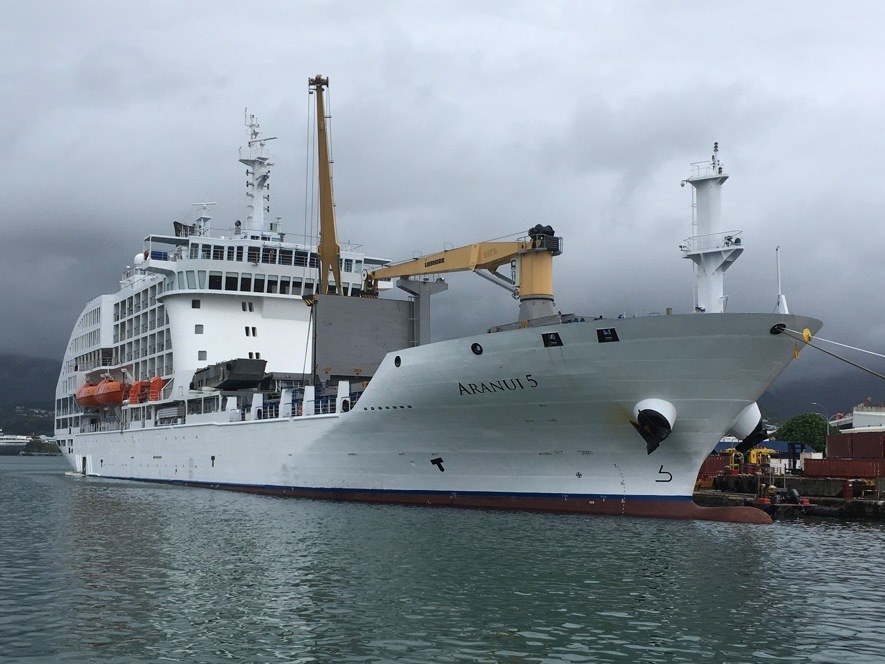
Aranui 5 is not, strictly, a cruise ship that carries some cargo, or a freighter that carries some passengers. She is both at once, by design: a dual-purpose passenger-cargo ship built to supply the Marquesas Islands — among the most remote inhabited archipelagos in the world — while carrying tourists in cruise-ship comfort on the same voyage. She entered service on 12 December 2015, homeported at Papeete, Tahiti, for the Compagnie Polynésienne de Transport Maritime (CPTM), whose ships have run the route for decades.
At 7,500 GT and 126.1 m she is tiny beside a modern cruise liner, but she is the lifeline of the islands she serves, carrying food, fuel, vehicles and building materials out from Tahiti and copra and produce back. Her passengers are, in effect, guests aboard a working supply run. In 2024 she briefly became famous far beyond the South Pacific when she served as a floating athletes' village for the surfing competition of the Paris Olympic Games, held off Teahupo'o, Tahiti.
Key specifications
The dataset records 7,500 GT, a length of 126.1 m, a beam of 22.2 m, a speed of 15 knots and a maximum capacity of 254. Her own article gives a beam of 24 m and a capacity of 256 — small conflicts with the dataset and with the operator's own figures, logged in the batch notes; the operator describes about 230 passengers in 103 cabins. Both sources agree on the essentials: a deadweight of about 3,300 tons for cargo, a shallow draught of about 5.2–5.5 m that lets her work small island wharves, and container stowage served by her own cranes — contemporary reporting gives stowage for 191 containers handled by two onboard cranes.
The dataset leaves her builder blank. Her article names Huanghai Shipbuilding of Shandong, China, as builder, with yard number K-19, and her design is credited in trade reporting to the Shanghai Merchant Ship Design & Research Institute (SDARI). She is registered as a passenger ship under SOLAS, under the French flag at Papeete, with a crew of about 64.
Design and construction
Aranui 5 was purpose-built in China for CPTM as a replacement for Aranui 3, which had entered service in 2003 and was visibly more freighter than cruise ship. The brief for the new ship reversed the emphasis without abandoning the cargo role: freight forward, passengers aft, and the passenger half designed from the start as a small cruise liner rather than as accommodation added to a cargo hull.
The result is a ship of two halves. Forward are holds, container decks and cranes for the supply work. Aft and above are eight passenger decks with 103 cabins — the operator notes that more than 90 per cent of its premium staterooms have private balconies, alongside standard outside cabins and small dormitory-style Class C cabins for four or eight, a survival from the ship's role as transport for islanders as well as tourists. Her shallow draught is a working specification, not an economy: the Marquesas anchorages and wharves she serves cannot take a deep-draught ship.
Naming, launch and maiden voyage
She was launched at the Huanghai yard on 8 February 2015 and entered service on 12 December 2015, the date the dataset records as her maiden voyage. The name continues CPTM's numbering — and explains a gap in it. There was no Aranui 4: the number four is considered unlucky in China, and the company's founder, Wing Wong, was Chinese, so the sequence jumped from Aranui 3 directly to Aranui 5. "Aranui" itself is usually rendered as "the great highway" or "great path" in Māori-derived Polynesian usage.
Career by operator
| Period | Name | Operator | Notes |
|---|---|---|---|
| 2015–present | Aranui 5 | Aranui Cruises / CPTM (Compagnie Polynésienne de Transport Maritime) | Dual-purpose cargo-passenger service from Papeete; replaced Aranui 3 |
Aranui 5 has had one operator and one essential trade. Her working pattern, described here in general terms because it defines the ship rather than as a current schedule, is a roughly twelve-day round voyage from Papeete to the Marquesas, calling at atolls in the Tuamotus on the way and at the six inhabited Marquesas ports, loading and discharging cargo at each stop while passengers go ashore. The operator also runs occasional voyages to other French Polynesian groups and, about once a year, to Pitcairn Island.
Her one departure from routine was a celebrated one. During the 2024 Summer Olympics, whose surfing events were held at Teahupo'o in Tahiti, Aranui 5 was anchored offshore as the athletes' village — the first floating Olympic village — housing 28 surfers from 19 delegations.
Onboard character
The onboard character follows from the ship's double life. The operator describes interiors that reflect the Polynesian heritage of owners and crew: a single casual restaurant where all meals are served, one main lounge, conference rooms used for lectures on the Marquesas, several bars including a panoramic Sky Bar, an outdoor pool, a spa and gym, and what the line promoted as the first tattoo studio at sea — a fitting detail in the islands where tattooing has deep cultural roots.
The defining experience, though, is not a venue. It is watching the ship work: cranes swinging containers and copra sacks onto rudimentary wharves while the village turns out to meet the ship that is its supply line, market and link to Tahiti. Aranui 5 sells participation in a working trade route, and her small scale — a few hundred passengers at most — keeps that character intact.
Major refits and incidents
No major refit or casualty is recorded in the sources used for this guide. One trade listing reports a refurbishment in 2025. The ship's newsworthy episodes have been operational rather than accidental: her entry into service in December 2015, inaugurated with ceremony at Papeete, and her 2024 Olympic role. Her article records no fire, grounding or machinery casualty.
Sister ships and class
Aranui 5 is a one-off design with no sister ship built to the same plans. Her family is the succession of CPTM supply ships that share her name and route: Aranui 1, 2 and 3 preceded her — the Aranui 3 she replaced was a converted freighter of a quite different character — and the company subsequently ordered a larger successor-generation vessel, launched in reporting as Aranui 6 / Aranoa, for the Austral Islands trade. None of these are sisters in the naval-architectural sense; each Aranui has been a separate answer to the same supply problem.
Fate and where she is now
Aranui 5 remains in active service, status "Operating" in the dataset and "In service" in her own article, on the trade she was built for: the cargo-passenger run between Tahiti and the Marquesas. She is one of the last purpose-built cargo liners in the world still carrying fare-paying passengers as a central part of her purpose, and her Olympic summer made her, briefly, the best-known small ship in the Pacific.
Sources: https://en.wikipedia.org/wiki/List_of_cruise_ships, https://en.wikipedia.org/wiki/Aranui_5, https://www.aranui.com/us/the-vessel