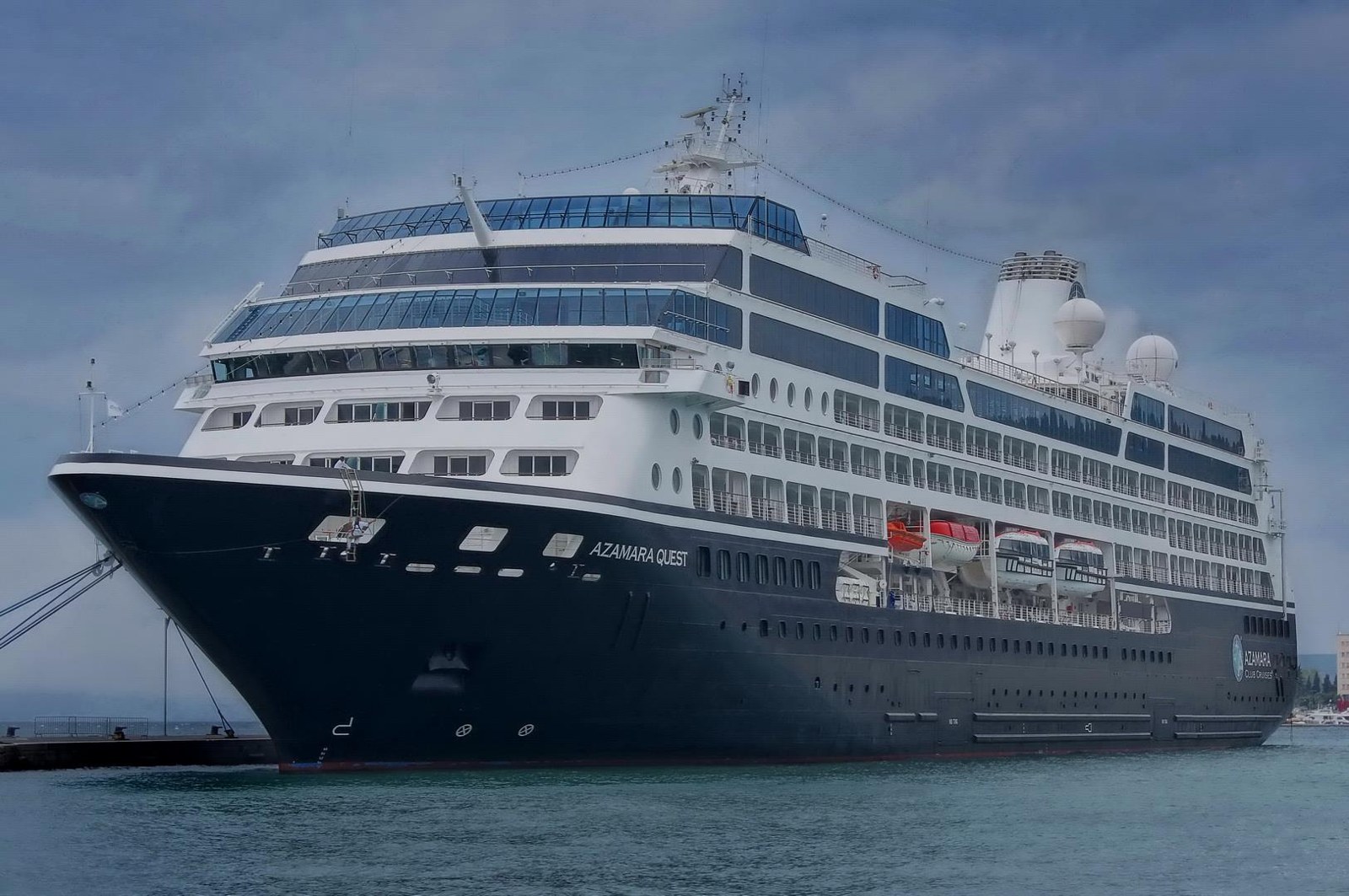
| IMO | 9210218 |
|---|---|
| Gross tonnage | 30,277 GT |
| Length | 181.0 m |
| Beam | 25.46 m |
| Passenger capacity (max) | 686 |
| Service speed | 18.0 knots |
| Builder | Chantiers de l'Atlantique |
| Hull number | Z31 |
| Launched | 2000 |
| Maiden voyage | 2000 |
| Class | R-class cruise ship |
| Operator | Azamara |
| Status | Active |
| All names | Azamara Quest; Blue Moon; Delphin Renaissance; R Seven |
Overview
Azamara Quest is an R-class cruise ship built in 2000 for Renaissance Cruises as R Seven, and since 2007 the joint founding ship — with her sister Azamara Journey — of the Azamara brand. Between those two identities she survived the collapse of her original owner, a lay-up, a German charter career as Delphin Renaissance and a spell as Pullmantur's Blue Moon, before becoming one of the ships that defined the small-ship, destination-focused style of premium cruising in the 2010s.
At just over 30,000 GT and carrying fewer than 700 guests, she is a fraction of the size of contemporary mega-ships. That smallness is her whole proposition: she can enter smaller harbours, stay late or overnight in port, and sustain a notably high crew-to-guest ratio, and she has been marketed on exactly those terms for most of her Azamara career.
Key specifications
The dataset gives Azamara Quest at 30,277 GT, 181.0 metres long and 25.46 metres in beam, with a maximum capacity of 686 passengers and a service speed of 18 knots. Wikipedia's figures are consistent: about 710 passengers at double occupancy — the dataset's 686 is best read as the lower-berth capacity quoted by several fleets lists — and a crew of about 410. Her propulsion is diesel-electric, built around four Wärtsilä 12V32 diesel engines.
Two dataset fields are wrong or doubtful and are flagged here and in the batch notes. The launched year is given as 2007 — but 2007 is the year she joined Azamara, not her launch; she was built and launched in 2000 as R Seven, as the dataset's own maiden-voyage year of 2000 confirms. And the dataset's hull number, Y31, differs from the Z31 quoted for her in detailed ship histories; her sister-sequence position as the seventh R-class ship supports the Z-series reading.
Design and construction
She was built by Chantiers de l'Atlantique at Saint-Nazaire, France, as the seventh of Renaissance Cruises' eight R-class ships, built between 1998 and 2001. The R class was a standardised design: 30,277 GT, eleven decks, and a layout intended for worldwide deployment by a single, fast-growing brand. The ships were deliberately mid-sized, with a high proportion of outside and balcony cabins for their era, and a country-club style of public rooms — panelled library, show lounge, and a main dining room — rather than resort-ship spectacle.
Delivered in 2000, she entered Renaissance service in the autumn of that year; her maiden voyage as R Seven began on 28 September 2000 in most detailed accounts. She served barely a year before Renaissance Cruises collapsed in September 2001, in the travel crisis that followed the 11 September attacks, and the nearly new ship was laid up at Gibraltar.
Naming, launch and maiden voyage
Her names chart her owners' fortunes. R Seven was a fleet-sequence name, seventh of the R class. Delphin Renaissance kept the Renaissance word under her German charter. Blue Moon was a Pullmantur fleet name. Azamara Quest — Azamara being a coined brand name combining elements suggesting "sea" and the name Acamar — was applied in 2007 when Royal Caribbean created the Azamara brand around her and her sister R Six, renamed Azamara Journey. She entered Azamara service on 24 October 2007.
Career by operator
The dataset's name field omits her German charter identity, Delphin Renaissance (2003–2006); the full chain, from her Wikipedia article, is:
| Name | Operator | Years |
|---|---|---|
| R Seven | Renaissance Cruises | 2000–2001 |
| R Seven (laid up) | Cruiseinvest (ownership) | 2001–2003 |
| Delphin Renaissance | Delphin Seereisen (charter) | 2003–2006 |
| Blue Moon | Pullmantur Cruises | 2006–2007 |
| Azamara Quest | Azamara (Azamara Cruises / Azamara Club Cruises) | 2007–present |
After the Renaissance bankruptcy she spent about two years laid up before the Delphin Seereisen charter returned her to service for the German market. In 2006 she was sold to Spain's Pullmantur Cruises — by then part of the Royal Caribbean group — and renamed Blue Moon. A year later she was transferred, with her sister, to launch the new Azamara brand. Ownership of the brand itself changed in 2021, when Royal Caribbean sold Azamara to Sycamore Partners, but the ship's name and operator identity were unaffected.
Onboard character
The R class's character is intimacy and tradition: a ship of lounges, a proper library, a single main dining room supplemented over the years by speciality venues, and a pool deck of human scale. Under Azamara she was progressively refitted toward the brand's boutique-hotel positioning, but the era-defining features are those of the original design — the high share of sea-view accommodation, the compact nine-to-eleven-deck plan, and public rooms sized for hundreds rather than thousands.
Her size shaped her employment as much as her interiors: she could call at smaller, less-visited ports and use city-centre berths closed to large ships, and Azamara built its identity — longer stays, more overnights, destination immersion — around precisely that physical fact.
Major refits and incidents
Her defining incident came on 30 March 2012, when a fire broke out in an engine room a day after she left Manila for Sandakan, Malaysia, with 1,001 passengers and crew aboard. The fire was contained to the engine room, but the ship was temporarily disabled and left drifting south of the Philippines while repairs were made. Five crew members were injured; no passengers were hurt. The ship reached Sandakan under escort, the voyage was cut short, and she returned to service after repair — an episode widely reported, and one in which the crew's handling of the stranded ship was publicly praised by guests.
The 2012 fire year also saw a significant refurbishment — reported at the time as a roughly $10 million investment, with renewed pool deck, public-room furnishings and a redesigned buffet restaurant — and further fleet-wide "reimagining" work followed later in the decade as Azamara refreshed both founding ships.
Sister ships and class
She is one of eight R-class sisters built for Renaissance Cruises. Her closest sister is Azamara Journey (ex-R Six), the other founding Azamara ship; Azamara Pursuit (ex-R Eight) and Azamara Onward (ex-R Three) later joined the same fleet, so four of the eight sisters sail for Azamara. The other four built their careers with Oceania Cruises and Princess Cruises — among them Regatta, Insignia, Nautica, Sirena and the former Pacific Princess — making the R class one of the most widely dispersed and longest-lived classes in modern cruising.
Fate and where she is now
The dataset records her status as active, operating for Azamara. More than two decades after her launch — and four names into her career — Azamara Quest remains in service as one of the four R-class ships of the Azamara fleet, her survival a product of the same small-ship qualities that made the class attractive to three successive generations of premium operators.
Sources: https://en.wikipedia.org/wiki/List_of_cruise_ships; https://en.wikipedia.org/wiki/Azamara_Quest