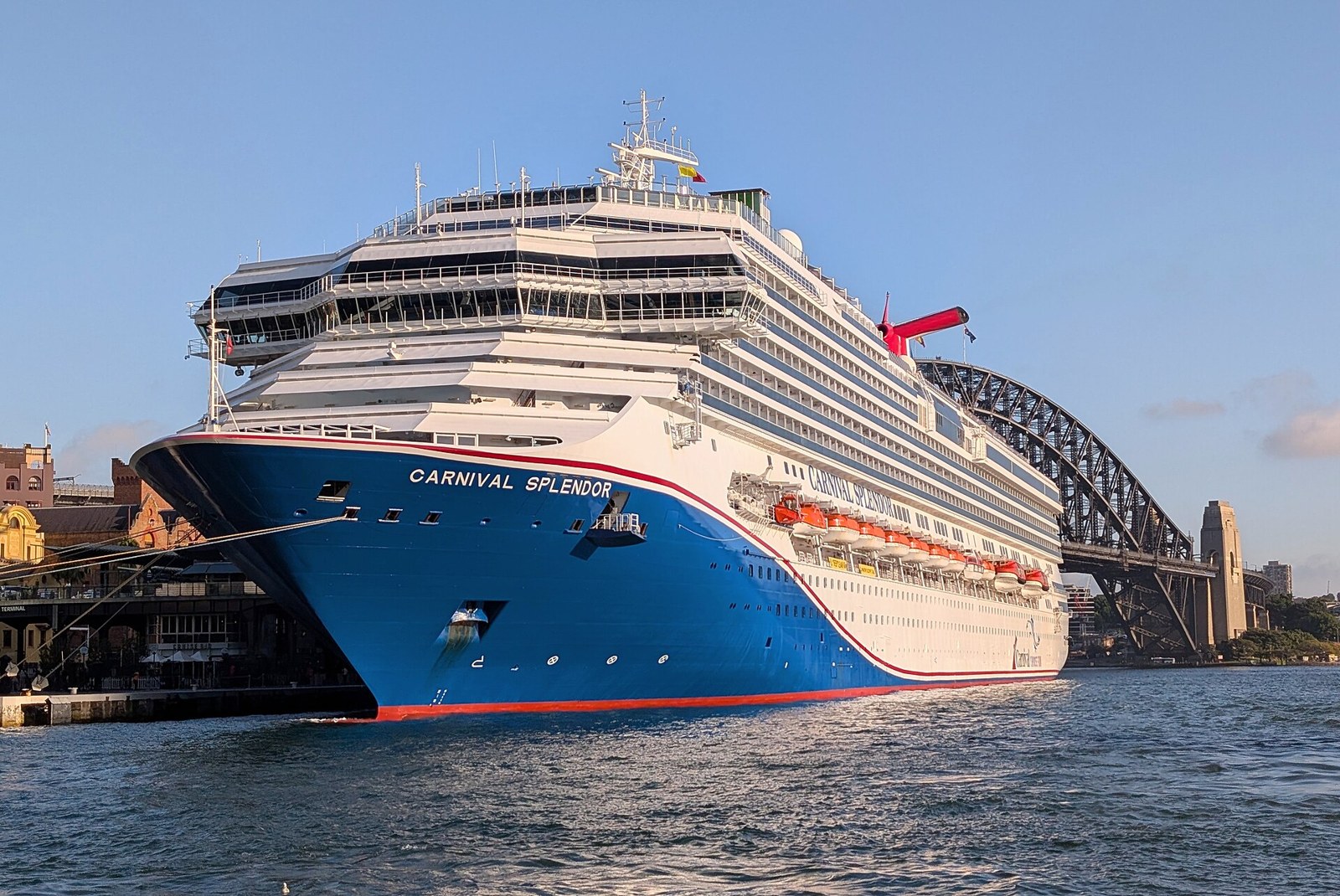
| IMO | 9333163 |
|---|---|
| Gross tonnage | 113,300 GT |
| Length | 290.2 m |
| Beam | 35.3 m |
| Passenger capacity (double) | 3012 |
| Passenger capacity (max) | 3954 |
| Service speed | 21.0 knots |
| Builder | Fincantieri |
| Hull number | 6135 |
| Launched | 2007 |
| Maiden voyage | 2008-07-02 |
| Class | Splendor-class cruise ship |
| Operator | Carnival Cruise Line |
| Status | Active |
Overview
Carnival Splendor is a one-off Fincantieri-built cruise ship for Carnival Cruise Line that entered service in July 2008 as the largest ship in the fleet — and is remembered worldwide for the event of 8 November 2010, when a catastrophic generator failure and engine-room fire left her dead in the water off Mexico with nearly 4,500 people aboard, to be supplied by a United States Navy aircraft carrier and towed to San Diego. The "Spam cruise", as the press named it, became the defining cruise-industry crisis story of its decade.
Beyond that week, hers is the career of a distinctive ship: a modified Concordia-class design treated by Carnival as a class of one, the first Carnival ship ever to sail around Cape Horn, and a vessel whose retractable-roof pool and vast spa were novelties when she was new.
Key specifications
The dataset records Carnival Splendor at 113,300 GT (ship records give 113,323 GT), 290.2 metres long and 35.3 metres in beam, with a maximum capacity of 3,012 passengers, a service speed of 21 knots and hull number 6135. Her builder is listed as Fincantieri, Genoa — the Sestri Ponente yard — though the dataset's hull field carries stray formatting, "[[Genoa]], 6135", which is cleaned here and logged in the batch notes.
Her power plant, central to her history, consists of six Wärtsilä diesel generators split between forward and aft engine rooms, in a diesel-electric arrangement. At her 2010 fire she carried 3,299 passengers and about 1,167 crew — figures that show the dataset's 3,012 as a double-occupancy rather than a full complement number.
Design and construction
Splendor began life as a Costa Cruises order for an enlarged Concordia-class ship and was transferred to Carnival during construction — the reason she is a near-unique hybrid: Concordia-class bones, completed to Carnival's arrangement and decoration. She was built by Fincantieri at Sestri Ponente, Genoa, as hull 6135. The dataset lists her launch year as 2008, her delivery year; her float-out at Genoa predates it, in 2007.
Two features defined the design. Her midships pool was covered by a retractable Magrodome roof, allowing all-weather swimming — a first for a Carnival ship of her type and a practical feature for the cooler Pacific itineraries she later worked. And her Cloud 9 Spa was the largest in the fleet at her debut, extending over two decks with a thalassotherapy pool and an associated block of spa cabins.
Naming, launch and maiden voyage
Her maiden voyage began on 2 July 2008, a cruise from Genoa to Dover to open her inaugural northern European season. Her christening followed in Dover on 10 July 2008 and was one of the more theatrical on record: her godmother, the singer and presenter Myleene Klass, played "Sailing" on the piano while a Royal Navy diver climbed five decks on a rope and smashed the champagne bottle against the bow by hand.
Career by operator
Carnival Splendor has served one operator under one name.
| Name | Operator | Years |
|---|---|---|
| Carnival Splendor | Carnival Cruise Line | 2008–present |
After her first European season she crossed to Fort Lauderdale in November 2008. In January 2009 she repositioned to Long Beach, California — a 49-day voyage around Cape Horn, because her post-Panamax beam barred the Panama Canal as it then was; she was the first Carnival ship ever to make that passage. From Long Beach she settled into Mexican Riviera service. After her 2010–11 fire repairs and a return to the Pacific, she later moved through a period of United States east-coast and Caribbean deployment before transferring in late 2019 to year-round service from Australia — her size and roofed pool suiting that market — a deployment interrupted, like all cruising, by the COVID-19 era.
Onboard character
Splendor's interiors continued Carnival's themed style with a pink-accented, exuberant decorative scheme often described as celebrating "splendid" things. But her era-defining features were architectural rather than decorative: the retractable roof over the main pool, creating an indoor-outdoor space no other Carnival ship then had; the two-deck Cloud 9 Spa with its thermal suite and thalassotherapy pool; and a layout inherited from the Costa Concordia-class platform — a different internal geography from the Farcus-era Carnival ships built in Finland and Italy before her, with the platform's characteristic arrangement of restaurants and lounges.
Major refits and incidents
The fire of 8 November 2010 is the major incident of her career, and one of the most thoroughly investigated in cruise history. At about 06:00 Pacific Time, on the second day of a Mexican Riviera cruise from Long Beach, her No. 5 diesel generator suffered a catastrophic failure — a split crankcase, in Carnival president Gerry Cahill's words — ejecting components and oil and starting a fire in the aft engine room. The fire spread into the overhead cable runs; the heat destroyed cabling whose loss disabled not only the aft plant but the ship's whole electrical system, a failure mode the design was supposed to prevent. The fixed CO₂ system could not be discharged into the space — remote activation failed, a section valve was inoperable and fittings leaked — and the cable fire finally burned itself out for lack of oxygen by about 13:15.
No one was injured. But with no propulsion, no air conditioning, no hot food and only emergency power, the ship drifted some 200 miles south of San Diego while the US Navy carrier USS Ronald Reagan, diverted to assist, airlifted supplies — the tinned meat and pastries among them that fixed the "Spam cruise" label in the press. Tugs towed her into San Diego, arriving on 11 November. Passengers were refunded in full with a free future cruise. She was repaired — initially at San Diego and San Francisco — and returned to service in February 2011. The United States Coast Guard's investigation report of 2013 remains a standard case study in marine fire safety.
Her later career has included the fleet's usual dry-dock refurbishments, including work connected with her 2019 transfer to Australian service; no comparable casualty has recurred.
Sister ships and class
The dataset classes her as Concordia class, and her hull and platform are indeed of that Fincantieri family — the class of Costa Concordia and her sisters. But because she was completed to a substantially different arrangement for Carnival, she is more precisely described, as Wikipedia treats her, as a class of one: the Splendor class, a modified Concordia design with no true sister. She is the only ship of her exact design.
Fate and where she is now
The dataset records her status as active. Carnival Splendor remains in Carnival service under her original name — the ship of the 2010 fire long since returned to ordinary, reliable work, her notoriety now a chapter of cruise history rather than a description of the ship herself.
Sources: https://en.wikipedia.org/wiki/List_of_cruise_ships; https://en.wikipedia.org/wiki/Carnival_Splendor; https://www.govinfo.gov/content/pkg/GOVPUB-HS7-PURL-gpo53281/pdf/GOVPUB-HS7-PURL-gpo53281.pdf