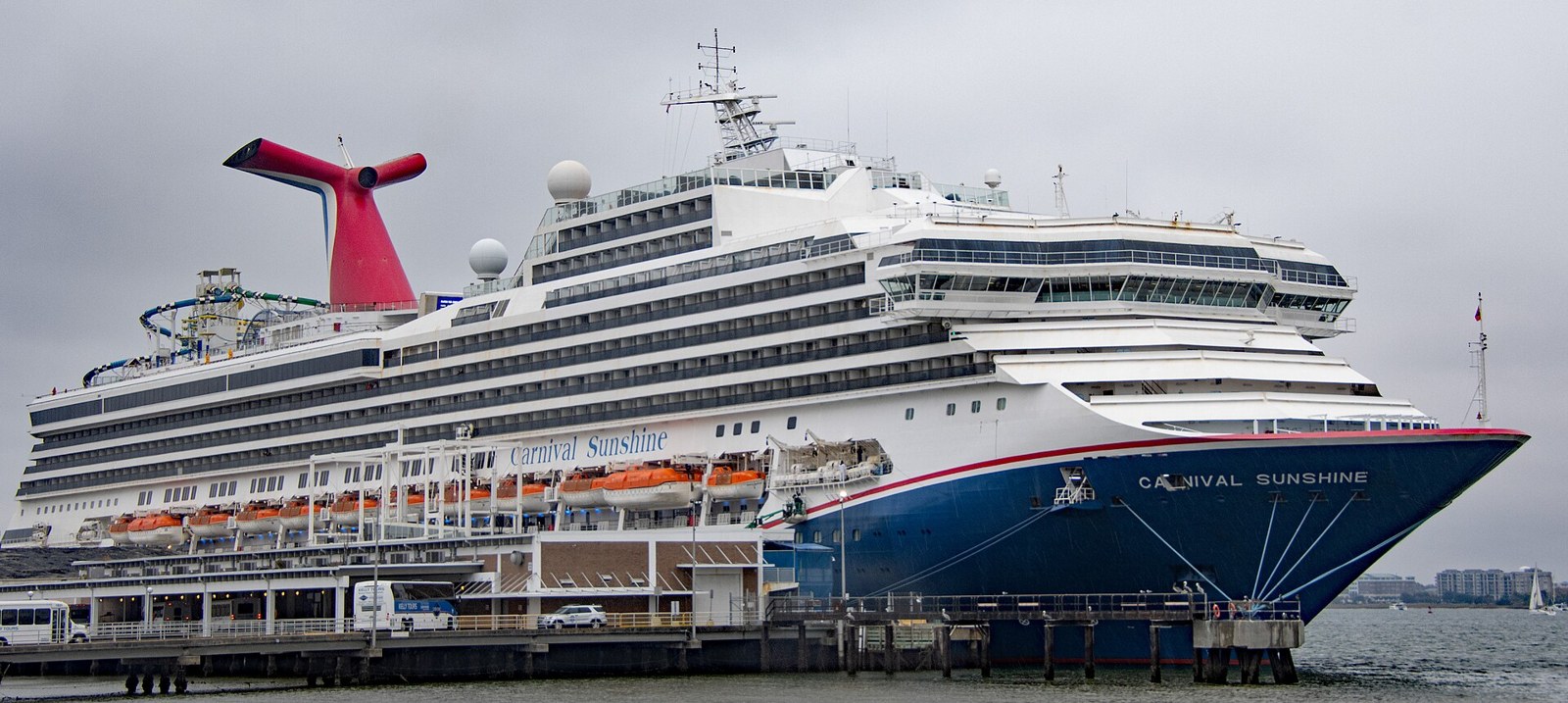
| IMO | 9070058 |
|---|---|
| Gross tonnage | 102,853 GT |
| Length | 272.2 m |
| Beam | 35.3 m |
| Passenger capacity (double) | 3006 |
| Passenger capacity (max) | 3859 |
| Service speed | 21.0 knots |
| Builder | Fincantieri |
| Hull number | 5941 |
| Launched | 1995 |
| Maiden voyage | 1996-11-24 |
| Class | Destiny-class cruise ship |
| Operator | Carnival Cruise Line |
| Status | Active |
| All names | Carnival Sunshine; Carnival Destiny |
Overview
Carnival Sunshine is a Destiny-class cruise ship operated by Carnival Cruise Line — but for the first seventeen years of her life she was Carnival Destiny, one of the most significant cruise ships ever built. Delivered in 1996, Destiny was the first passenger ship in history to exceed 100,000 gross tons, and briefly the largest passenger vessel in the world. In 2013 she underwent a US$155 million rebuild so extensive that Carnival treated her as a new ship: she emerged with a new name, Carnival Sunshine, a rechristening, extra cabins and an extra partial deck.
Following the retirements of older tonnage, she is now the oldest ship in the Carnival fleet — a 1990s hull still working as a front-line ship three decades after she reset the industry's sense of scale.
Key specifications
The dataset records the ship at 102,853 GT, 272.2 m long and 35.3 m in beam (her article gives 35.5 m), with a maximum capacity of 3,002 passengers and a speed of 21.0 knots after her refit; as built she was credited with 22.5 knots and 2,642 passengers. Some fleet listings quote 103,881 GT for the ship today. She has 13 decks as rebuilt, against 12 as built. Her original 100,000-ton milestone is worth stating precisely: gross tonnage measures internal volume, not weight, and Destiny's 102,853 GT made her the first cruise ship across a threshold the industry had been approaching for a decade.
Design and construction
The ship was built by Fincantieri at its Monfalcone shipyard in Italy as hull number 5941, ordered in 1994 at a reported cost of about US$409 million. She was launched on 15 November 1995 as Carnival Destiny — the dataset's 1996 launch year is her service-entry year. The Destiny design scaled up the Fantasy-class concept into a true mega-ship: a broad, terraced stern, a large lido deck with multiple pools, and accommodation for well over 2,600 passengers, at a size no passenger ship had previously reached.
Naming, launch and maiden voyage
Carnival Destiny was christened in Venice in November 1996 by Lin Arison, wife of Carnival founder Ted Arison, and her maiden voyage is recorded in the dataset as 24 November 1996. She held the title of world's largest passenger ship until 1998. Seventeen years later Arison performed the same role again: after the 2013 rebuild, the ship was formally renamed Carnival Sunshine at a ceremony in New Orleans on 17 November 2013, with Arison — godmother to three Carnival ships across her lifetime association with the line — again as godmother, a pairing of christenings no other Carnival ship shares.
Career by operator
One operator, two names, divided by a rebuild:
| Years | Name | Operator |
|---|---|---|
| 1996–2013 | Carnival Destiny | Carnival Cruise Line |
| 2013–present | Carnival Sunshine | Carnival Cruise Line |
As Destiny she worked mainly Caribbean programmes from Miami and San Juan. The dataset's `names_all` field records only her current name; her original name is preserved in its fate note ("Originally, the Carnival Destiny (renamed after refit)") and is restored in the table above. After the rebuild she returned to service in Europe in May 2013, crossed to New Orleans that November, and has since been rotated through Carnival's US homeport system in the line's usual pattern.
Onboard character
As Destiny, the ship's character was scale itself: the first 100,000-ton resort at sea, with the full Fantasy-era formula — big show lounge, casino, multiple dining rooms and sprawling pool decks — stretched over a much larger hull. The 2013 rebuild deliberately recast that character in the image of Carnival's newest ships of the day, under the line's "Fun Ship 2.0" programme: branded burger, cantina and bar venues, a racing-themed water park with one of the largest slides in the fleet, an expanded spa, and 182 additional cabins worked into the existing structure, including a new partial deck. The result is a ship whose bones are 1996 and whose public face was designed in 2013 — the clearest example in the fleet of Carnival's rebuild-rather-than-replace strategy of that period.
Major refits and incidents
The 2013 refit dominates her record: a 75-day, US$155 million drydock in Italy that Carnival described as the most extensive it had ever attempted, rebuilding virtually every guest area and adding cabins, venues and — following a fleetwide review after the Carnival Triumph fire that February — enhanced redundancy, emergency-power hotel services and fire systems. She had earlier received a multimillion-dollar refurbishment in 2005 and further upgrades in 2010, including a poolside movie screen, and has drydocked for further work since, with refits recorded in 2018, 2021 and 2025. No major casualty attaches to the ship herself; her historical importance is constructive rather than accidental.
Sister ships and class
Built as the Destiny class, the group now collectively carries the Sunshine name: Carnival Sunshine (1996, ex-Destiny), Carnival Sunrise (1999, ex-Triumph) and Carnival Radiance (2000, ex-Victory) — the two later sisters following Sunshine's lead with rebuild-and-rename transformations of their own in 2019 and 2021. The related Fortuna class built for Costa — Costa Fortuna and Costa Magica — shares the same design ancestry.
Fate and where she is now
Carnival Sunshine remains in active service with Carnival Cruise Line, the oldest ship in the fleet and still the hull that first took cruising past 100,000 gross tons.
Sources: https://en.wikipedia.org/wiki/List_of_cruise_ships, https://en.wikipedia.org/wiki/Carnival_Sunshine