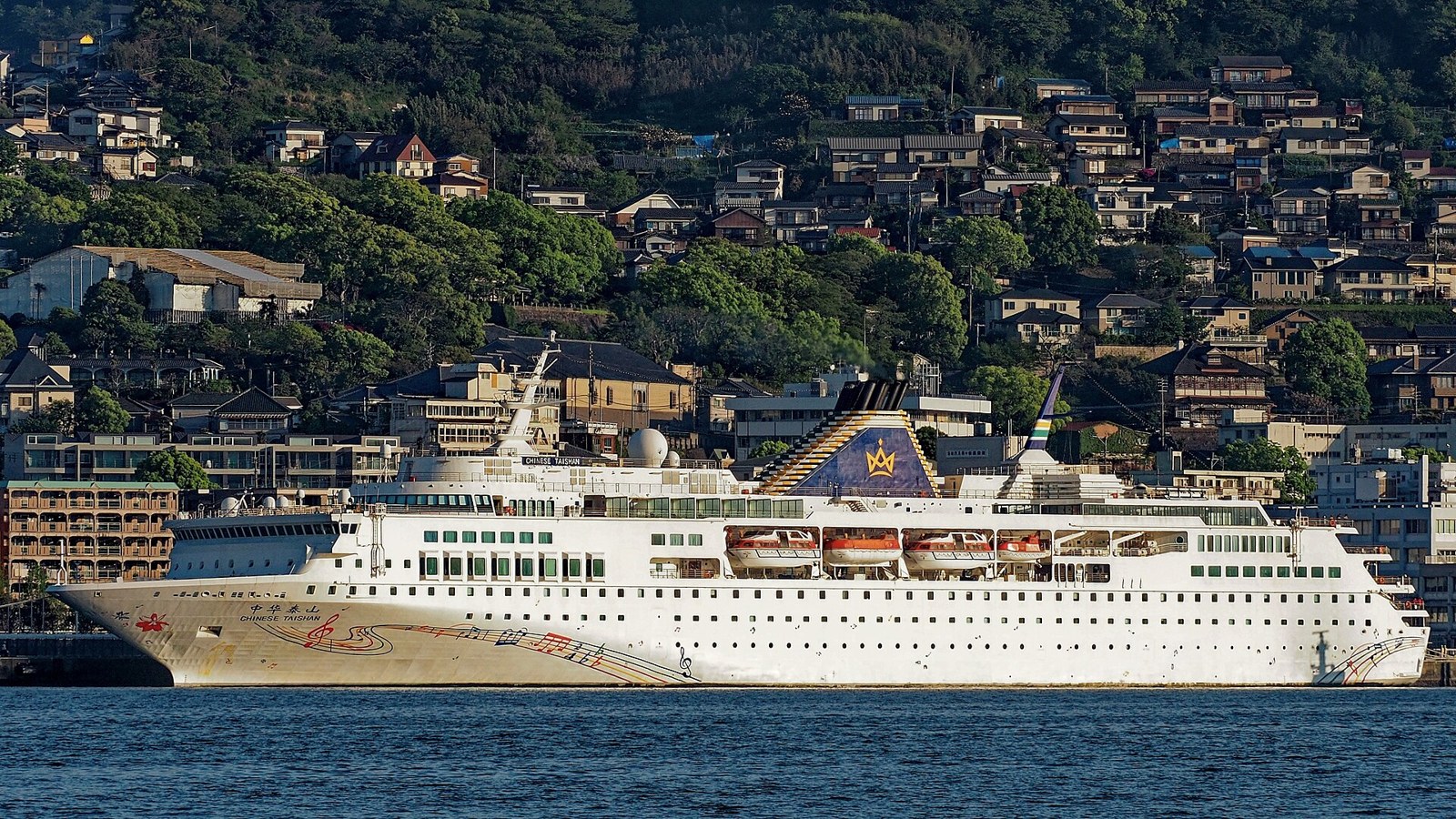
| IMO | 9183506 |
|---|---|
| Gross tonnage | 24,427 GT |
| Length | 180.7 m |
| Beam | 25.6 m |
| Passenger capacity (double) | 832 |
| Passenger capacity (max) | 927 |
| Service speed | 28.0 knots |
| Builder | Blohm+Voss |
| Hull number | 961 |
| Launched | 1999 |
| Maiden voyage | 2000-06-24 |
| Operator | Bohai Ferry |
| Status | Active |
| All names | Chinese Taishan; Costa Voyager; Grand Voyager; Voyager; Olympic Voyager |
Overview
The ship the dataset lists as Costa Voyager lived most of her life under other names, went faster than almost any cruise ship of her size, survived a freak-wave casualty that was filmed from rescue helicopters, and finished her Costa chapter in only a little over two years. She was built in Hamburg for the Greek line Royal Olympic Cruises as Olympic Voyager, entering service in June 2000 as one of a pair of unusually fast newbuilds intended to let a Mediterranean line offer port-intensive itineraries at speeds normally associated with ferries.
At 24,427 GT and 180.45 metres in the dataset, with a maximum speed of 28 knots, she was the opposite of the large, slow resort ships being built at the same time. Her speed was her selling point and her design brief: four Wärtsilä engines, diesel-electric transmission and a relatively small hull for under 1,000 passengers, so that distant ports could be combined in a single week.
Her Costa identity (December 2011–February 2014) was her third career: she came from Iberocruceros as Grand Voyager and left for China as Chinese Taishan. The dataset freezes her in that Costa window; this guide restores the full chain from her own article, filed under Chinese Taishan.
Key specifications
The dataset records 24,427 GT, 180.45 m length, 25.5 m beam, a maximum capacity of 927 and 28.0 knots speed, built by Blohm+Voss as hull 961. Her own article gives closely matching figures: 24,427 GT, 180.7 m length, 25.6 m beam, six decks, 832 to 927 passengers in 416 cabins, and a crew of 353.
Machinery, from the same article, is four Wärtsilä 9L46C engines, diesel-electric, driving twin inboard propellers, for a maximum speed of 28 knots. That maximum is exceptional: most cruise ships of her generation had service speeds of 21–24 knots. Her speed figures should be read as a design maximum; sustained commercial operation at 28 knots would have carried a heavy fuel penalty, which is part of why ships of this type did not become the industry norm.
The dataset leaves crew blank; the 353 figure above is a published-source figure, not a dataset figure.
Design and construction
She was built by Blohm+Voss (Blohm + Voss) in Hamburg, Germany, as yard number 961, for Royal Olympic Cruises of Piraeus, Greece. She was launched on 14 July 1999 — not in 2011. She was christened on 22 June 2000 and made her maiden voyage on 24 June 2000, the dataset's maiden-voyage year of 2000.
Royal Olympic ordered the pair to modernise an ageing fleet, applying Greek ferry speed practice to cruising. They had few balconies by later standards — a weakness noted in accounts of the line's failure — but their machinery was genuinely novel at 24,000 GT.
Naming, launch and maiden voyage
Launched as Olympic Voyager on 14 July 1999 at Hamburg, she was christened on 22 June 2000 and began her maiden voyage from Piraeus on 24 June 2000, according to her article and the Fakta om Fartyg record it cites.
Her name changes track her owners. A corporate renaming of Royal Olympic — prompted, in contemporary accounts, by pressure over the Olympic name — produced the Olympia Voyager form in 2002. In 2004–2005 she passed briefly through the name Voyager before settling as Grand Voyager for Iberocruceros in 2005. She became Costa Voyager in 2011 and Chinese Taishan in 2014.
Career by operator
| Name | Operator | Period |
|---|---|---|
| Olympic Voyager (later styled Olympia Voyager) | Royal Olympic Cruises | 2000–2004 |
| Voyager | Transitional / charter service | 2004–2005 |
| Grand Voyager | Iberocruceros (Ibero Cruises) | 2005–2011 |
| Costa Voyager | Costa Crociere | 2011–2014 |
| Chinese Taishan | Bohai Ferry Company | 2014–present |
The table follows her own Wikipedia article, which gives owners as Royal Olympic (2000–2005), Carnival Corporation (2005–2014) and Bohai Ferry (from 2014), and operators in the same sequence. Royal Olympic collapsed in 2004 after the post-September 11 downturn and the Iraq war's effect on eastern Mediterranean tourism, accounts of the line's failure record, and the ship passed to Carnival's Spanish brand.
As Grand Voyager she sailed for Iberocruceros from 2005. In November 2011 she transferred to Costa after a Genoa refit (reported €2.5 million) that repainted her funnel in Costa yellow with the blue “C” and adapted rooms to Costa standards. She entered Costa service that December, initially on Red Sea work, later in the Mediterranean and northern Europe, including a period replacing Costa Allegra's itineraries.
In February 2014 Costa sold her for US$43.68 million to Bohai Ferry Company of Yantai, China, and she was renamed Chinese Taishan — described in later Chinese-market reporting as the first cruise ship independently operated by a Chinese company. That sale ended her Costa career and, with it, the period the dataset describes.
Onboard character
Her character was speed in service of intimacy. As Costa's smallest ship, carrying roughly 800–900 against 3,000-plus on the large newbuilds, she offered the standard Costa room set at a scale reviewers called intimate and adult-leaning, with children's facilities added later.
Architecturally she predates the balcony-dominated resort template: public rooms and fast overnight runs between distant ports shaped the day around long hours ashore.
Major refits and incidents
Her defining incident occurred as Grand Voyager on 14 February 2005, during a mistral storm in the Mediterranean, on a voyage from Tunis toward Barcelona. A wave described in her article as 40 to 50 feet (12 to 15 metres) high struck the bridge, breaking a window; water entering the bridge disabled engine controls, leaving her adrift and rolling heavily. Helicopter footage of the ship in that condition was widely broadcast. Power was eventually restored and she reached Sardinia on 16 February 2005. The incident occurred less than a month after a similar bridge-wave event aboard her sister, then sailing as Explorer in the Pacific — a pairing that drew attention at the time to bridge-window vulnerability in heavy weather.
The 2011 Genoa refit was branding and standards work, not structural. No lengthening or rebuild is recorded at any stage; hull and machinery remained essentially as built.
Sister ships and class
She has one sister: Olympic Explorer (later Olympia Explorer), delivered a year later after a disputed handover, later Semester at Sea's Explorer, then Celestyal Odyssey and Glory Sea. They were Royal Olympic's only fast newbuilds; no more were ordered. She has no class name in the dataset, and none is claimed here.
Fate and where she is now
The dataset records her as active and operating as Costa Voyager, with a fate note listing her earlier names. That Costa status ended in 2014. Her documented position since then is as Chinese Taishan for Bohai Ferry Company, the name under which her own Wikipedia article is filed. Later reporting in 2026 describes Bohai Ferry listing the laid-up ship for sale as it exits the cruise business. No scrapping is recorded in the sources used. This directory therefore records her Costa chapter as complete, and her hull as surviving under a Chinese name, rather than as a currently operating Costa ship.
Sources: https://en.wikipedia.org/wiki/List_of_cruise_ships, https://en.wikipedia.org/wiki/Chinese_Taishan