| IMO | 9007491 |
|---|---|
| Gross tonnage | 14,983 GT |
| Length | 187.0 m |
| Beam | 20.0 m |
| Passenger capacity (double) | 368 |
| Passenger capacity (max) | 386 |
| Service speed | 16.4 knots |
| Builder | Ateliers et Chantiers du Havre |
| Hull number | 282 |
| Launched | 1992 |
| Maiden voyage | 1992 |
| Operator | Club Med |
| Status | Active |
Overview
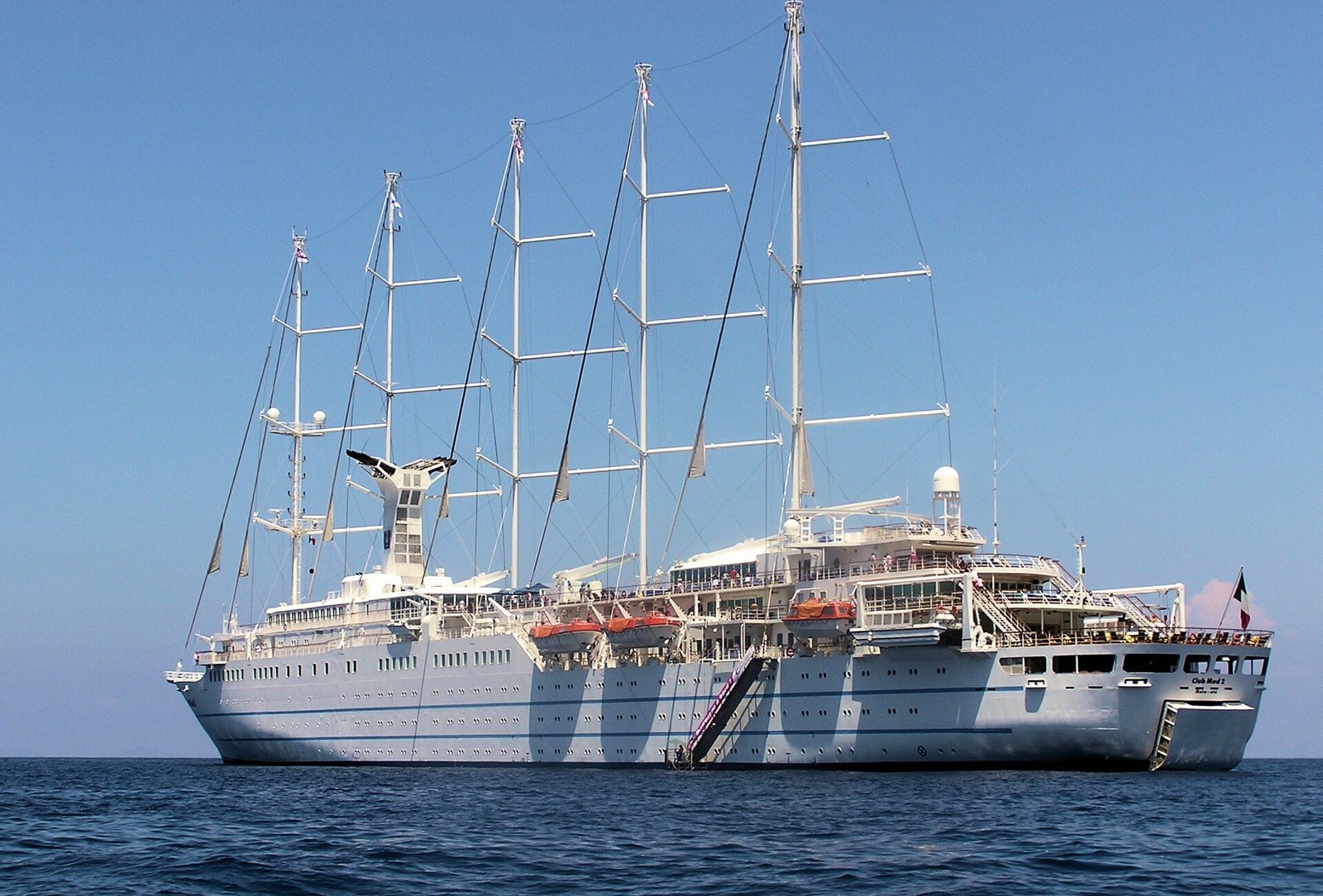
Club Med 2 is one of the largest sailing cruise ships ever built: a five-masted, computer-controlled staysail schooner of 187 metres that happens also to be a diesel-electric cruise ship, carrying up to 392 passengers in the dataset's figure (386 in most published references) with a crew of about 214. She is the floating expression of Club Med's resort idea — a village that moves — translated onto a hull derived from Windstar's motor-sailing yachts but scaled up to true ship size.
Launched at Le Havre in 1992 — the dataset's launch and maiden-voyage years are transposed, as explained below and logged in the batch notes — she has spent more than three decades doing what no conventional cruise ship can: anchoring in small harbours, deploying a water-sports marina from her stern, and moving on overnight under a press of automatically trimmed sail. Her sister, Club Med 1, left the fleet in 1998 to become Windstar's Wind Surf, leaving Club Med 2 alone in her role.
Key specifications
The dataset lists 14,983 GT, 187.0 metres length, 20.0 metres beam, 392 maximum passengers and 16.4 knots. Published figures put her hull length at about 182 metres with the 187-metre figure including spars, capacity at 386 passengers, and speed at about 16–16.5 knots under power — differences of definition rather than substance, with the dataset values retained above.
The machinery behind the romance is conventional and clever at once: four diesel generators supply two electric motors driving twin shafts with controllable-pitch propellers, while seven computer-operated sails on five masts provide auxiliary — and, in the right conditions, primary — propulsion. The system trims, reefs and furls sail automatically, allowing a sailing ship of unprecedented size to be worked by a normal cruise-ship deck department. Her shallow draught, around 5 metres, is the operational key: she can use anchorages closed to deep-draft ships.
The dataset's hull number, "CLUBMED2," is plainly a placeholder rather than a yard number.
Design and construction
The design grew out of the Windstar motor-sailers Wind Star, Wind Spirit and Wind Song — 5,350-ton, 148-passenger ships built at the same Le Havre yard, the Société Nouvelle des Ateliers et Chantiers du Havre, in the mid-1980s. Club Med, which had chartered and then acquired experience with the type, ordered two enlarged versions for its own fleet: Club Med 1 (1990) and Club Med 2.
Scaling a sailing rig to nearly 15,000 GT required the computer control that became the ship's signature. Sails are set and adjusted from the bridge, loads are monitored continuously, and the rig — five masts carrying seven staysails in schooner arrangement — was engineered to work with, not against, the ship's hotel operation: no sail-handling noise or labour on passenger decks, and a stable platform helped by the diesel-electric plant and stabilisers.
Interiors were planned as a Club Med village at sea, with decks named for Riviera resorts — Cannes, Saint-Tropez, Monte-Carlo, Portofino in later descriptions — and every cabin given a sea view. The stern water-sports platform, deployable at anchor for swimming, sailing, water-skiing and windsurfing directly from the ship, has no equivalent on a conventional cruise ship of any size.
Naming, launch and maiden voyage
Club Med 2 was launched at Le Havre in July 1991 by some references, and entered service in 1992; Wikipedia's article states she was launched in 1992 in Le Havre, and the ship was completed on 6 October 1992. The dataset's pairing — launched 1996, maiden voyage 1992 — is impossible as written and is plainly a transposition or data-entry error: a ship cannot make a maiden voyage four years before she is launched. This guide dates her launch and entry into service to 1992, following the ship's article, and logs the dataset error. The "1996" may derive from a fleet table that lists her Club Med service in some sources from a later restructuring.
The name is functional rather than romantic: the second Club Med sailing ship, numbered like the villages' fleet she was.
Career by operator
She has had one operator for her entire life. Club Med has run her seasonally between the Mediterranean, Aegean and Adriatic in summer and the Caribbean in winter, with transatlantic repositioning crossings in spring and autumn — a pattern documented since her early years and still the shape of her employment, described here in evergreen terms rather than as a current itinerary. Her sister's departure in 1998 made her the sole ship of the concept.
| Name | Operator | Period |
|---|---|---|
| Club Med 2 | Club Med | 1992–present |
Onboard character
The character is the rig itself. Seven white staysails rising above a long, low hull give her a profile closer to a great 19th-century schooner than to any contemporary cruise ship, and the experience is organised around the sea rather than around interior entertainment: ballroom dancing, bridge and music in the evenings documented in early descriptions, daytime water sports from the stern marina, and a rhythm of sailing at night to arrive at a new anchorage each morning.
Below decks the mood is French resort — informal luxury, strong gastronomy, and public rooms named for Mediterranean resorts — a deliberate contrast with the Anglo-American cruise-ship formula of her contemporaries. With fewer than 400 guests, she operates socially as a large yacht rather than a small liner.
Major refits and incidents
Secondary references record a drydock reconstruction in 1996, a complete interior redesign in 2008 by designer Sophie Jacqmin (also rendered Jacquemin), and a further major refurbishment in 2022, reported at about $10.5 million, which refreshed the Pinto-era interiors in a lighter palette while retaining the ship's golden-age references. No major casualty, grounding or fire appears in her documented history; for a sailing passenger ship of her size and age, that clean record is itself notable.
Sister ships and class
Her sister is Club Med 1 (1990), identical in concept and tonnage, sold in 1998 to Windstar Cruises and renamed Wind Surf — under which name she still sails, making the pair, in different liveries, the two largest sailing cruise ships of their generation. Her design ancestors are Windstar's Wind Star class of 1986–88, which proved the computer-controlled rig at one-third of her size.
Fate and where she is now
Club Med 2 remains in active service with Club Med, as the dataset records. More than thirty years after her launch she still holds her place among the largest sailing passenger vessels in the world — a 1992 experiment that became a permanent institution, and the last ship of her kind operated by the company that created her.
Sources: https://en.wikipedia.org/wiki/List_of_cruise_ships; https://en.wikipedia.org/wiki/Club_Med_2