| IMO | 9479852 |
|---|---|
| Gross tonnage | 113,216 GT |
| Length | 290.0 m |
| Beam | 36.0 m |
| Service speed | 23.2 knots |
| Builder | Fincantieri |
| Hull number | 6188 |
| Launched | 2011 |
| Maiden voyage | 2011 |
| Class | Concordia-class cruise ship |
| Operator | Costa Cruises |
| Status | Active |
Overview
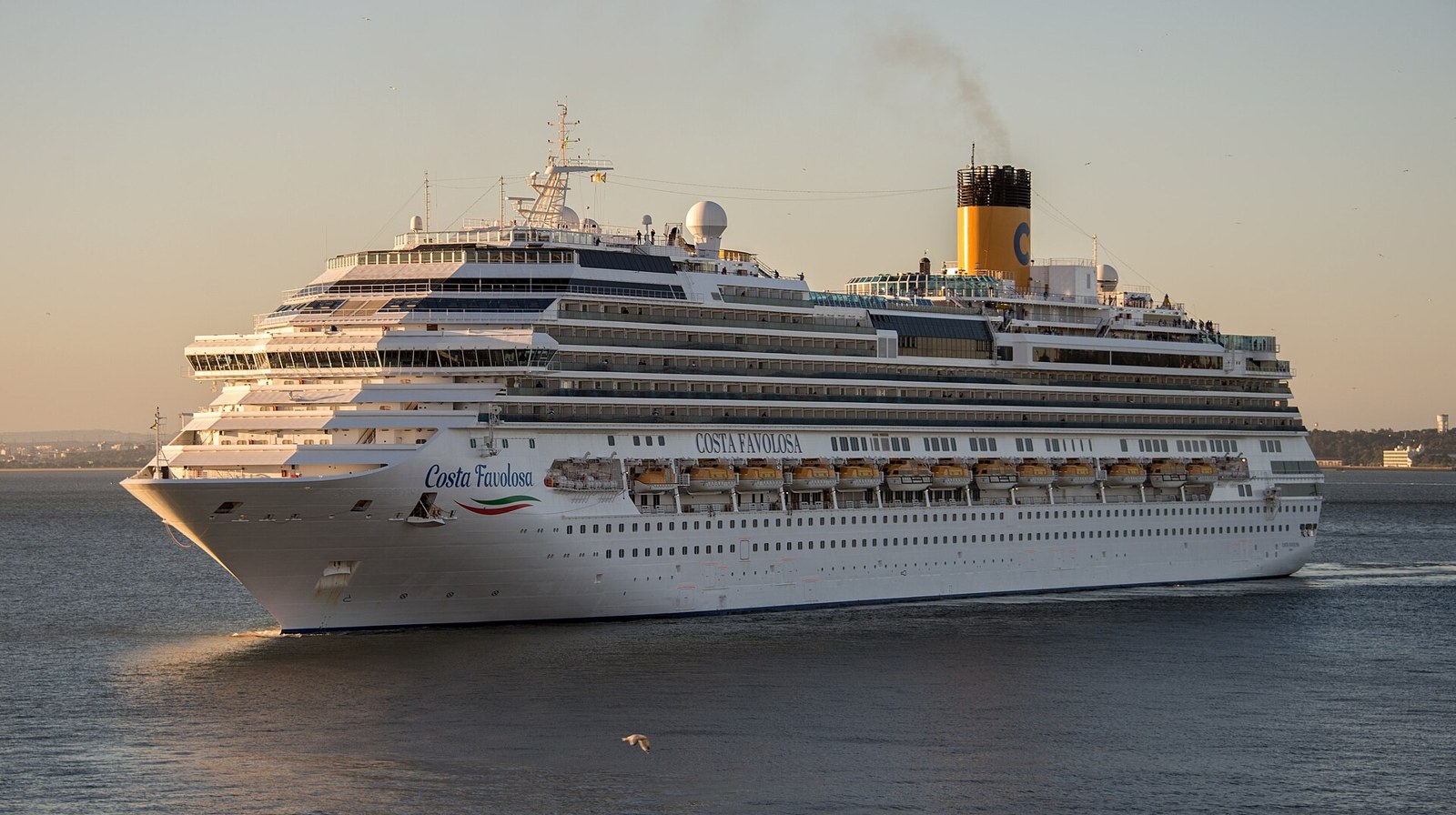
Costa Favolosa is a modified Concordia-class cruise ship operated by Costa Crociere (Costa Cruises), the Italian brand of Carnival Corporation. Ordered in October 2007 and delivered in 2011, she was the fifteenth ship in the Costa fleet and part of the largest expansion in the company's history — a five-ship, €2.4 billion programme that increased Costa's capacity by about half between 2009 and 2012. Her name, chosen by public competition, means "fabulous," and was selected to evoke a fairy-tale ship: favola is Italian for a fable or fairy tale. She is also, unavoidably, a member of the class defined in public memory by her lead sister Costa Concordia, whose loss in January 2012 came six months after Favolosa entered service; Favolosa herself was built to a later, modified version of the design and has had an uneventful technical career.
Key specifications
The dataset records 113,216 GT, 290.0 m length, a 36.0 m beam, a speed of 23.2 kn and Fincantieri hull 6188. Her own article's infobox gives the same tonnage and length, a beam of 40 m (an overall figure including bridge wings, against the dataset's hull beam), a draught of 8.5 m, 13 decks, capacity of 3,780 passengers and a crew of 1,110. The article's design text quotes an earlier 114,500 GT figure and 1,506 cabins — six more cabins than previous Concordia-class ships — illustrating why this guide follows the dataset's measured 113,216 GT. Propulsion is diesel-electric, driving two shafts with fixed-pitch propellers.
Design and construction
Costa Favolosa and her sister Costa Fascinosa were ordered in October 2007 as the Concordia-class element of Costa's five-ship expansion; Favolosa cost €510 million. She was built at Fincantieri's Marghera yard near Venice: the first section was laid down on 5 November 2009 and she was floated out of the building dock on 6 August 2010. The dataset's "launched 2011" is therefore her service year rather than her float-out year, a discrepancy logged in the batch notes. The design is the mature Concordia platform — a large Italian-market resort ship of just over 113,000 GT — with detail changes over the earlier ships of the class, including the small increase in cabin count noted above.
Naming, launch and maiden voyage
Her name was not assigned by the line but won. Costa ran a competition in which travel agents and their customers worldwide submitted name pairs meant to suggest magical, glamorous places: some 16,000 pairs were entered, 25 pairs were shortlisted, and more than 42,000 visitors voted on the company's website. Favolosa ("fabulous") and Fascinosa ("fascinating" or "glamorous") were the winning pair, the second name going to her sister. She was christened on 2 July 2011 and entered service on 4 July 2011 with a three-day preview sailing from Venice, followed by an eleven-day inaugural cruise from Venice on 7 July 2011.
Career by operator
Costa Favolosa has had one operator throughout: Costa Crociere, under Carnival Corporation ownership.
| Period | Name | Operator |
|---|---|---|
| 2011–present | Costa Favolosa | Costa Cruises (Costa Crociere) |
Within that single-operator career, her first seasons followed the classic big-ship Costa pattern of Mediterranean summers and winter deployments further afield, and in March 2020 she became one of the ships caught in the COVID-19 shutdown far from home (section 7). Otherwise her career is the steady, unrenamed, un-transferred service the Concordia platform was built for — notable in a fleet where Costa hulls have frequently been transferred to sister brands.
Onboard character
The Concordia class expressed Costa's "Italy at sea" idea at its largest scale of the period: a fairy-tale design brief (Favolosa was marketed around the favola concept), grand multi-deck public rooms, a large wellness area — contemporary descriptions put the spa complex at some 6,000 square metres — and multiple pools, one under a retractable glass roof. As a modified Concordia she carried the class signatures: a theatre, casino and cinema-scale entertainment plant arranged for a multilingual, predominantly European family market, quite distinct in tone from the American resort ships of Carnival Cruise Line built on related platforms.
Major refits and incidents
No major casualty has touched the ship herself; her recorded refit history is the normal drydock rhythm. Her one brush with the record books is the pandemic. In March 2020, after disembarking passengers in Guadeloupe — six of whom tested positive for COVID-19 — she anchored off Miami, where the US Coast Guard evacuated seven sick crew members on 26 March; a CNN update of 3 April reported her docked near Miami with evacuations continuing. An Indian crew member who had been taken to a Miami hospital on 29 March died of the disease on 8 April, and on 8 May it was reported that four of 78 Belgian nationals who had holidayed aboard had died. She returned to service when cruising resumed, like the rest of the fleet.
Sister ships and class
The Concordia class as built for Costa comprised Costa Concordia (2006, lead ship, lost at Isola del Giglio in 2012 and subsequently scrapped), Costa Serena (2007), Costa Pacifica (2009), Costa Favolosa (2011) and Costa Fascinosa (2012); the related Carnival Splendor (2008) was built for Carnival Cruise Line on the same platform. Favolosa's closest sister is Fascinosa, ordered with her as a pair and delivered the following year.
Fate and where she is now
In service with Costa Cruises, unchanged in name and operator since delivery — the dataset status "active, operating" stands. Of the Costa Concordia-class quintet she and Fascinosa are the youngest, and the class's story in service is now theirs to carry.
Sources: https://en.wikipedia.org/wiki/List_of_cruise_ships, https://en.wikipedia.org/wiki/Costa_Favolosa