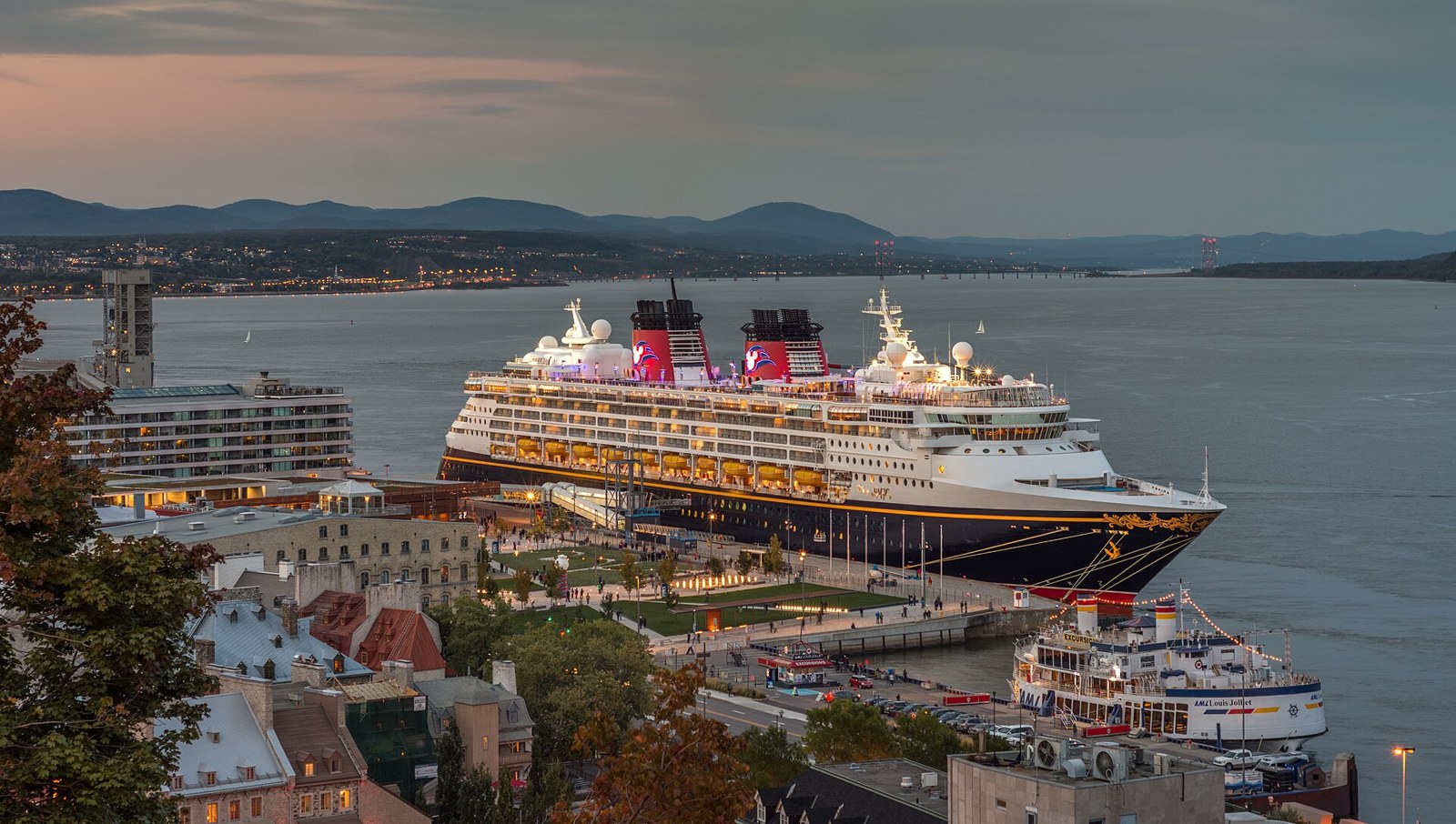
| IMO | 9126807 |
|---|---|
| Gross tonnage | 83,338 GT |
| Length | 294.0 m |
| Beam | 32.2 m |
| Passenger capacity (max) | 2713 |
| Service speed | 24.0 knots |
| Builder | Fincantieri |
| Hull number | 5989 |
| Launched | 1997 |
| Maiden voyage | 1998 |
| Operator | Disney Cruise Line |
| Status | Active |
Overview
Disney Magic was the first ship of Disney Cruise Line and the vessel that carried one of the world's most powerful entertainment brands into ocean cruising. Ordered in April 1995 and delivered in 1998, she was a deliberate statement of intent: rather than buy secondhand tonnage, Disney commissioned a purpose-built ship whose black hull, raked bow and twin funnels consciously recalled the great ocean liners of the early twentieth century, translated into a family cruise ship. She has carried a single name and a single operator throughout her career, a stability that is unusual in this directory, and she remains in service more than a quarter of a century after her debut. Her historical importance is out of proportion to her size — at under 84,000 GT she is modest beside modern megaships — because she proved that a cruise line built entirely around storytelling and characters could sustain a premium fleet, a model Disney has since expanded ship by ship.
Key specifications
The dataset records Disney Magic at 83,969 GT, 294.0 m long with a beam of 32.2 m and a speed of 24.0 knots, built by Fincantieri as hull 5989. Two cautions apply to those figures. Her own reference article gives a measured tonnage of 83,338 GT, so the dataset figure is best read as the rounded class figure often quoted for the ship. The article likewise gives passenger capacity as 1,750 at double occupancy and 2,713 at maximum, which suggests the dataset's 3,600 maximum figure counts everyone aboard, crew included, rather than passengers alone. Her service speed in the article is 21.5 knots, with 24.7 knots as a maximum, which reconciles reasonably with the dataset's 24.0 knots read as a top rather than cruising figure. She has eleven decks and diesel-electric machinery built around five Sulzer diesel engines driving electric propulsion motors.
Design and construction
Disney Magic was built by Fincantieri at Marghera, Italy. Her keel was laid on 31 October 1996 and she was floated out on 13 May 1997 — a date worth noting, because the dataset records 1998 as her launch year; 1998 was the year of her completion and delivery, on 30 June 1998, not of her launch. The exterior design was a conscious piece of theatre. At a time when new cruise ships were almost universally white, Disney specified a black hull with a red funnel band — two funnels, in the classic liner manner, although only the forward funnel is functional in the traditional sense. Character art was built into the ship's very structure: Sorcerer Mickey on the bow, a bronze Helmsman Mickey standing in the atrium, and Goofy at the stern. The ship reportedly cost around US$400 million, a substantial sum for her size in the mid-1990s, reflecting the cost of bespoke theming throughout.
Naming, launch and maiden voyage
The ship was never named for anyone but herself: Magic established the pattern of evocative, single-word-plus-brand names that Disney has used ever since. She was sponsored by Patricia Disney and christened on 28 July 1998, two days before her maiden voyage from Port Canaveral on 30 July 1998. That first season established the template of short Bahamas and Caribbean cruises paired with Disney's private island calls that defined the line's early years, before the ship's deployments broadened in later seasons to include extended repositioning voyages, among them a celebrated deployment to the US West Coast in 2005 for Disneyland's 50th anniversary year.
Career by operator
| Period | Name | Operator |
|---|---|---|
| 1998–present | Disney Magic | Disney Cruise Line |
One hull, one name, one operator: the table is short because Disney has retained its first ship throughout. Within that single-operator career, however, the ship's role changed. She began as half of a two-ship fleet working short, intensive family itineraries; as larger Dream- and Wish-class ships arrived from 2011 onwards, Disney Magic became the fleet's versatile elder, taking on longer and more varied deployment patterns including European seasons and transatlantic crossings. She also held, for a time, the record for the highest regular toll paid for a Panama Canal transit, at US$331,200, before the Coral Princess surpassed it — a small footnote that underlines how often she has been used as the line's pathfinder on new routes.
Onboard character
The era-defining idea aboard Disney Magic was that a cruise ship could be organised like a Disney film. The public rooms were executed in an elegant Art Deco idiom — sweeping staircases, brass, marble tones and a three-deck atrium — into which characters and stories were woven rather than pasted on. Her main dining concept, in which guests and their serving team rotate together between themed restaurants, debuted with this ship and became a signature of the line; Animator's Palate, where the room itself changes colour during dinner, was the best known of the original venues. The ship's horn even plays a phrase from "When You Wish Upon a Star". None of this was standard cruise practice in 1998: family cruising then usually meant children's facilities added to an adult ship, whereas Disney Magic was designed from the keel up around multi-generational storytelling, with large dedicated children's and adults-only zones held in careful balance.
Major refits and incidents
The defining refit came in autumn 2013, when the fifteen-year-old ship spent roughly five weeks in dry dock at Cádiz, Spain, in what Disney marketed as a "re-imagining". The work added the AquaDunk, a three-storey body slide whose trapdoor launch sends riders in a translucent tube out over the side of the ship; rebuilt the children's clubs, introducing Marvel's Avengers Academy, the first Marvel presence on a Disney ship; reworked the atrium, restaurants and adult areas; and renewed cabins and technology throughout. The scale of the investment — on a ship already halfway through a conventional career — signalled that Disney intended its first ship to remain a front-line unit. Her incident record, by contrast, is comparatively quiet: no major casualty or fire defines her career in the sources consulted, and her long service has been marked by routine drydockings rather than mishaps. Any more detailed incident chronology is against primary marine sources before publication.
Sister ships and class
Disney Magic is the lead ship of a two-ship class completed by Disney Wonder (1999), a near-sister built by Fincantieri immediately after her. Together the pair formed Disney Cruise Line's founding fleet and are often grouped as the Magic class. They were succeeded, at a much larger scale, by the Dream class (2011–12), the Wish class (from 2022) and later designs, but the two original ships established the visual and operational DNA — twin funnels, black hull, rotational dining, character-driven design — that every later Disney ship still follows.
Fate and where she is now
There is no fate to record beyond continued service: Disney Magic remains an active Disney Cruise Line ship, the oldest in the fleet and still working front-line deployments more than twenty-five years after her maiden voyage. For a ship whose launch-era contemporaries have largely been sold, transferred or scrapped, her survival in original ownership and original name is itself the story — evidence of how completely Disney's first gamble on cruising paid off.
Sources: https://en.wikipedia.org/wiki/List_of_cruise_ships; https://en.wikipedia.org/wiki/Disney_Magic