| IMO | 5119105 |
|---|---|
| Gross tonnage | 6,818 GT |
| Length | 130.35 m |
| Beam | 16.8 m |
| Service speed | 14 knots |
| Builder | Newport News Shipbuilding |
| Hull number | 176 |
| Launched | 1914 |
| Operator | BizNaz Resources International |
| Status | Preserved |
| Preserved at | Bintan Island, Indonesia |
| All names | Doulos Phos; Doulos; Franca C; Roma; Medina |
Overview
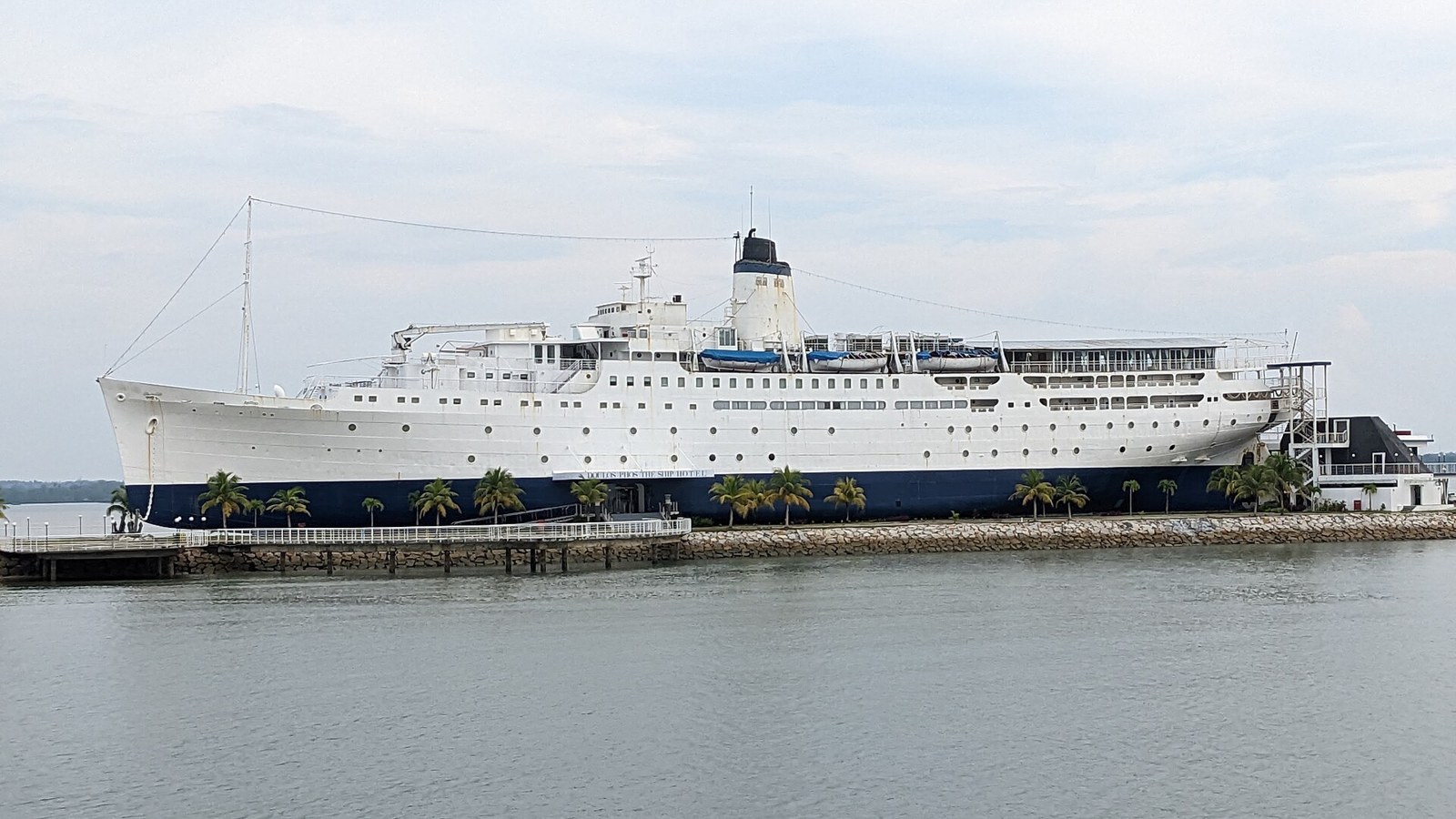
Doulos Phos has the longest biography of any ship in this directory's first phase: launched in 1914 as the American freighter Medina, converted to an emigrant ship as Roma, rebuilt as the Italian cruise liner Franca C, and saved from scrap in 1977 to become Doulos, the world's largest floating bookshop, in which role she sailed until the end of 2009 — holding, at her retirement, the record as the world's oldest active ocean-going passenger ship. She survives today, hauled out of the water onto dry land on Bintan Island, Indonesia, as the Doulos Phos Ship Hotel, opened in 2019 — 105 years after her launch.
Five names, four industries, three continents of service and one continuous hull: her story is the strongest argument this directory can make for the hull, not the brand, as the unit of maritime history. The dataset row is thin — no tonnage, length or speed survives into it — and where this guide gives the ship's documented dimensions, it does so from her article and says so.
Key specifications
The dataset supplies her IMO number 5119105, her builder Newport News Shipbuilding, hull number 176, a launch year of 1914 and her preserved status and location. Everything else must come from her article, and it is a record of a ship repeatedly re-measured as she was rebuilt: as built she was 5,426 GRT, 130.35 metres (427.66 ft) long with a 16.8-metre beam, a single triple-expansion steam engine of about 4,100 hp fed by four coal-fired boilers (converted to oil in 1922), and a speed of about 14 knots. Rebuilt after 1949 she measured 6,822 GRT (1960), later 6,549 GRT and, in her final seagoing form, 6,818 GT (2009). Those figures are given here as documented history, not as dataset specs.
Her 1949 conversion gave her cabins for 287 passengers plus dormitory accommodation for 694 more — the arithmetic of the post-war emigrant trade, in which she briefly worked, including voyages carrying pilgrims in the Holy Year of 1950 and emigrants toward Australia.
Design and construction
Newport News Shipbuilding and Dry Dock Company built her as hull 176 under a contract signed on 28 August 1913 by the Mallory Steamship Company for two steel freight steamships, hulls 175 and 176 — to be Neches and Medina, named for Texas rivers; Neches was lost in a collision in 1918, leaving Medina to carry the pair's history alone. The original specification — a 186-page contract volume preserved in accounts of the ship — described a single-screw steamship of hurricane-deck type with a straight stem and elliptical stern, fitted even with mosquito nets for tropical service between Galveston and New York.
She was laid down on 21 January 1914 and launched on 22 August 1914, sponsored by Frances Stuart Semmes, entering service on 29 September 1914 as a cargo steamer on the US Atlantic coast. Her later forms were rebuilds on this Edwardian cargo hull: the 1949 passenger conversion at La Spezia, the 1952–53 Costa reconstruction in which steam gave way to diesel and she emerged as a motor vessel, and a further re-engining with Fiat diesels in 1970. The hotel conversion of 2015–19, which lifted her bodily onto land at Bintan, is the fourth great alteration of the same riveted hull.
Naming, launch and maiden voyage
The dataset's name list runs newest-first; chronologically it reads Medina (1914), Roma (1948), Franca C (1953), Doulos (1977) and Doulos Phos (2010). Each name marks a change of world: Medina for the Texas river of her owners' trade; Roma for her Panamanian-flag emigrant and pilgrim work; Franca C for the Costa family, the "C" of Giacomo Costa's Linea C; Doulos, Greek for "servant," for her missionary decades; and Doulos Phos, "Servant of Light," for her hotel rebirth. The dataset gives no maiden-voyage date, and none is asserted beyond her documented entry into service on 29 September 1914.
Career by operator
| Name | Operator | Period |
|---|---|---|
| Medina | Mallory Steamship Company / Clyde-Mallory Line | 1914–1948 |
| Roma | Cia Naviera San Miguel | 1948–1953 |
| Franca C | Costa Lines (Linea C) | 1953–1977 |
| Doulos | Gute Bücher für Alle | 1977–2010 |
| Doulos Phos | BizNaz Resources International | 2010–present |
As Medina she traded on the US coast for 34 years and served with the US Coast Guard during the Second World War. Sold in 1948 to the Panamanian Cia Naviera San Miguel, she became the emigrant ship Roma. Costa bought her in 1952–53 — sources differ by a year — dieselised and rebuilt her as Franca C, running her first on the South American services and then, from 1959, as a Mediterranean cruise ship out of Venice, among the pioneers of post-war cruising. In 1977, booked for scrap, she was bought instead on 4 November 1977 by the German charity Gute Bücher für Alle ("Good Books for All"), the Operation Mobilisation-linked organisation that ran her for 32 years as a floating bookshop and mission ship with a volunteer crew, visiting more than 100 countries and receiving millions of visitors. Her bookshop years ended at Singapore in late 2009, ahead of the 2010 SOLAS changes, and she was handed over on 18 March 2010 to BizNaz Resources International of Singapore.
Onboard character
Each era had its own character, and the hull absorbed them all: Texas fruit and general cargo; emigrant dormitories; Costa's first-class Mediterranean cruising of the 1960s, when Franca C offered Venice-to-Greek-islands itineraries to a recovering Europe; and finally the bookship, carrying 3,000–5,000 titles on display and, by oft-quoted accounts, half a million books in the hold, with exhibitions, a book fair deck and a multinational volunteer community as the ship's real public rooms. No other vessel in this directory has been, in succession, a freighter, a dormitory ship, a luxury cruiser and a library.
Major refits and incidents
The great refits are the 1949 passenger conversion, the 1952–53 Costa dieselisation and rebuild, the 1970 Fiat re-engining, and the 2013–19 hotel conversion — towed from Singapore to Batam in September 2013, then mounted on dry land at Bintan in a reported $25 million resort project. The defining incident came on 11 August 1991 at Zamboanga City in the Philippines, when a grenade thrown by Abu Sayyaf militants exploded during an onboard performance: two crew members and four local people were killed and 32 others injured. It remains the darkest page in the bookship's history, and the ship sailed on for another eighteen years.
Sister ships and class
Her only sister was hull 175, SS Neches, built to the same 1913 Mallory contract and lost in a collision with a British warship in 1918. She has belonged to no class since; every later identity was a one-off conversion of a unique survivor.
Fate and where she is now
Her fate is preservation — the dataset's status, and a happier ending than the scrapyard bookings of 1977 and 2010 that she twice escaped. Retired from seagoing service at the end of 2009 as the world's oldest active ocean-going passenger ship, she was bought for hotel conversion, renamed Doulos Phos, and opened in June 2019 as a hotel on dry land at Bintan Island, Indonesia.
Visit her today
Doulos Phos stands on dry land at Bintan Island, Indonesia, as the Doulos Phos The Ship Hotel — the dataset's preserved location and fate text agree with the ship's article. The conversion kept the hull whole and visitable: guests stay in cabins on decks A and B in hotel configuration, and the ship functions as both hotel and maritime monument, with her bookship and Costa-era history presented as the attraction's core story. She is reached via Bintan's resorts area, a ferry ride from Singapore. Unlike every other ship in this batch, she can be visited without sailing anywhere — boarded at leisure, on land, 110 years and more after her launch at Newport News.
Sources: https://en.wikipedia.org/wiki/MV_Doulos_Phos; https://en.wikipedia.org/wiki/MV_Doulos