| IMO | 8716899 |
|---|---|
| Gross tonnage | 48,563 GT |
| Length | 210.81 m |
| Beam | 30.7 m |
| Passenger capacity (double) | 1602 |
| Passenger capacity (max) | 1840 |
| Service speed | 19.5 knots |
| Builder | Chantiers de l'Atlantique |
| Hull number | G29 |
| Launched | 1989 |
| Maiden voyage | 1990 |
| Operator | Cordelia Cruises |
| Status | Active |
| All names | Empress; Empress of the Seas; Nordic Empress; Future Seas |
Overview
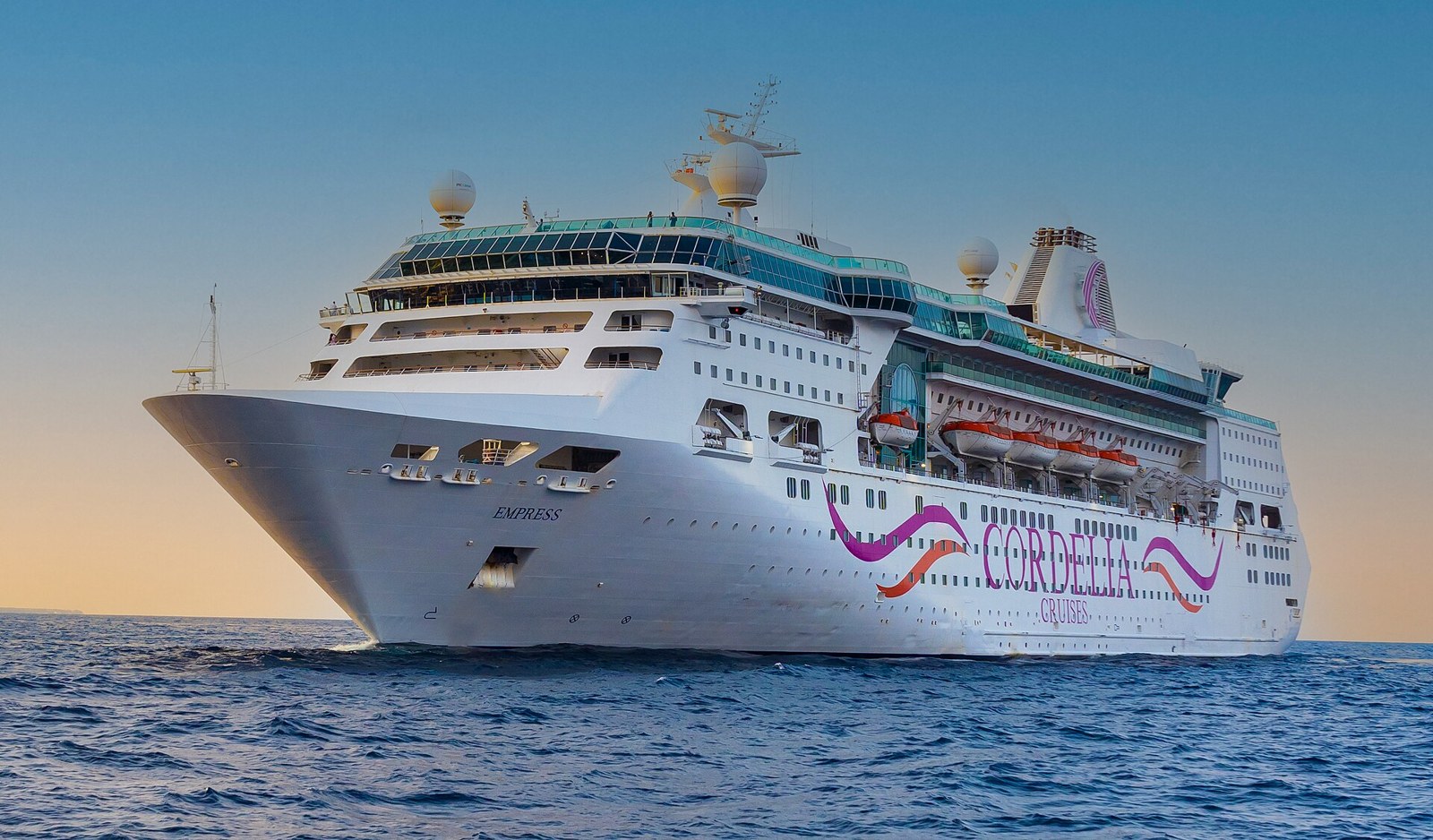
The ship sailing today as Empress for India's Cordelia Cruises has lived several complete lives. She entered service in 1990 as Nordic Empress, the ship that completed Royal Caribbean's transformation of the old Admiral Cruises order book; became Empress of the Seas in 2004; spent eight years in Spain as Pullmantur's Empress; returned to Royal Caribbean in 2016 for an Indian summer of short cruises; and was sold in December 2020 to become the founding ship of an Indian cruise brand. At 48,563 GT she was, by the end of her Royal Caribbean career, the fleet's smallest and one of its oldest ships — yet she outlasted almost all her contemporaries, because her modest size and simple layout made her ideal for exactly the short-cruise work she was designed for. The dataset's name field records only "Empress"; the full chain below comes from her own reference article.
Key specifications
Chantiers de l'Atlantique at Saint-Nazaire built her as hull G29. The dataset gives 48,563 GT, a length of 210.81 m, a beam of 30.7 m and a service speed of 19.5 knots, all of which agree with her reference article. On capacity, the dataset's 1,602 corresponds to the double-occupancy figure in Royal Caribbean's own fast-facts sheet; the same sheet gives 1,840 guests at full occupancy and a crew of 668, while the article's as-built capacity is 1,640. She has nine passenger decks and was powered by two Wärtsilä diesels totalling about 16,200 kW. One dataset date needs correcting in the prose: she was launched on 25 August 1989, not in 1990; 1990 was the year of her delivery and entry into service.
Design and construction
She was ordered by Admiral Cruises, to be named Future Seas and to join Azure Seas and Emerald Seas. When Royal Caribbean merged with Admiral in 1987, the Admiral brand was dissolved and the still-unbuilt ship was absorbed into the Royal Caribbean programme, gaining signature brand elements during construction, including the Viking Crown lounge wrapped around her funnel and a Windjammer Café. She is a class of one — the sole ship of her design — and she was purpose-shaped for a specific job: Nordic Empress was the first mainstream cruise ship designed especially for the three- and four-night cruise market, compact, quick to turn around, and economical to run on short, intensive itineraries. That specialisation, unfashionable as the industry chased ever-larger ships, is precisely why she remained useful for three decades.
Naming, launch and maiden voyage
Launched on 25 August 1989 and sponsored by Gloria Estefan, she was delivered on 31 May 1990 and made her maiden voyage on 25 June 1990 as Nordic Empress. She was the last Royal Caribbean ship whose name did not end in "of the Seas", a distinction she kept until a major rebuilding concluded on 8 May 2004, when she was renamed Empress of the Seas to match the fleet's naming convention. Each subsequent transfer brought a shorter name: Pullmantur simplified her to Empress in 2008; Royal Caribbean restored Empress of the Seas in 2016; Cordelia returned her to plain Empress in 2020.
Career by operator
| Period | Name | Operator |
|---|---|---|
| Ordered as (construction) | Future Seas | Admiral Cruises (order absorbed by Royal Caribbean, 1987) |
| 1990–2004 | Nordic Empress | Royal Caribbean International |
| 2004–2008 | Empress of the Seas | Royal Caribbean International |
| 2008–2016 | Empress | Pullmantur Cruises |
| 2016–2020 | Empress of the Seas | Royal Caribbean International |
| 2020–present | Empress | Cordelia Cruises |
The career falls into four acts. As Nordic Empress she worked short Bahamas cruises, then combined them with short cruises from San Juan, and from 1999 took over the New York–Bermuda run. A planned South American season in 2000 was cancelled in favour of a larger ship, keeping her in the Caribbean. Transferred within the Royal Caribbean group to Spain's Pullmantur in March 2008, she cruised for Spanish-speaking markets for eight years. In 2016 she returned to Royal Caribbean after an extensive refurbishment — reported at around US$50 million — and resumed short-cruise service. In December 2020, as the pandemic reshaped fleets worldwide, she was sold out of the group to Waterways Leisure Tourism, the company behind India's Cordelia Cruises, becoming the new brand's first ship.
Onboard character
Empress is a ship of the pre-megaship era, and her character follows from that. Nine passenger decks, a single dramatic atrium stair, a casino, a show lounge and the Viking Crown high above the sea gave her the complete 1990 cruise formula at half the size of the giants that followed. Contemporary reviewers returning to her in her final Royal Caribbean years remarked on the preserved early-1990s detailing — heavy theatre curtains, an old-school casino, quiet window-lined corners — alongside the standard brand venues added over the years, such as the Windjammer Café and Boleros lounge. For her Indian career the ship was repositioned rather than reinvented: a familiar, manageable first cruise ship for a new market, which is exactly the role her designers had in mind in 1990.
Major refits and incidents
Two refits frame her career: the extensive rebuilding completed in May 2004 that accompanied her renaming to Empress of the Seas, and the spring 2016 refurbishment that prepared her return to Royal Caribbean. Her most serious incident came as Nordic Empress. In June 2001, sailing some 140 miles north of Bermuda, she suffered an extensive engine-room fire traced to a failed bolt in a fuel-line flange that had been improperly repaired; leaking fuel ignited on hot engine surfaces. Sprinklers, halon flooding and fire hoses brought the three-hour incident under control, she returned to Bermuda under reduced power, and she was out of service for two weeks for repairs, with costs and lost revenue put at over US$8.8 million. No comparable casualty has defined her later career.
Sister ships and class
She has no sisters. Her reference article describes her as the sole ship of her class, a one-off design produced by the Admiral order and completed to Royal Caribbean's specification. Her nearest relatives are therefore contextual rather than structural: the slightly earlier Sovereign-class ships that set the template for Royal Caribbean's late-1980s expansion, and the small short-cruise ships of rival fleets built for the same three- and four-night market she pioneered.
Fate and where she is now
Empress remains in active service as the ship of Cordelia Cruises of India, the fourth operator and third country of her career. A hull ordered for a defunct American budget line, launched in 1989 and designed for weekend cruises, she has become the foundation vessel of Indian ocean cruising — an outcome nobody involved in her launch could have predicted, and a good illustration of how a sound, simple, mid-sized ship can keep finding new markets long after larger contemporaries have gone to the breakers.
Sources: https://en.wikipedia.org/wiki/List_of_cruise_ships; https://en.wikipedia.org/wiki/Empress_of_the_Seas