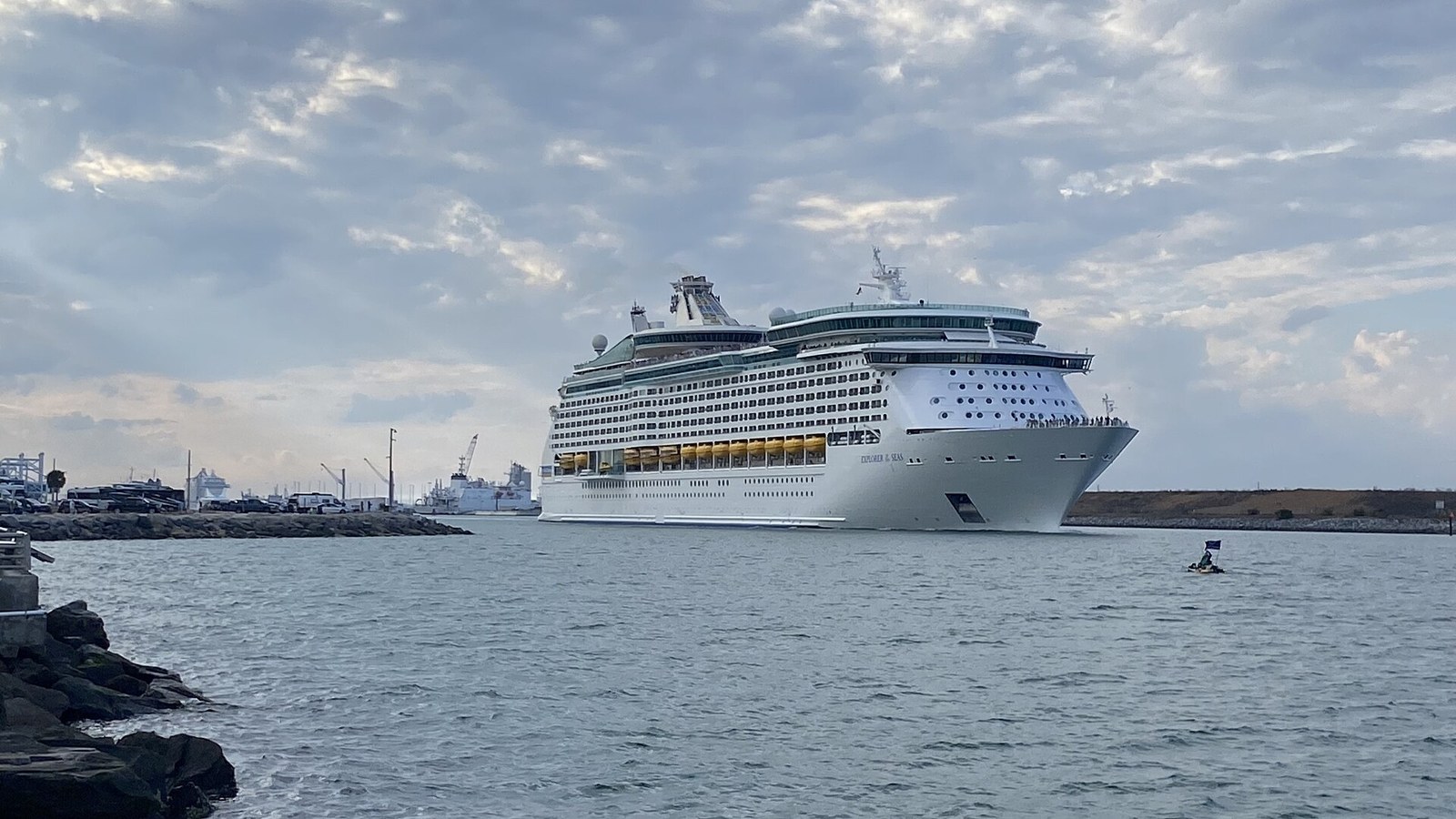
| IMO | 9161728 |
|---|---|
| Gross tonnage | 138,194 GT |
| Length | 311.0 m |
| Beam | 49.1 m |
| Passenger capacity (max) | 4029 |
| Service speed | 23.7 knots |
| Builder | Kvaerner Masa-Yards |
| Yard | Perno shipyard |
| Hull number | 1345 |
| Launched | 1999 |
| Maiden voyage | 2000-10-28 |
| Class | Voyager-class cruise ship |
| Operator | Royal Caribbean International |
| Status | Active |
Overview
Explorer of the Seas is the second ship of Royal Caribbean's Voyager class, the design that at the turn of the century reset expectations of how big and how activity-filled a cruise ship could be. Completed in Finland in 2000, she briefly held the title of the world's largest passenger ship. She is also the class's science ship: for her first years she carried a working atmospheric and oceanographic laboratory run with the University of Miami's Rosenstiel School, an arrangement no other mainstream cruise ship has matched. She remains in service a quarter-century after launch, her tonnage grown by refit from 137,308 GT as built to the 138,194 GT recorded today.
Key specifications
The dataset records 138,194 GT, 311.0 m length, a beam of 49.1 m, a maximum capacity of 4,029 and a speed of 23.7 knots; the ship's article gives 3,286 passengers at double occupancy and a crew of about 1,180. Two figures need explaining. The beam of 49.1 m is the ship's maximum breadth over the bridge wings; at the waterline she is 38.6 m wide. And the tonnage is dated: she measured 137,308 GT at delivery — 32 GT more than her sister Voyager of the Seas, enough to take the world-size record — and grew to 138,194 GT in her 2015 refit. Power is diesel-electric: six Wärtsilä 12V46 engines driving two Azipods and one fixed pod, an early large-ship pod installation that became class standard.
Design and construction
The Voyager design, built by Kværner Masa-Yards at the Perno shipyard in Turku (hull 1345), was organised around the Royal Promenade, a four-deck-high internal boulevard longer than a football field, lined with shops, cafés and cabin windows facing inward — the feature that announced the class to the industry. Wrapped around it were the other Voyager signatures: an ice-skating rink that doubled as a television studio, a rock-climbing wall, and extensive sports decks. Explorer's distinguishing design element was invisible to most guests: the OceanLab research facility, with atmospheric and oceanographic instruments feeding live data to scientists and to passenger education programmes. The keel was laid on 15 June 1998 and the ship launched on 4 November 1999; the dataset's "launched 2000" and its maiden-voyage date of 28 September 2000 are respectively her completion year and her completion date, corrected in the notes log.
Naming, launch and maiden voyage
She carried her name from the outset — each Voyager-class ship took an aspirational noun, and Explorer fitted the science mission built into this hull. Completed on 28 September 2000, she was christened on 21 October 2000 by her godmother, the American athlete Jackie Joyner-Kersee, and sailed her maiden voyage on 28 October 2000. She was registered first at Monrovia, Liberia, moving to Nassau, Bahamas, in 2002.
Career by operator
| Period | Name | Operator |
|---|---|---|
| 2000–present | Explorer of the Seas | Royal Caribbean International |
A single-operator career. Within it, her deployment has been unusually global for a ship of her generation — she has been based at various times in the Caribbean, Northern Europe and the Mediterranean, and in Australia and the US Pacific Northwest — but ownership, name and operator have never changed.
Onboard character
The Voyager class defined the "activities ship" era: the ship as destination, with the promenade as high street, ice shows and climbing walls as headline entertainment, and thousands of passengers absorbed by sheer internal variety. Explorer of the Seas added a layer none of her sisters had. Until 2007, working scientists used her onboard laboratory, and passengers could join lectures and outreach built around real atmospheric and oceanographic research gathered as the ship sailed; an automated data-gathering system was installed in 2008 and continued the measurement programme after the staffed lab closed. That combination — a mainstream resort ship that was also a research platform — remains her era-defining distinction.
Major refits and incidents
Her major refit came in early 2015, when the inline skating rink was replaced by a FlowRider surf simulator, other Voyager-class features were refreshed, and her tonnage rose to 138,194 GT. A much larger "$110 million" amplification announced in 2019 for 2020 was postponed indefinitely by the pandemic; a technical refurbishment was carried out instead, with a further technical dry dock in 2023.
Incidents on record include the rescue, on 16 February 2008, of three men from the disabled sailing vessel Tumbleweed, which had drifted for 11 days southeast of North Carolina. On 14 September 2012, Norwegian Star broke against her stern in heavy winds at Bermuda; neither ship was significantly damaged. In January 2014 a norovirus outbreak ultimately sickened 684 of the 4,237 people aboard and cut the cruise short — one of the largest such outbreaks the CDC investigated. In December 2015 she weathered a storm in which she listed 10 degrees in extreme crosswinds, alongside a gastrointestinal outbreak affecting 182 passengers. In July 2021 she served a shore-side role, housing rescue and recovery personnel after the Surfside condominium collapse in Florida. In November 2024 a storm near the Canary Islands heeled her 14.5 degrees, causing injuries and material damage.
Sister ships and class
The Voyager class comprises five ships, all from Turku: Voyager of the Seas (1999), Explorer of the Seas (2000), Adventure of the Seas (2001), Navigator of the Seas (2002) and Mariner of the Seas (2003). Explorer held the class's size record from her delivery — by a margin of 32 GT over Voyager — until Navigator overtook her in 2002. The enlarged Freedom class that followed was a direct development of this design.
Fate and where she is now
Explorer of the Seas is in active service with Royal Caribbean International, Bahamas-registered. A quarter-century into a single-operator career, she is one of the surviving flagships of the turn-of-the-century size race.
Sources: https://en.wikipedia.org/wiki/List_of_cruise_ships, https://en.wikipedia.org/wiki/Explorer_of_the_Seas