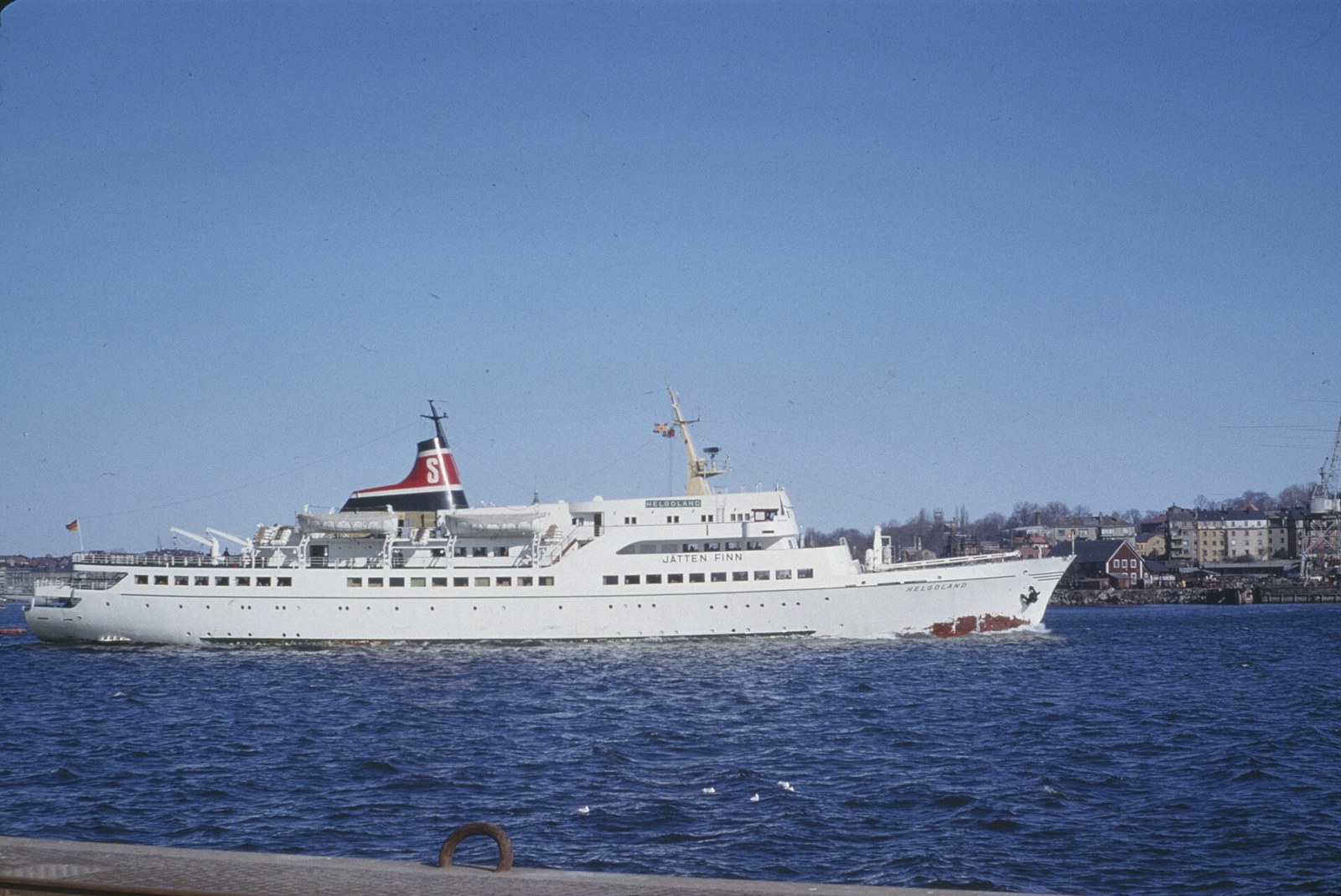
| IMO | 5404964 |
|---|---|
| Gross tonnage | 2,890 GT |
| Length | 91.92 m |
| Beam | 14.53 m |
| Service speed | 19.0 knots |
| Builder | Howaldtswerke Hamburg |
| Hull number | 943 |
| Launched | 1963 |
| Maiden voyage | 1963 |
| Operator | Galatours |
| Status | Active |
| All names | Galapagos Legend; Helgoland; Stena Finlandica; Baltic Star |
Overview
Few ships still at work have had three lives as different as this one's. Built at Hamburg in 1963 as Helgoland, a German seagoing day ship, she became a Red Cross hospital ship in the Vietnam War, then a Baltic ferry under two further names, and since 2000 she has cruised the Galápagos Islands as Galapagos Legend, a 100-passenger ship notable in the archipelago for being locally owned in Ecuador rather than part of a large corporation. At 2,890 gross tons and just under 92 metres, she is a modest hull with an outsized history — and one of the oldest cruise ships in regular service anywhere.
Key specifications
The dataset records 2,890 gross tons, 91.92 m length, 14.53 m beam and 19.0 knots. The ship's article clarifies that 19 knots is her maximum speed; service speed is 15 knots. Installed power is 6,000 hp from two KHD RBV12M350 diesel engines. Capacity has swung wildly with her roles: she was a short-route seagoing ship in 1963, a 150-bed floating hospital from 1966, a Baltic ferry credited with carrying up to 1,500 passengers in the 1990s "butter cruise" trade, and — after her 2000 conversion — a cruise ship for 100 passengers, the figure that defines her today.
Design and construction
Helgoland was built by Howaldtswerke Hamburg AG (yard number 943) for the HADAG shipping company, as a sea-going ship for the Cuxhaven–Helgoland route, where she replaced the Bunte Kuh of 1957. She was a substantial day ship rather than a ferry in the later roll-on sense: built to make the exposed run out to the island of Heligoland in the German Bight in all seasons. That sturdy, sea-going origin explains much of her longevity — the hull was designed for open water from the start, which is why it could later be adapted to ocean cruising in the Pacific. In her first years HADAG also chartered her out of season to Stena Line, between Gothenburg and Frederikshavn and between Stockholm and Mariehamn — the connection that shaped her next career.
Naming, launch and maiden voyage
She was launched on 9 March 1963 and completed on 24 May 1963 as Helgoland, named for the island she served. Her first career lasted only until 1965 on the Cuxhaven run — replaced by Alte Liebe in 1966 — but the name's retirement was temporary: when this hull was sold in 1972, HADAG commissioned a new sea-going ship and gave it the name Helgoland, while the 1963 ship was renamed Stena Finlandica.
Career by operator
| Period | Name | Operator / owner |
|---|---|---|
| 1963–1972 | Helgoland | HADAG (German Red Cross charter, 1966–1971) |
| 1972–1975 | Stena Finlandica | Stena Reederei GmbH |
| 1975–2000 | Baltic Star | KG Seetouristik (from 1976); Förde Reederei Seetouristik (from 1993) |
| 2000–2006 | Galapagos Legend | Latin Cruises |
| 2006–present | Galapagos Legend | Galatours |
The Red Cross chapter inside the first row deserves its own sentence: chartered from 1966, extensively converted, and sent to South Vietnam as a civilian floating hospital under an agreement between the West German and South Vietnamese governments, she worked first off Saigon and from September 1967 at Da Nang, her staff treating only civilian patients, free of charge, until 31 December 1971.
Onboard character
Each of her lives rewrote her interiors. As a hospital ship she carried 150 inpatient beds, three operating theatres and four specialist departments — surgery, internal medicine, gynaecology and radiology — with a medical staff of doctors, technicians and nurses alongside a 30-strong crew. As Baltic Star she was a high-capacity Baltic day-cruise ferry. The 2000 conversion to Galapagos Legend cut her complement to 100 passengers and rebuilt her as a small expedition-style cruise ship: the exact opposite of her ferry years, and the character she keeps today — a ship whose scale suits naturalist-led island cruising rather than resort cruising, crewed in recent listings by around 60, including multilingual naturalist guides.
Major refits and incidents
The defining refit was the 1966 hospital conversion, an extensive rebuilding that turned a day ship into a self-contained floating hospital protected under the Geneva Conventions as a civilian hospital, marked with the Red Cross symbol. In Vietnam she earned the nickname "Chicken of the sea" for moving out into Da Nang harbour whenever a rocket attack on the port was threatened. The 2000 sale to Latin Cruises brought the cruise-ship conversion that created Galapagos Legend; secondary listings record further extensive refurbishment and reconstruction in 2002 and again in 2017. No major casualty — no fire, grounding or collision of record — appears in the sources consulted for any period of her career.
Sister ships and class
She is a one-off: no sister ships were built to the design. Her place in a lineage is functional rather than structural — she succeeded Bunte Kuh on the Helgoland run and was succeeded there by Alte Liebe, and her Stena and Baltic careers were spent among the mixed fleets of second-hand tonnage typical of the era rather than in a class of her own.
Fate and where she is now
Galapagos Legend is in active service, Ecuador-flagged and owned since 2006 by Galatours of Guayaquil, cruising the Galápagos Islands. A hull launched in 1963 for a North Sea island run, converted into a war-zone hospital and twice reborn since, she is among the most remarkable survivors in this directory.
Sources: https://en.wikipedia.org/wiki/List_of_cruise_ships, https://en.wikipedia.org/wiki/MV_Galapagos_Legend, https://www.cruisemapper.com/ships/Galapagos-Legend-1112?tab=review