| Passenger capacity (max) | 11 |
|---|---|
| Crew | 4 |
| Launched | 1975 |
| Operator | The Majestic Line |
| Status | Active |
Overview
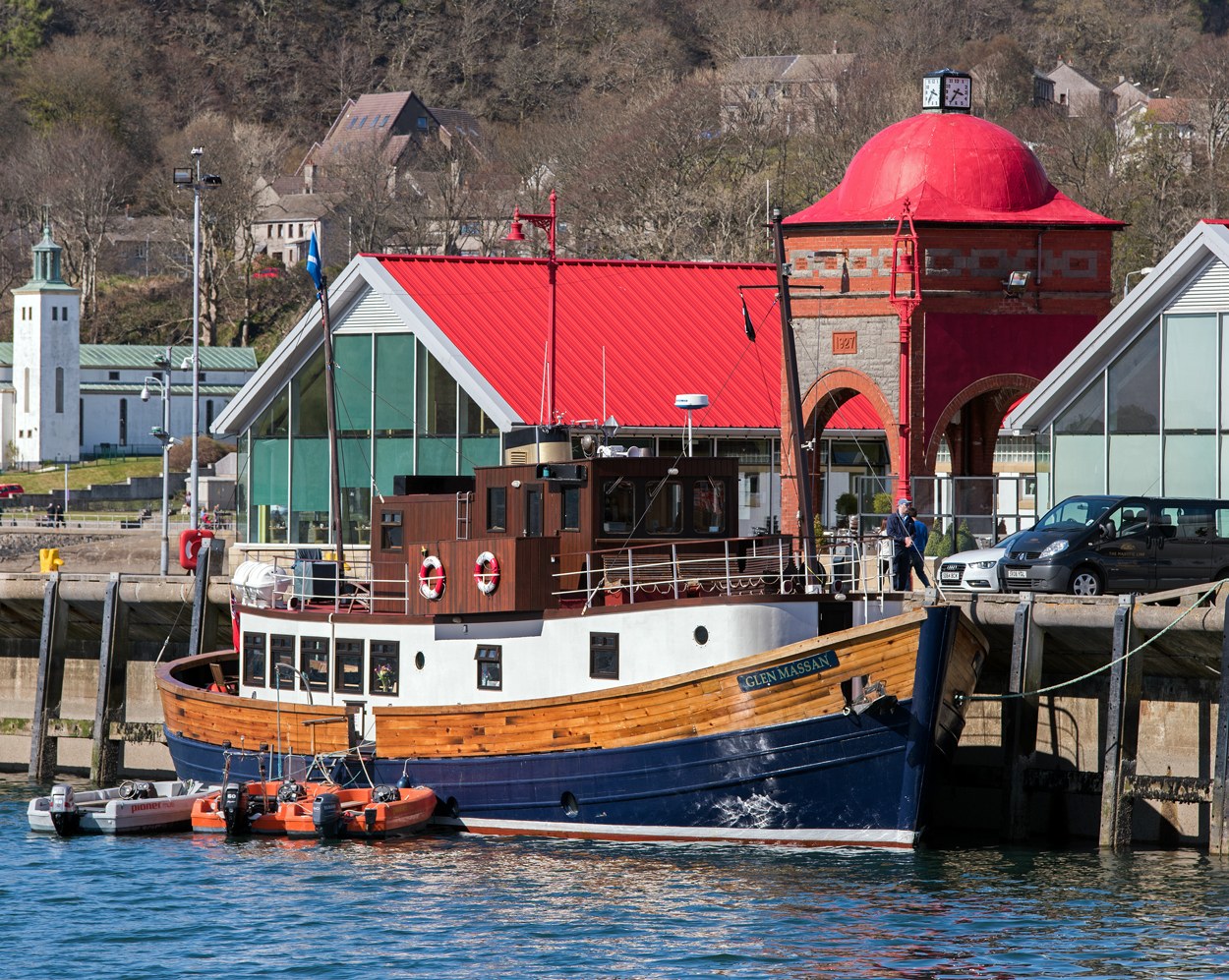
Glen Massan is the ship that founded The Majestic Line — and she is not, in any shipyard sense, a cruise ship at all. She began life as a wooden-hulled Irish fishing trawler, built in 1975 by most secondary accounts, worked the fishing trade for three decades, and was bought in 2003 by Andy Thoms and Dr Ken Grant, who converted her at the Holy Loch in Argyll into an 11-guest cruise vessel for Scotland's west coast. She entered cruise service in 2006 — the dataset's "launched" year, which is really her conversion year, as the prose below explains and the batch notes log.
The dataset's names field — "Glen Massan; a fishing trawler" — is roster prose, not a name chain: the second entry is a description, not a former name, and no earlier name for the trawler is given in the dataset or asserted here. What the fragment gets right is the essence. This is a directory of cruise ships that contains, at its smallest extreme, a converted trawler carrying eleven guests around the Hebrides with a crew of four — skipper, chef, engineer and steward — and it is included on the same roster logic as the 4,000-passenger Disney Dream. Both are, in their markets, cruise ships; the distance between them is the range of the industry itself.
Key specifications
The dataset supplies almost nothing technical: no IMO, no tonnage, no dimensions, no capacity, no builder. The spec box above therefore contains only what the dataset actually holds — her 2006 service-entry year, her active status and her operator, The Majestic Line.
Secondary sources fill part of the picture, and are used here as prose context rather than dataset specification: the Majestic Line's own pages describe 11 guests in six double/twin en-suite cabins — two on the main deck, four below — with a crew of four; CruiseMapper-style listings give about 25 metres length, 7 metres beam and roughly 180 GT; and Cruise Critic dates her fishing-boat construction to 1975 in Ireland. She is a wooden-hulled vessel — a fact central to her character and to her fleet's story, since no more suitable wooden trawlers could be found when the line later expanded.
Design and construction
Her "construction" as a cruise ship was a conversion, carried out after her 2003 purchase with local craftsmen at the Holy Loch, where she had been brought from Ireland. The work — led by Thoms, whose architectural skills the line itself credits — inserted six en-suite cabins into a fishing hull, created a combined deck saloon and dining room as the social heart of the ship, and fitted the outdoor aft deck and viewing spaces that Hebridean cruising requires, while keeping the hull, the wheelhouse character and the working-boat silhouette intact.
The design philosophy was the opposite of the newbuild cruise ship's: retain everything that made the vessel honest — wood, brass, low freeboard, a fishing boat's motion and manners — and add only comfort. The result reads, in the line's own description and in reviews, as a floating country-house party rather than a small liner: communal dining at one table, a well-stocked bar with a serious malt whisky selection, and panoramic saloon windows for a coastline that is the entire entertainment programme.
Naming, launch and maiden voyage
The Majestic Line takes its name from the fictional shipping company in Neil Munro's Para Handy tales of a Clyde puffer — the line's golden funnels are a nod to the same world — and its ships take Scottish glen names: Massan, Tarsan, Etive, Shiel. Glen Massan was named on her conversion; her name as a fishing vessel is not recorded in the sources used, and the dataset offers none, listing only the descriptive fragment noted above.
There was no launch ceremony in the liner sense: the "launch" of 2006 in the dataset is her entry into cruise service, following the 2003 purchase and the conversion at Holy Loch; the Majestic Line's own history dates the company's founding conversion work to 2004. Her maiden voyages were the line's first Hebridean seasons from the Sandbank and Oban bases.
Career by operator
She has had one cruise operator, The Majestic Line (Scotland) Ltd, founded in 2004 by Ken Grant and Andy Thoms and headquartered at Sandbank on the Cowal Peninsula; in 2024 the line was acquired by Craig of Campbeltown Limited, the family group behind West Coast Motors, without change to the ship's role. Before cruising, she fished — under owners the sources used do not name — for roughly three decades from her Irish building.
| Name | Operator | Period |
|---|---|---|
| (fishing vessel, name not recorded in sources used) | Fishing industry, Ireland | c. 1975–2003 |
| Glen Massan | The Majestic Line | 2006–present |
Onboard character
Eleven guests, six cabins, four crew, one table. Life aboard is organised around the deck saloon — club chairs, banquette seating, the bar, the communal dining table — and around the deck outside it, where canapés and drinks are served on the aft deck in the evening light. Food is a headline feature: menus built on Scottish produce and seafood taken aboard along the way, cooked by the embarked chef and eaten together.
The ship anchors overnight rather than berthing — boarding is by tender at Oban in the operating pattern described by reviewers, generators fall silent late in the evening — and days are shaped by weather, tide and walking ashore in places no larger vessel can reach. It is cruising reduced to its oldest elements: a boat, a coast, a cook and a small company.
Major refits and incidents
The conversion of 2003–06 is her defining refit, and the line records a later upgrade of the combined saloon and dining area shared with her fleetmate Glen Tarsan. No casualty, grounding or other major incident appears in the documented record available to this guide. For a converted wooden trawler in her sixth decade afloat, continued certification and service is itself the maintenance story.
Sister ships and class
Her sister in spirit and near-sister in fact is Glen Tarsan, another wooden-hulled Irish fishing trawler converted in 2007 to the same pattern after being, in the line's words, destined for the chop. When no further trawlers could be found, the line commissioned purpose-built steel vessels in a 1930s gentleman's-yacht style — Glen Etive (2016) and Glen Shiel (2019), built on the Isle of Bute — making Glen Massan the ancestor of a small fleet that outgrew her own construction method.
Fate and where she is now
Glen Massan remains in active service with The Majestic Line, as the dataset records — the founding vessel of Scottish small-ship cruising in its modern form, still working the sea lochs and islands she was converted for, and still, beneath the cabins and the saloon, the Irish fishing trawler the dataset's fragment describes.
Sources: https://en.wikipedia.org/wiki/List_of_cruise_ships; https://en.wikipedia.org/wiki/The_Majestic_Line; https://themajesticline.co.uk/vessel/mv-glen-massan/