| Length | 98.15 m |
|---|---|
| Beam | 15.39 m |
| Builder | William Patterson Shipbuilders |
| Launched | 1843 |
| Maiden voyage | 1845-07-26 |
| Operator | Great Western Steamship Company |
| Status | Preserved |
| Preserved at | Bristol, England, UK |
Overview
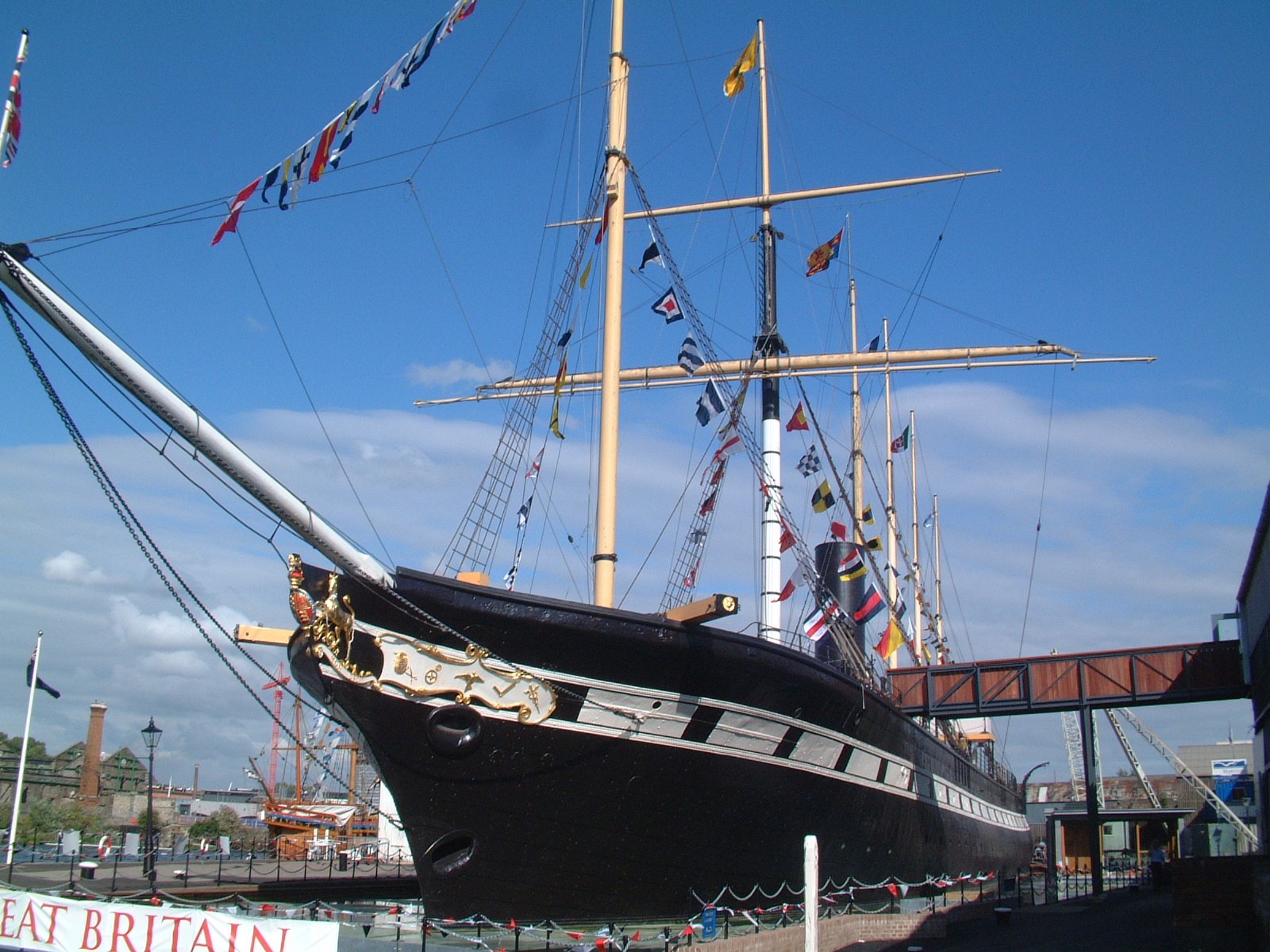
SS Great Britain is the oldest ship in this directory by more than seventy years and, by any measure, one of the most important ships ever built. Designed by Isambard Kingdom Brunel for the Great Western Steamship Company's transatlantic service between Bristol and New York, she was the first large ocean-going ship to combine an iron hull with screw propulsion — the two technologies on which every liner and cruise ship in this directory ultimately rests. When she crossed the Atlantic in 1845, in 14 days, she was the largest passenger ship in the world, a title she held until 1853.
Her working life lasted from 1845 to 1886 and took her from the North Atlantic to the Australian emigrant trade to a final career as a sailing ship; her afterlife lasted longer still — 47 years as a warehouse, quarantine ship and coal hulk in the Falkland Islands, scuttled in 1937, then an astonishing rescue in 1970, when she was towed home across the Atlantic to the very dry dock in Bristol where she had been built. She lies there today, a museum ship of the National Historic Fleet, visited by 150,000 to 200,000 people a year.
The dataset row is minimal — length, beam, builder, launch year, preserved status and location — because the roster from which it derives lists ocean liners, not measured cruise ships. The figures given in prose below are from her article, and the distinction is maintained throughout.
Key specifications
The dataset gives a length of 98.15 metres and a beam of 15.39 metres, builder William Patterson Shipbuilders of Bristol, and launch in 1843. Her article's fuller record: 322 feet (98 m) long, 50 ft 6 in (15.39 m) in beam, a displacement of 3,674 tons at load draught and 3,443 tons burthen, powered by two inclined twin-cylinder direct-acting steam engines — 88-inch bore, 6-foot stroke, about 500 hp at 18 rpm — driving a single screw, with auxiliary sail on six masts as completed. Her speed was 10 to 11 knots.
As completed she carried 360 passengers and a crew of about 120–130 across four decks, with cabins and dining and promenade saloons that set new standards of size at sea; after her Australian refit her capacity rose to 730. Cargo capacity was about 1,200 tons. These numbers look modest beside the cruise ships around her in this directory until they are set against her date: she was, in 1845, the biggest ship in the world by a wide margin, and her iron hull was the reason such size had become possible at all.
Design and construction
Great Britain began as a sister to the wooden paddle steamer Great Western of 1838 — she was even tentatively to be called City of New York — but Brunel and his collaborators, including the ship's builders William Patterson and the engine designer Francis Humphrys, converted the project first to iron construction and then, decisively, to screw propulsion, after trials of the screw steamer Archimedes demonstrated the propeller's superiority. The result was a ship built around a riveted iron hull — stronger, lighter, and divisible into watertight compartments — that no wooden shipbuilding tradition could have produced at this size.
She was laid down in July 1839 in a specially adapted dry dock at Bristol, and construction took six years, costs rising from a projected £70,000 to £117,000. The protracted build, and the difficulty of getting a vessel of her draught out of Bristol's floating harbour at all, strained her owners from the start — a pattern (technical triumph, commercial strain) that the rest of her career would repeat. She was not completed until 1845, two years after her launch.
Naming, launch and maiden voyage
She was launched on 19 July 1843, named Great Britain — a patriotic claim staked in iron. Her maiden voyage began on 26 July 1845, from Liverpool to New York, after the Bristol company found its home port impractical for a ship of her size; she made the crossing in 14 days, the first Atlantic crossing by an iron steamer, and the fastest of her era. The dataset leaves the maiden-voyage field blank; the documented date is given here from her article.
Career by operator
Her Great Western career was brief and unlucky. In September 1846 she ran aground at Dundrum Bay, County Down, through a navigation error, and lay there for nearly a year; the cost of refloating her broke the company, which was forced out of business. Sold for salvage in 1852 and repaired, she began the career for which thousands remembered her: emigrant voyages to Australia, from 1852, carrying thousands of settlers, a trade she worked for nearly thirty years. Converted to all-sail in 1881, she was damaged in a gale off Cape Horn in 1884 (some accounts date the final Falklands retirement from that damage; her article records retirement to the Falklands in 1884 after three years of sail service) and remained at Port Stanley as warehouse, quarantine ship and coal hulk until she was scuttled in 1937.
| Name | Operator | Period |
|---|---|---|
| Great Britain | Great Western Steamship Company | 1845–1852 (laid up after 1846 grounding; company defunct) |
| Great Britain | Gibbs, Bright & Co. and successors (Australian emigrant service) | 1852–1881 |
| Great Britain | (sailing cargo ship, then Falkland Islands hulk) | 1881–1937 |
Onboard character
Contemporary accounts stressed space and steadiness: an iron hull of unprecedented size allowed dining and promenade saloons on a scale wooden ships could not match, and her four decks separated first-class cabins, steerage emigrant accommodation and cargo with a formality that became the liner template. In her Australian years her character was the emigrant ship's — hundreds of settlers in communal berthing, a floating village on a two-month voyage — and the diaries of those voyages are now among the museum's richest sources. The ship visitors board today presents both worlds: the 1845 liner and the 1850s emigrant ship, restored within the same hull.
Major refits and incidents
The grounding at Dundrum Bay in 1846 is her defining incident: eleven months aground, protected by a breakwater built around her, refloated in 1847 at a cost that destroyed her owners — and, incidentally, the episode that completed Brunel's education in the economics of innovation. Her great refits were the 1852 repair and conversion for the Australian trade, which raised her capacity to 730; the 1853 alteration of her rig to three square-rigged masts; and the 1881 conversion to all-sail, engines removed, which extended her working life by three further years. A severe gale off Cape Horn in 1884 ended her seagoing life.
Sister ships and class
She had no sister; the projected companion was never built, and her owners did not survive to order one. Her predecessor and stablemate Great Western (1838), the wooden paddle steamer that proved the transatlantic steam service, is her true sibling in conception — and the contrast between them, wood and paddles against iron and screw, is the whole story of the 1840s revolution in shipbuilding, embodied in two ships of one company.
Fate and where she is now
Scuttled at Port Stanley in 1937, she was refloated in 1970 on a submersible pontoon, in a rescue funded by Sir Jack Hayward, and towed to Bristol — arriving, by design, on 19 July 1970, the anniversary of her launch. Restored in the Great Western Dockyard where she was built, she is now the centrepiece of Brunel's SS Great Britain, an award-winning museum and a listed member of the National Historic Fleet, her hull conserved in a dry dock whose glass "sea" and dehumidified environment are themselves landmarks of preservation engineering.
Visit her today
Great Britain lies in the dry dock where she was built, at Great Western Dockyard, Bristol, England — the dataset's preserved location, "Bristol, England, UK." Visitors descend beneath the glass plate that represents the sea to walk under her iron hull and view the conservation system, then board to explore the restored decks: the 1845 saloons, the emigrant steerage, the engine-room reconstruction and the dockyard museum, Brunel's Great Britain alongside the Being Brunel museum devoted to her designer. She receives between 150,000 and 200,000 visitors a year. Of every ship in this directory, she is the one whose visit needs no qualification: she is home, in her own dock, 180 years after she left it.
Sources: https://en.wikipedia.org/wiki/List_of_ocean_liners; https://en.wikipedia.org/wiki/SS_Great_Britain