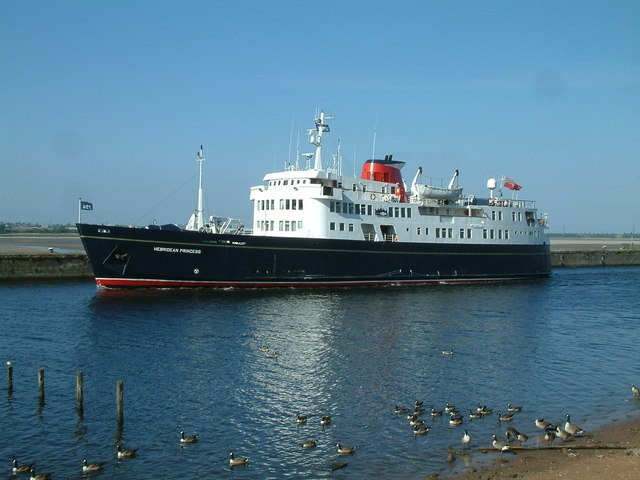
| IMO | 6409351 |
|---|---|
| Gross tonnage | 2,112 GT |
| Length | 71.63 m |
| Beam | 13.26 m |
| Passenger capacity (max) | 49 |
| Builder | Hall, Russell & Company |
| Hull number | 912 |
| Launched | 1964 |
| Maiden voyage | 1964-07-30 |
| Operator | Hebridean Island Cruises |
| Status | Active |
| All names | Hebridean Princess; Columba |
Overview
Hebridean Princess has spent her whole life in the waters she was built for, in two utterly different roles. Launched at Aberdeen in 1964 as Columba, she was a Scottish government car ferry and Royal Mail Ship, carrying up to 870 passengers and 50 cars among the Hebrides for 25 years. In 1989 she was rebuilt as a luxury cruise ship for just 49 guests and has cruised Scotland's west coast ever since — the only cruise ship to hold a Royal Warrant, and twice chartered by Queen Elizabeth II for private family holidays. The dataset's "launched 1989" dates the conversion, not the ship; she is a 1964 hull, and the correction is logged in the batch notes.
Key specifications
The dataset records 2,112 GT, 71.63 m length, 13.26 m beam and a maximum capacity of 49 — the ship's article rounds her dimensions to 72 m by 14 m, adds a draught of only about 3 m that lets her work shallow island anchorages, and a speed of 12 knots from her Crossley engines. Her two sets of numbers tell her story. As Columba she carried 600 passengers at first, raised to 870 in 1968 when buoyant seating was added on the after deck, plus 50 cars loaded by a forward hydraulic hoist, with sleeping berths for 51 below the car deck. As Hebridean Princess she carries 49 passengers with a crew of 38 — a near one-to-one ratio that is the essence of the product.
Design and construction
Columba was the last of three near-identical car ferries built in 1964 by Hall, Russell & Company of Aberdeen (yard number 912) for the Secretary of State for Scotland and chartered to David MacBrayne Ltd. They had a Cold War secret: the trio were equipped to serve as floating nuclear shelters — "Citadel ships" in the operator's managing director's words — with vertical sliding watertight doors that could seal off the car deck, immediately aft of the hoist. Her interiors, like her sisters', were designed by a young John McNeece, who went on to design cruise-ship interiors for forty years. She was a hoist-loading ship to the end of her ferry career — from 1985 the last dedicated hoist-loading vessel in service — a design already old-fashioned when she was young, and part of her charm now.
Naming, launch and maiden voyage
She was launched on 12 March 1964 by Lady Craigton and named Columba, for the sixth-century saint and an earlier famous Clyde steamer of the same name, initially styled RMS — Royal Mail Ship — Columba. She entered service on 30 July 1964, the date the dataset records as her maiden voyage, taking up the Isle of Mull service from Oban in place of the elderly Lochearn and Lochmor. The Hebridean Princess name arrived a quarter-century later, with the 1989 conversion; she began cruising under it on 26 May 1989.
Career by operator
| Period | Name | Operator |
|---|---|---|
| 1964–1973 | Columba | David MacBrayne Ltd |
| 1973–1989 | Columba | Caledonian MacBrayne |
| 1989–present | Hebridean Princess | Hebridean Island Cruises |
Behind the table: the Scottish Office owned her throughout the ferry years. Her Mull service ended in 1972 — she was the first vessel to make the once-controversial Sunday sailings — and she spent her later ferry years on Mallaig and relief work before returning to Oban routes. Bought in 1988 by the new Hebridean Island Cruises venture of Skipton, she has kept the same operator since; in June 2009 All Leisure Group bought the operating company, and the ship continued exactly as before.
Onboard character
The conversion at George Prior Engineering in Great Yarmouth in 1989 kept everything that made her a good Hebridean sea boat — small size, shallow draught, sturdy Aberdeen build — and replaced the ferry's function entirely. She initially kept a token car-carrying capability; within two years it was removed and the space became cabins, driving the crew-to-guest ratio up to luxury levels. The result is deliberately un-ship-like in the modern sense: a 49-guest vessel with the atmosphere of a country-house party rather than a cruise, sailing slowly among islands a large ship cannot reach. Sixty years on, her operator marks the point that she still sails the waters she was designed for.
Major refits and incidents
One refit defines her: the major 1989 Great Yarmouth rebuild from car ferry to cruise ship, followed within two years by the removal of the car deck and the addition of further cabins. Earlier, in ferry service, the 1968 addition of after-deck seating that raised her certificate from 600 to 870 passengers was her only significant alteration. No grounding, fire or collision of record appears in the sources consulted across either career — a clean sheet consistent with six decades of short, sheltered-water service.
Sister ships and class
Her sisters were the other two members of the 1964 Hall, Russell trio for the Secretary of State for Scotland: Hebrides and Clansman, near-identical hoist-loading car ferries chartered to MacBrayne. Columba outlived both in ferry service and is, in her operator's words, the only survivor of the three — the last of the Scottish government's 1964 ferry generation still at sea, and the only one to find a second career.
Fate and where she is now
Hebridean Princess is in active service with Hebridean Island Cruises, home port Oban, sixty years after her launch. Her distinctions are unusual ones: a Royal Warrant granted by Queen Elizabeth II in 2012 — unique for a cruise ship — and two royal charters, in July 2006 for the Queen's 80th birthday and again in July 2010. A working car ferry that became, by conversion and by patronage, one of the most storied small cruise ships in the world.
Sources: https://en.wikipedia.org/wiki/List_of_cruise_ships, https://en.wikipedia.org/wiki/MV_Hebridean_Princess, https://www.ukinbound.org/member-news/hebridean-princess-celebrates-60th-anniversary/