| Length | 163.3 m |
|---|---|
| Beam | 20.1 m |
| Passenger capacity (max) | 289 |
| Service speed | 18.5 knots |
| Builder | Yokohama Dock |
| Yard | Yokohama |
| Launched | 1929 |
| Maiden voyage | 1930-05-13 |
| Class | Hikawa Maru-class ocean liner |
| Operator | Nippon Yusen |
| Status | Preserved |
| Preserved at | Yokohama, Japan |
Overview
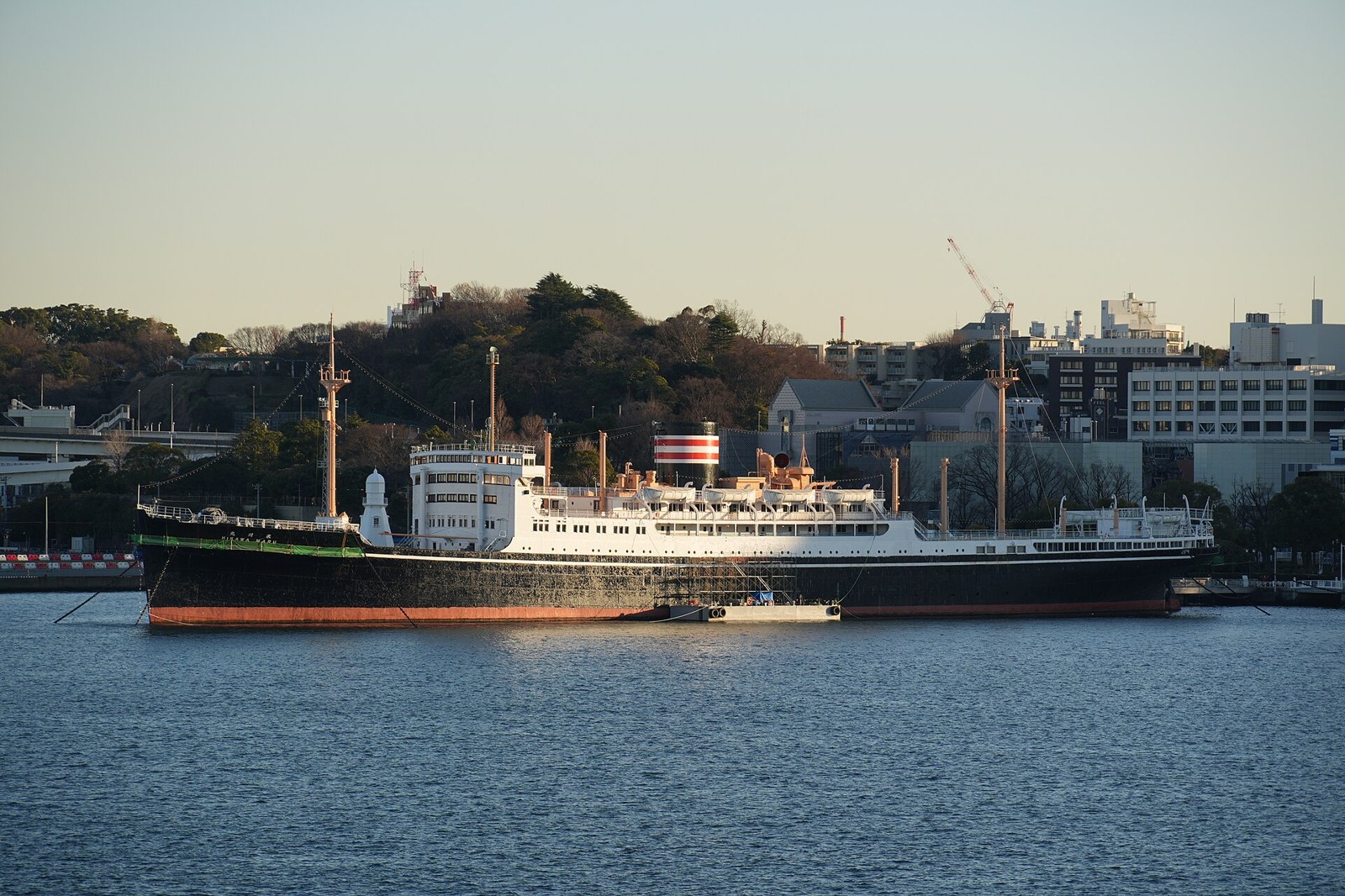
Hikawa Maru is a Japanese ocean liner of 1930, built at Yokohama for the NYK Line (Nippon Yusen), and one of the most historically layered hulls in this directory: trans-Pacific liner, refugee ship, wartime hospital ship, repatriation transport, cargo ship, liner again, and — since 1961 — a museum ship permanently berthed at Yamashita Park in Yokohama. Nicknamed "The Queen of the Pacific" for her food and her Art Deco interiors, she was one of only two large Japanese passenger ships to survive the Second World War, and she is described in museum and official accounts as the only surviving Japanese cargo-passenger liner built before that war. In 2016 she was designated an Important Cultural Property of Japan. Her dataset row is sparse — no IMO and no tonnage are recorded — so where this guide gives her registered figure of 11,622 GRT it follows her own article, and the GRT (gross register tons, the liner-era measure) should not be read as a modern GT figure.
Key specifications
Dataset figures: length 163.3 m, beam 20.1 m, speed 18.5 kn, maximum capacity 289, builder Yokohama Dock at Yokohama, launched 1929 and maiden voyage 13 May 1930. Her article gives the tonnage the dataset omits — 11,622 GRT — and a speed of 18.38 knots, consistent with the dataset's rounded figure. It also gives a passenger capacity of 331 in three classes — 75 first class, 70 tourist class and 186 third class — carried by a crew of 147; the dataset's 289 cannot be reconciled with that breakdown and is logged as a suspected dataset error in the batch notes. Propulsion was by Burmeister & Wain marine diesel engines driving twin screws — she was a motor ship, not a steamer, part of the diesel generation that was displacing steam in the liner trades by 1930. Her hull number at Yokohama Dock, 177, is given in her Wikimedia Commons vessel record rather than the dataset.
Design and construction
Hikawa Maru was laid down on 9 November 1928 at the Yokohama Dock Company and launched on 30 September 1929, completing in April 1930. She was one of three Hikawa Maru-class motor ships, all named for major Shinto shrines — hers for the Hikawa Shrine in Saitama. The class was built for NYK's Yokohama–Vancouver–Seattle service, carrying passengers in three classes together with cargo, the classic cargo-passenger liner arrangement of the interwar Pacific. Contemporary and later accounts stress the thickness of her steel plating, credited with her surviving three mine strikes as a hospital ship (section 7) with only minor damage — construction quality that is also a large part of why a 1930 hull still exists to be visited.
Naming, launch and maiden voyage
She was launched on 30 September 1929 and made her maiden voyage from Kobe to Seattle on 13 May 1930. The shrine naming placed her within NYK's "-Maru" convention, maru being the traditional suffix for Japanese merchant ships. Her public identity formed quickly: splendid food, beautiful Art Deco interiors and reliable service on the Seattle route earned her the "Queen of the Pacific" nickname that museum interpretation still uses. Notable early passengers mark her pre-war career — Charlie Chaplin travelled aboard during his 1932 round-the-world tour, and Kanō Jigorō, the founder of judo and Japan's member of the International Olympic Committee, died aboard in 1938 on his way home from Cairo.
Career by operator
| Period | Name / role | Operator |
|---|---|---|
| 1930–1941 | Hikawa Maru — ocean liner, Yokohama–Vancouver–Seattle | NYK Line |
| 1941–1945 | Hikawa Maru — hospital ship | Imperial Japanese Navy |
| 1945–1947 | Hikawa Maru (SCAJAP number H-022) — repatriation transport | SCAJAP (US occupation shipping authority) |
| 1947–1953 | Hikawa Maru — cargo ship | NYK Line |
| 1953–1960 | Hikawa Maru — ocean liner, Yokohama–Seattle | NYK Line |
| 1961–present | Hikawa Maru — museum ship, Yokohama | Museum operators; NYK Line from 2006 restoration |
The pre-war decade also carries a humanitarian chapter: in 1940–41, hundreds of Jewish refugees fleeing Nazi persecution reached Canada and the United States via Japan, many sailing on Hikawa Maru — including a party of 82 German and Lithuanian Jews who reached Seattle in August 1940, and Rabbi Zerach Warhaftig and his family, who left Yokohama aboard her on 5 June 1941 and landed at Vancouver on 17 June. In October 1941 she became the last NYK ship to visit a US port before the Pacific War. Her post-war totals summarise the working life: 238 peacetime voyages and 25,000 passengers on the Seattle route across 1930–41 and 1953–60 (some museum accounts give 254 Pacific crossings in all), before NYK decommissioned her on 21 December 1960 as air travel took the route's traffic.
Onboard character
What survives of her character is the point of the ship: first-class public rooms and cabins in full Art Deco dress — the style that, with her cuisine, made her reputation — set within the disciplined three-class layout of a working cargo-passenger liner. First class numbered just 75 berths; the ship's social world was correspondingly intimate, more North Pacific mail liner than floating resort. The restored interiors, wheelhouse and engine spaces now on view are significant precisely because so little pre-war Japanese liner fabric survives anywhere: her two sisters were both lost in the war, and the rest of NYK's great pre-war passenger fleet with them.
Major refits and incidents
Her refits were changes of life: conversion to a hospital ship at Mitsubishi's Yokohama yard between 1 and 21 December 1941, a week before Pearl Harbor; the post-war cargo years; and the 1953 refit that restored her as a liner. As a hospital ship she treated casualties from the February 1942 attacks on Kwajalein and Wotje and received some 500 wounded from the Battle of Midway in June 1942. Three times she survived mines: entering Surabaya on 3 October 1942, off the Caroline Islands on 15 July 1944, and leaving Singapore on 17 February 1945, each time repaired and returned to service. After Japan's surrender she was one of only two surviving large Japanese passenger ships, and as SCAJAP ship H-022 she repatriated thousands of Japanese soldiers and civilians until August 1946.
Sister ships and class
The Hikawa Maru class comprised three motor ships named for shrines: Hikawa Maru, Heian Maru and Hie Maru. Both sisters were converted to submarine depot ships during the war and were sunk — Hie Maru in 1943 and Heian Maru in 1944 — leaving Hikawa Maru the sole survivor of her class and, in the usual description, of her whole generation of Japanese liners.
Fate and where she is now
Retirement made her, rather than ending her. Permanently berthed at Yamashita Park, Naka-ku, Yokohama, in 1961 as a floating museum, hotel and restaurant, she served for decades as a youth hostel and maritime museum; the hotel closed in 1973 but the museum continued. In 2005 her owners, citing heavy losses, sought to sell her, and in December 2006 the museum closed with her future in doubt. NYK Line stepped back in, funded a restoration beginning in August 2007, and she reopened to the public on 25 April 2008 as NYK Hikawamaru — the name on her hull unchanged. On 17 August 2016 she was designated an Important Cultural Property of Japan, the first transoceanic liner so recognised.
Visit her today
Hikawa Maru is permanently moored at Yamashita Park in Naka-ku, Yokohama, in front of the park on the Yokohama waterfront, and is operated as a museum ship in association with the NYK Maritime Museum. The visit is a self-guided route through the ship: restored first-class cabins and public rooms with their Art Deco interiors, the dining saloon and lounges, crew and passenger spaces, the wheelhouse and bridge, and the engine room, together with exhibition spaces tracing her liner, hospital-ship and refugee voyages and the history of NYK. She is presented as a cultural property rather than an attraction ride — the appeal is the survival of the thing itself, a complete pre-war liner you can walk through, in the port she was built in. Check the official NYK Hikawa Maru museum pages for current opening arrangements before visiting; prices and hours are deliberately not stated here because they change.
Sources: https://en.wikipedia.org/wiki/List_of_ocean_liners, https://en.wikipedia.org/wiki/Hikawa_Maru