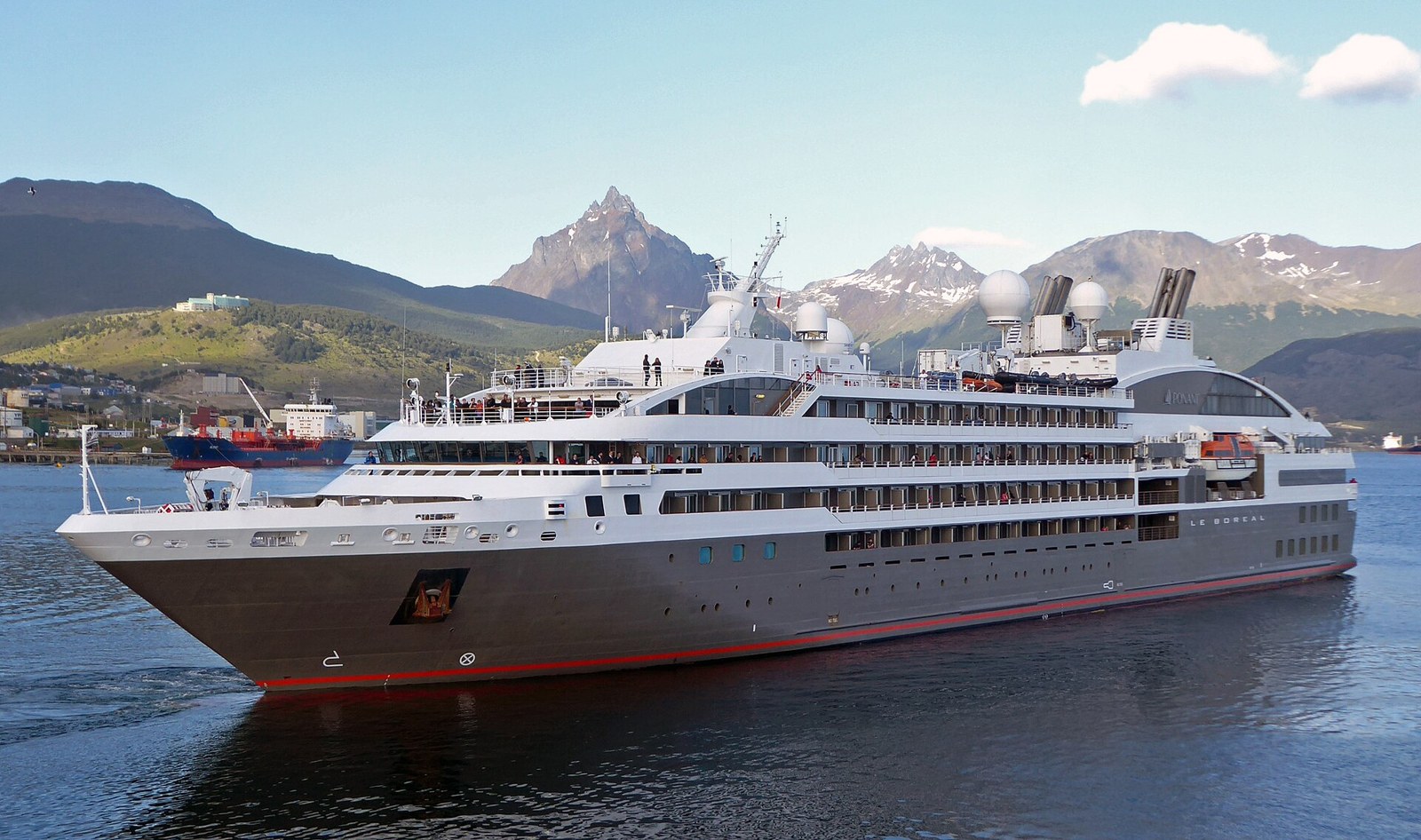
| IMO | 9502506 |
|---|---|
| Gross tonnage | 10,944 GT |
| Length | 142.1 m |
| Beam | 18 m |
| Passenger capacity (double) | 208 |
| Passenger capacity (max) | 264 |
| Crew | 136 |
| Builder | Fincantieri |
| Yard | Ancona |
| Hull number | 6192 |
| Launched | 2009 |
| Operator | Ponant Cruises |
| Status | Active |
Overview
Le Boréal is the lead ship of the French line Ponant's Boreal series — four near-identical, yacht-scaled luxury expedition ships built by Fincantieri at Ancona, Italy. Entered into service on 6 May 2010, she was conceived as a large private yacht that happens to sell cabins: 132 of them, for a maximum of 264 passengers, almost all with balconies, on a hull small and shallow enough to reach ports and anchorages closed to conventional cruise ships. She is best known outside cruising for the serious engine-room fire of November 2015 that forced the evacuation of everyone aboard near the Falkland Islands — an accident she survived, was repaired from, and returned to service after. The dataset row for this hull is unusually thin — no IMO, dimensions or tonnage — so the researched figures in this guide are given in the text, with sources, rather than in the spec box.
Key specifications
From her own article and builder-era reporting: IMO 9502506, 10,944 GT, 142.1 m in length, 18 m beam and a draught of just 4.8 m. She carries 264 passengers in 132 cabins and suites — all ocean-view, 94 percent with a private balcony — and a crew of 136. Her machinery is diesel-electric, with a service speed around 16 knots. The figures that matter most to her role are the small ones: at under 11,000 GT and under 5 m draught, she was designed to go where the mainstream fleet cannot, while dynamic positioning lets her hold station without anchoring on sensitive seabeds.
Design and construction
Ponant ordered the series from Fincantieri as its move from sailing ships and small vessels into purpose-built luxury expedition cruising. The design — interiors by the French designer Jean-Philippe Nuel — pursued a mega-yacht aesthetic: sleek, arched-window styling, muted contemporary interiors, and public spaces scaled to 264 guests rather than thousands. Environmental technology was a headline of the design brief, unusual for 2010: dynamic positioning to avoid anchor damage, advanced wastewater treatment, diesel-electric propulsion using low-sulphur fuel with catalytic emission reduction, and waste and smoke management systems intended to suit polar and protected-area operation. She was laid down at Ancona on 22 April 2009 and built as yard number 6192.
Naming, launch and maiden voyage
Fincantieri launched Le Boréal at Ancona in October 2009 — the dataset's "launched 2010" is her service-entry year, corrected and logged — with Véronique Saadé as godmother, in a ceremony attended by the ship's future captain, Jean Philippe Lemaire. Her name, "the northern one," set the series' compass-point naming pattern, followed by L'Austral (the southern) and their sisters. She was completed on 27 April 2010 and entered service on 6 May 2010 with a first cruise from Marseille, Ponant's home port. The industry noticed: she won the European Cruiser Association's "Best Newcomer of the Year" gold award for 2010. She is French-flagged, registered at Mata Utu in Wallis and Futuna.
Career by operator
| Period | Name | Operator |
|---|---|---|
| 2010–present | Le Boréal | Compagnie du Ponant (Ponant Cruises) |
A single-operator career: Ponant has owned and operated her since delivery, deploying the Boreal-series ships across the expedition map — polar regions in their seasons, and the Mediterranean, the Americas and Asia-Pacific in between — without any change of name or flag.
Onboard character
Her character is the point of the series: intimacy engineered at the design stage. With 264 guests and 136 crew, a ratio near one crew member to two guests, and interiors by a hotel designer rather than a ship outfitter, Le Boréal was meant to read as a private yacht with a cruise programme attached. The all-outside, nearly all-balcony accommodation, the shallow draught and the expedition equipment — including the Zodiac landing craft that are the working tools of polar cruising — define her as clearly as her styling. She helped establish the template that the later Ponant generations, and much of the luxury expedition market, followed.
Major refits and incidents
On the night of 17–18 November 2015, three days into an Antarctic cruise from Ushuaia, an engine-room fire broke out near Cape Dolphin, at the northern point of East Falkland. The official French investigation by BEAmer, published in July 2016, found that a clogged fuel filter on one diesel generator prompted a change-over; the officer then mistakenly opened a filter housing on a different, still-pressurised generator, and sprayed fuel onto a hot turbocharger. The water-mist system triggered but could not stop the fire spreading along cable runs; all power was lost and the ship drifted. The captain ordered abandonment: all 347 people aboard — 187 passengers and 160 crew — were evacuated, 90 of them airlifted from life rafts by RAF helicopters, the rest taken off by her sister L'Austral and other vessels, with HMS Clyde and British Forces South Atlantic Islands assisting. There were no injuries. The burned-out ship was towed to Punta Arenas, loaded onto the heavy-lift vessel Kang Sheng Kou in January 2016, and carried to Genoa, where Fincantieri repaired her over about twelve weeks. She returned to service in May 2016. Ponant changed its rules afterwards: no lone night work on fuel lines, and tighter control of engineering tasks, both on the investigators' recommendations.
Sister ships and class
Le Boréal is the lead ship of the Boreal series: L'Austral (2011), Le Soléal (2013) and Le Lyrial (2015) followed her from Fincantieri's Ancona yard to near-identical designs — L'Austral close enough, and close at hand, to take off her passengers in 2015. The series made Ponant a purpose-built expedition operator and was followed by the larger Explorer class later in the decade.
Fate and where she is now
Le Boréal is in active service with Ponant, repaired, re-certified and back in the expedition trade she was built for. Her fire is the defining event of her career to date — and, in the completeness of the evacuation and the investigation that followed, a case study in how a small ship survives a worst-case night.
Sources: https://en.wikipedia.org/wiki/List_of_cruise_ships, https://en.wikipedia.org/wiki/Le_Boreal, https://www.marinelog.com/legal/safety-and-security/clogged-fuel-filter-and-human-error-led-to-cruise-ship-fire/, https://www.seatrade-cruise.com/ports-destinations/ponant-s-fire-damaged-le-bor-al-to-be-repaired-by-fincantieri-in-genoa-port