| Launched | 2000 |
|---|---|
| Operator | Magna Carta Steamship Company Ltd |
| Status | Active |
Overview
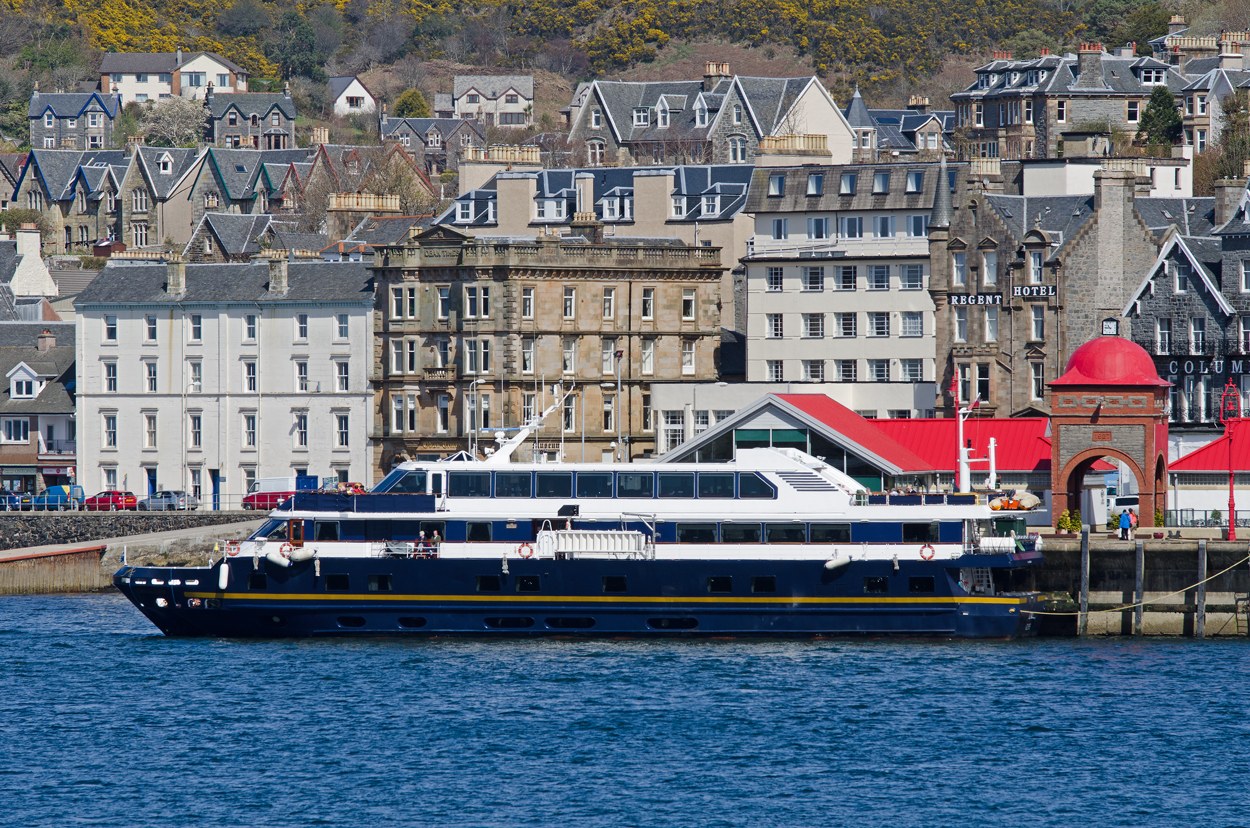
Lord of the Glens is the small ship built — or rather rebuilt — for one specific piece of water: Scotland's Caledonian Canal. Just under 50 m long and carrying about 50 guests, she threads the 29 locks of the canal between Inverness and Fort William, sails Loch Ness, and continues out into the sea lochs and islands of Scotland's west coast — a combined canal-and-coastal programme no other vessel offers in quite this form. Her dataset entry records her ambiguity honestly: she mixes canal cruising with open-water Scottish coastal legs, which is why she is kept in this ocean-and-coastal directory rather than classed as a river ship. She began life in 1985 as a Greek ferry named Victoria, and was so radically reconstructed in 1999–2000 that almost nothing but her keel and main engines survived into the Scottish ship.
Key specifications
The dataset row carries no IMO, tonnage or dimensions — only her operator, her 2000 launch year and her canal-and-coastal programme. The figures carried by her operator material and ship databases are: IMO 8966470; 729 GT; about 46 m long with a beam of about 10 m (some operator literature rounds her to 150 feet); four decks; 25–27 cabins for roughly 48–54 guests, with about 20 crew. The critical dimensions are the ones the Caledonian Canal dictates: she was rebuilt to fit its locks with, in her designer's words, only inches to spare, and her shallow draught — reported at about 3.7 m — serves both the canal and small west-coast harbours. Her dataset launch year of 2000 is her relaunch year as Lord of the Glens; the hull itself dates from 1985.
Design and construction
She was built in Greece in 1985 — one source names the Psarros yard at Perama — as the small ferry Victoria, working in the Aegean. The Magna Carta Steamship Company bought her for conversion, and the Spanish naval architects Oliver Design carried out the rebuild. Their account of the project is unusually candid: the stripping-out revealed so much deterioration that in the end only the keel and the two main engines of the Greek ferry remained. Rebuilding her wholly in steel, they lengthened her by about 23 feet with a new section forward of the engine space and widened her with all-round sponsons forming a stabilising skirt — while keeping her slim enough for the Caledonian Canal's locks. When she was tried at Fort William in August 2000 she fitted, by inches. The interiors were designed in homage to the royal-yacht tradition: polished wood, teak decks, and decks named for famous Scots.
Naming, launch and maiden voyage
As Victoria she was a working Aegean ferry from 1985; a late-1990s rename to Victoria II (the name is also rendered Victoria 2) preceded the Scottish sale. The name Lord of the Glens was chosen for her new role, evoking the Great Glen — the geological fault valley the Caledonian Canal follows through Lochs Lochy, Oich and Ness. She entered Scottish service in 2000 after the rebuild, under the Magna Carta Steamship Company, founded the year before to operate her. There is no record in the sources used of a formal naming ceremony; small-ship relaunches of this kind were commercial rather than ceremonial events.
Career by operator
| Years | Name | Operator |
|---|---|---|
| 1985–1999 | Victoria (later Victoria II) | Greek ferry operators, Aegean service |
| 2000–2020 | Lord of the Glens | Magna Carta Steamship Company Ltd |
| 2020– | Lord of the Glens | HP Shipping Ltd, operated by Hebridean Island Cruises |
The dataset names the Magna Carta Steamship Company as her operator, which was correct for her first two Scottish decades: Magna Carta ran her on five- and seven-night cruises between Inverness, Fort William, Oban and Kyle of Lochalsh, mixing the canal transit with the Inner Hebrides — Mull, Iona and Skye among them — and she was also chartered seasonally to Lindblad Expeditions for its National Geographic-associated Scottish programmes. In August 2020 she was bought by HP Shipping Ltd, owner of the celebrated Hebridean Princess, and passed to HP's brand Hebridean Island Cruises, under which she continues the same canal-and-coast programme. The dataset's operator entry is therefore one ownership out of date, as logged in the batch notes.
Onboard character
Her character is deliberately anachronistic: a floating country-house hotel in polished wood, with 25 or so outside cabins, a single restaurant serving locally sourced Scottish produce, and the Sir Walter Scott lounge and bar on the upper deck wrapped in panoramic windows for the passing Highland scenery. With around 50 guests, no elevator and decks named for Scots worthies, the emphasis — in the operator's own phrasing — is not on speed but on style. She was designed, her literature says, in homage to the grand old Royal Yacht Britannia, and the resemblance is in manner rather than scale: formal service, a captain's dinner culture, and scenery as the entertainment.
Major refits and incidents
The 1999–2000 Oliver Design reconstruction was a refit so extensive it amounted to a new ship on an old keel, as described above. Oliver Design also carried out a rehabilitation and upgrade of the ship in 2015. No casualty or major incident is recorded for the hull in the sources used for this guide.
Sister ships and class
She has no true sister, but she acquired a consort: Magna Carta followed her success with Lord of the Highlands, a second small ship converted — by the same designers, from another former ferry — for the same Scottish programme, entering service in 2019. The pair, with HP Shipping's Hebridean Princess, form the little fleet of British-flagged small ships working the Highlands and Islands.
Fate and where she is now
She is active, British-flagged, and still working the programme she was rebuilt for: Caledonian Canal transits between Inverness and Fort William combined with west-coast and Hebridean coastal cruising, now under Hebridean Island Cruises ownership. A ship that exists because of one canal's lock dimensions, she remains — uniquely — both a canal boat and a sea-going coastal cruiser, which is precisely the scope judgement the dataset records for her.
Sources: https://en.wikipedia.org/wiki/List_of_cruise_ships; https://www.cruisemapper.com/ships/Lord-of-the-Glens-871; https://oliverdesign.es/en/portfolio/glens/; https://cdn.expeditions.com/about/fleet/lord-of-the-glens