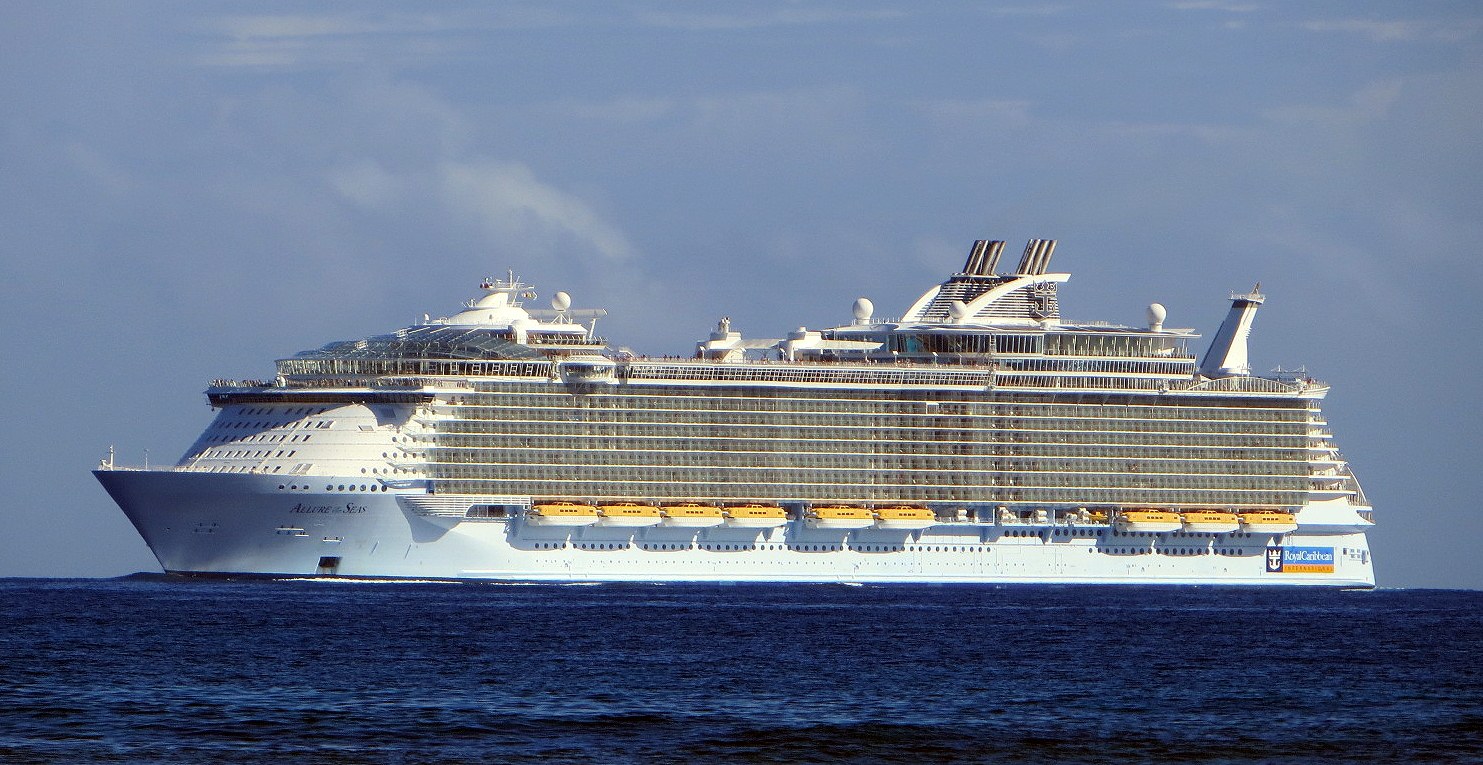
| IMO | 9383948 |
|---|---|
| Gross tonnage | 225,282 GT |
| Length | 361.6 m |
| Beam | 47.0 m |
| Passenger capacity (max) | 6780 |
| Service speed | 22.0 knots |
| Builder | STX Finland |
| Yard | Perno shipyard |
| Launched | 2010 |
| Maiden voyage | 2010 |
| Class | Oasis-class cruise ship |
| Operator | Royal Caribbean International |
| Status | Active |
Overview
Allure of the Seas is the second ship of Royal Caribbean International's Oasis class and was, on her launch, the largest passenger ship in the world. Built at Turku, Finland, and delivered in October 2010, she took the size record from her sister Oasis of the Seas by the narrowest of margins — she is about 50 millimetres longer than her sister, although both were built to the same specification. Together the two ships changed the physical ceiling of the cruise industry: at 225,282 GT, an Oasis-class ship was roughly five times the tonnage of the large liners of the 1960s and carried more people than many towns. Allure remains one of the defining hulls of the megaship era, and her career has been spent entirely with the line that conceived her.
Key specifications
The dataset records 225,282 GT, a capacity maximum of 6,780, a speed of 22.0 knots, builder STX Finland at the Perno shipyard, Turku, and launch and maiden voyage both in 2010. Two dataset figures need explicit caution. The listed length of 330.65 m conflicts with published overall lengths of about 361–362 m for this ship; and the listed beam of 47.0 m appears to be a waterline or moulded figure rather than the ship's maximum breadth across the bridge wings. Published sources give a double-occupancy capacity of about 5,484 within the 6,780 maximum, and a crew of roughly 2,200. Tonnage is GT, a volumetric measure. Even allowing for those cautions, the headline fact stands: on delivery she was the largest cruise ship afloat by gross tonnage.
Design and construction
The ship was designed under the name Project Genesis and ordered in February 2006 from Aker Finnyards; construction began at the Perno yard, Turku, in February 2008, by which time the yard had passed to STX Europe. Her keel was laid on 2 December 2008, and she was launched on 20 November 2009, becoming the world's largest passenger ship at her launch. The Oasis design's defining move was to split the superstructure into two separate blocks, fore and aft, creating an open-air canyon down the ship's centre — the space that holds the Boardwalk and the plant-filled Central Park neighbourhoods. She is propelled by three Azipod units and fitted with telescoping funnels so that she can pass under fixed bridges; her delivery voyage required her to pass under Denmark's Storebælt (Great Belt) Bridge, an operation planned around clearance and the squat effect of a large hull moving at speed in shallow water. She was declared complete and delivered on 28 October 2010 and left Turku the following day.
Naming, launch and maiden voyage
The names Oasis of the Seas and Allure of the Seas were chosen in May 2008 following a naming contest held by the line. Allure was formally named at her homeport on 28 November 2010 by an unusual godmother: Princess Fiona, the fictional character from the Shrek films, reflecting Royal Caribbean's entertainment partnership of that era. The dataset records her maiden voyage simply as 2010; her first passenger sailing followed the naming ceremony at the end of November 2010. Her arrival at Port Everglades, Florida, on 11 November 2010 drew thousands of spectators, an early sign that the Oasis ships were public spectacles as much as transport.
Career by operator
Allure of the Seas has carried one name for one operator throughout her career.
| Name | Operator | Period |
|---|---|---|
| Allure of the Seas | Royal Caribbean International | 2010–present |
The dataset's operator history is a single line, and her service pattern has been the standard Oasis-class pattern of high-capacity warm-water cruising, with a Mediterranean season in 2015 that required the class's size to be accepted by European ports, and a return to European deployment after her 2025 revitalisation. Like the rest of the world fleet, she was laid up during the 2020–21 pandemic suspension and returned to service as cruising resumed. No sale, transfer or renaming has ever been reported for this hull — unsurprising, since ships of this size can only be operated by a handful of companies, and Royal Caribbean built its large-ship strategy around the class.
Onboard character
The Oasis class introduced the "neighbourhood" as an organising principle: the ship is divided into seven distinct districts, including Central Park, an open-air garden planted with living trees and plants in the split-superstructure canyon; the Boardwalk, a carnival-style open-air arcade at the stern; and the Royal Promenade, an internal shopping and social street. Other era-defining features included an ice-skating rink carried over from the Voyager class, a two-deck dance hall, and the AquaTheater at the stern, an outdoor performance pool overlooked by the Boardwalk. Interior decoration included extensive mural work by artist Clarissa Parish, and a small solar array powered the shopping district's lighting — a minor technical detail that was widely publicised at launch. This is the design vocabulary that every subsequent Royal Caribbean class, up to the Icon class, has inherited; the guide deliberately does not reproduce her current venue list.
Major refits and incidents
Her most unusual maintenance event came in February 2014, when she entered dry dock at Grand Bahama for seven days to replace a damaged gearbox in one of her Azipods. No dry dock then in the region could fully accommodate an Oasis-class ship in the normal way, and the work required a bespoke solution the yard called "Project Atlantis," with the ship partially supported so the pod could be serviced. Her Royal Amplification refit, planned for 2020, was postponed by the pandemic and was finally carried out in early 2025 at Cádiz, Spain, at a reported cost of over US$100 million, adding the class's later attractions including the Ultimate Abyss slide and new pool-deck spaces; her departure from the yard was briefly delayed when technicians found several Azipod propellers in poor condition and replaced them before she returned to service. In 2026 a propulsion problem forced a reduced-speed sailing and a port substitution, reported at the time by cruise trade media. No fire, grounding or casualty of structural significance is recorded for the ship.
Sister ships and class
The Oasis class began with Oasis of the Seas (2009) and Allure of the Seas (2010), both built at Turku. The class was later revived with larger derivatives built in France: Harmony of the Seas (2016), which took the world size record from Allure, Symphony of the Seas (2018), Wonder of the Seas (2022) and Utopia of the Seas (2024). Allure is thus the second of six sisters and the last of the original Finnish-built pair. All share the split superstructure, the neighbourhood layout and Azipod propulsion; the later ships are slightly larger, but the 2009–10 pair established the template and, between them, held the title of world's largest passenger ship for the first half of the 2010s.
Fate and where she is now
The dataset records her as active and operating for Royal Caribbean International, and her 2025 revitalisation — a nine-figure investment in a fifteen-year-old hull — is the clearest evidence of her operator's long-term intent. She is a mid-career megaship in her original owner's hands, with no sale or withdrawal reported. Her permanent place in the record is already secure: she was the ship that proved the Oasis concept was a class and not a one-off, and the 50-millimetre margin by which she exceeded her sister remains one of the most quoted statistics in modern shipbuilding.
Sources: https://en.wikipedia.org/wiki/List_of_cruise_ships, https://en.wikipedia.org/wiki/Allure_of_the_Seas, https://www.royalcaribbeanblog.com/2025/04/09/royal-caribbean-ship-propulsion-problem-delay