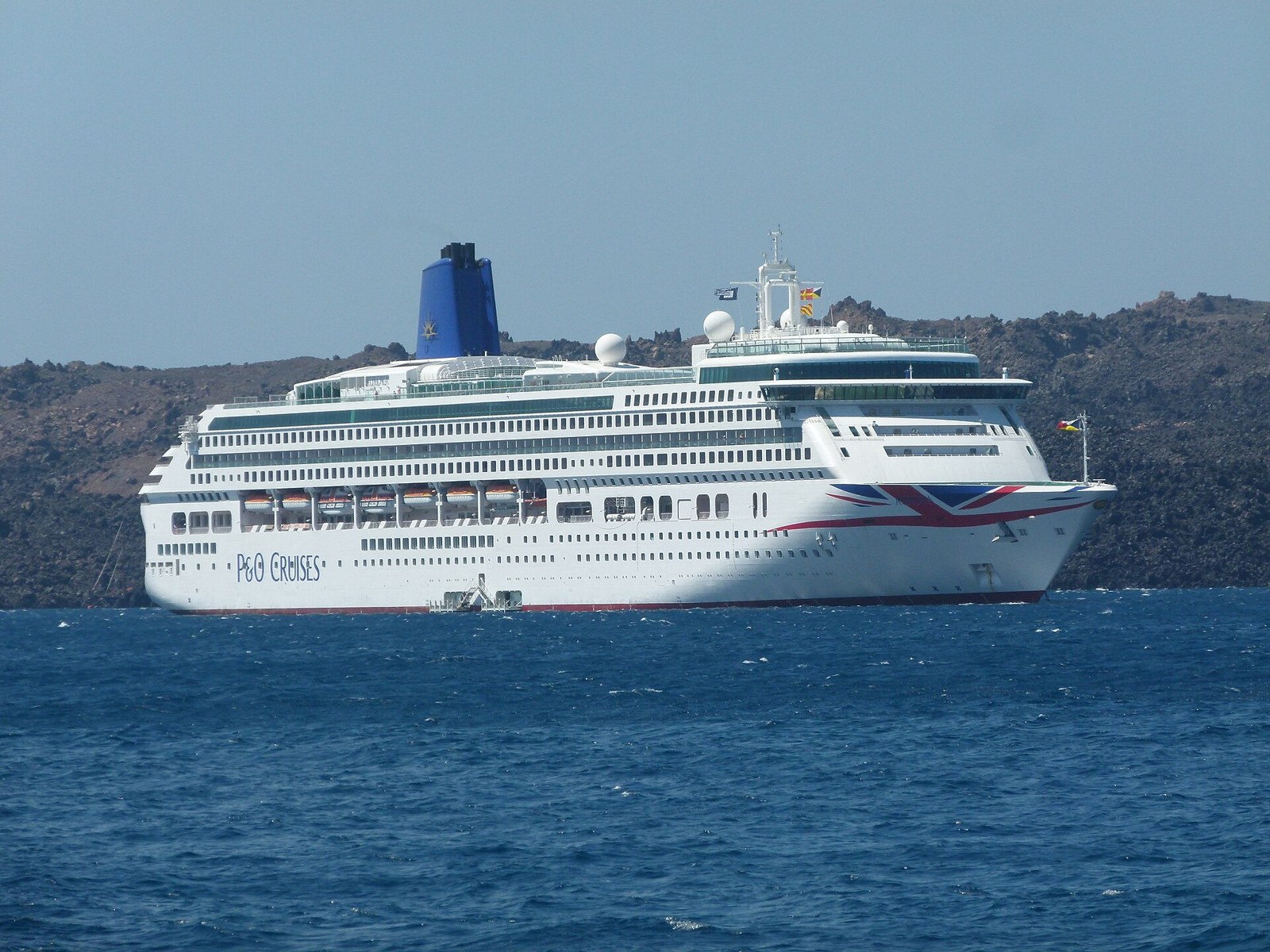
| IMO | 9169524 |
|---|---|
| Gross tonnage | 76,152 GT |
| Length | 270 m |
| Beam | 32.2 m |
| Passenger capacity (double) | 1878 |
| Passenger capacity (max) | 1950 |
| Crew | 936 |
| Service speed | 24 knots |
| Builder | Meyer Werft |
| Hull number | 640 |
| Launched | 2000 |
| Maiden voyage | 2000 |
| Operator | P&O Cruises |
| Status | Active |
Overview
Aurora is a P&O Cruises ship built by Meyer Werft at Papenburg and entered service in 2000 as the line's flagship for the British market — an enlarged, refined successor to the much-loved Oriana of 1995. She is famous, unfairly but permanently, for her christening: on 27 April 2000 the Princess Royal named her at Southampton and the champagne bottle failed to break, falling unopened into the sea, an omen seafarers dread. Her maiden voyage then had to be abandoned after 16 hours with a failed propeller-shaft bearing. Few modern ships have started worse; few have recovered better. Aurora went on to become one of P&O's most durable and affectionately regarded ships, the last of the line's German-built, liner-styled generation, and — with Arcadia — one of its two adults-only vessels. She remains, in the dataset and in her article, in service: the oldest ship in the current P&O fleet.
Key specifications
The dataset records 76,152 GT, a length of 271.0 m, a beam of 32.2 m, a maximum capacity of 2,865, Meyer Werft hull 640, and IMO 9169524, with no speed figure. Her article confirms the tonnage — sometimes labelled GRT in older sources, the same 76,152 figure — the beam, the hull number and the IMO, and gives an overall length of 270.0 m rather than the dataset's 271.0 m, a minor difference most likely of measurement basis. Its capacity figures, however, contradict the dataset outright: 1,878 passengers regular and 1,950 maximum, in 939 cabins, with a crew of about 850. Her article also supplies the speed the dataset omits: a service speed of 24 knots, with 29 knots reached on trials, from four MAN B&W 14V48/60 diesels totalling about 58,800 kW in a diesel-electric plant. She has a draught of about 7.9–8.95 m depending on the source table. Tonnage is treated here as GT.
Design and construction
Aurora was designed for one market with unusual single-mindedness. P&O wanted a British ship: traditional in feel, liner-like in profile, and able to undertake long voyages including world cruises. She was built as an extended and improved version of Oriana — similar in outward concept, including the raked, tiered stern that deliberately recalls classic liners, but larger and substantially different inside, with an enclosed centre swimming pool under a sliding cover, a feature her extra tonnage over Oriana partly reflects. Her keel was laid at Papenburg on 15 December 1998. P&O Princess would have preferred a British yard, her article notes, but no British yard remained large enough for the order — a small, telling fact about British shipbuilding in 1998. She left the yard on 19 February 2000 after her January launch, and was delivered in April 2000 at a cost reported as $375 million.
Naming, launch and maiden voyage
She was launched on 18 January 2000 and christened at Southampton on 27 April 2000 by the Princess Royal, Princess Anne. The unbroken bottle — swinging, striking, and dropping whole into the Solent — was widely reported and has been attached to the ship's story ever since, blamed in retelling for every early setback. Her maiden voyage began on 1 May 2000, a 14-night Mediterranean cruise. Sixteen hours out, the crew identified a major technical problem: a propeller-shaft bearing damaged by overheating. The cruise was abandoned, the ship returned to Southampton by 3 May, and passengers disembarked to a full refund and compensation package reported at about £6 million. Aurora sailed to Blohm + Voss in Germany for repairs and returned to service on 15 May 2000 for her second scheduled cruise, to the Canary Islands — which she completed without incident, beginning the long process of outliving her omen.
Career by operator
Aurora has had a single name and a single operator throughout her career.
| Name | Operator | Period |
|---|---|---|
| Aurora | P&O Cruises | 2000–present |
Her registration moved, from London (2000–2007) to Hamilton, Bermuda (from 2007), in line with the rest of the P&O fleet, but her ownership and operation did not change. Within that single-operator career she has been used as a traditional British cruise ship in the fullest sense: seasonal programmes from Southampton and, repeatedly, the line's long winter world voyages, work for which her size, speed and seakeeping were designed. She is described in her article as the half-sister and running mate of Oriana until that ship's retirement in 2019 left Aurora as the last of P&O's 1990s-generation flagships. Since then she has traded as the fleet's veteran — the ship for loyal, repeat British passengers who prefer her scale to the 184,000 GT Excel-class ships that now head the fleet list.
Onboard character
Her onboard character is the late-1990s British flagship formula, preserved by loyalty as much as by design: a tiered, liner-style stern; a central pool that can be enclosed against northern weather; a proper promenade tradition; and a spread of lounges, bars and dining rooms scaled for under 2,000 guests, including — in her later years — speciality dining of the kind P&O developed across the fleet, such as the Indian restaurant Sindhu in partnership with chef Atul Kochhar, noted in profiles of the ship. The design intent, stated in her article, was to appeal to the British market with features similar to traditional ocean liners, modernised: where Oriana had proved the concept in 1995, Aurora enlarged and improved it. Her 2014 refit gave her a place in fleet history of its own: she was the first P&O ship to receive the line's updated Union Flag bow design and a blue, rather than buff, funnel — the livery change that re-branded the whole fleet's look, applied first to its oldest flagship.
Major refits and incidents
The refit on record in detail is that of 2014, described above: livery apart, it was a general modernisation of a fourteen-year-old ship, and it fixed her role for her third decade. Her incident history is dominated by her beginning — the failed christening bottle of 27 April 2000 and the abandoned maiden voyage of 1–3 May 2000, both covered in the naming section — which her article explicitly connects, noting that the unbroken bottle "has been blamed for the numerous setbacks that Aurora has encountered throughout her career." That framing is folklore rather than engineering, and this guide records it as the ship's legend, not as causation. No major casualty in her later, long career is recorded in the sources used for this guide, and none is invented here; a ship whose worst documented chapter remains her first fortnight has, by any measure, beaten her omen.
Sister ships and class
Aurora has no true sister. She is best understood as a half-sister to Oriana (1995), also built by Meyer Werft for P&O: externally similar in concept, larger in tonnage, and different in internal arrangement, as her article puts it. The dataset records no class for her, which is correct — she was a bespoke, single-ship development of the Oriana design rather than a series build. Her real peer group is the small set of purpose-built British-market flagships of the 1990s — Oriana, Aurora, and Cunard's contemporaries — built in Germany because British yards could no longer take them, and designed with liner styling at a moment when the wider industry was moving to slab-sided balcony blocks. Oriana's withdrawal in 2019 left Aurora as the sole survivor of that pair in P&O service.
Fate and where she is now
The dataset records her as active, fate "Operating," and her article confirms her in service with P&O Cruises, registered at Hamilton, Bermuda. She is the oldest and, after Arcadia, one of the two smallest ships in the fleet she once headed — a complete inversion of her position in 2000, when she was P&O's largest ship. No sale, transfer or retirement date is on record in the sources used. Her significance is already settled: the last liner-styled, German-built flagship of P&O's independent generation, the ship that carried the fleet's new livery first in 2014, and the most famous unbroken christening bottle in modern cruising — an omen she has now spent more than twenty-five years disproving.
Sources: https://en.wikipedia.org/wiki/List_of_cruise_ships, https://en.wikipedia.org/wiki/MV_Aurora_(2000)