| IMO | 8806204 |
|---|---|
| Gross tonnage | 50,142 GT |
| Length | 240.96 m |
| Beam | 29.6 m |
| Passenger capacity (max) | 960 |
| Service speed | 21.0 knots |
| Builder | Mitsubishi Heavy Industries Nagasaki Shipyard & Machinery |
| Hull number | 2100 |
| Launched | 1989 |
| Maiden voyage | 1990 |
| Operator | Nippon Yusen Kaisha |
| Status | Active |
| All names | Asuka II; Crystal Harmony |
Overview
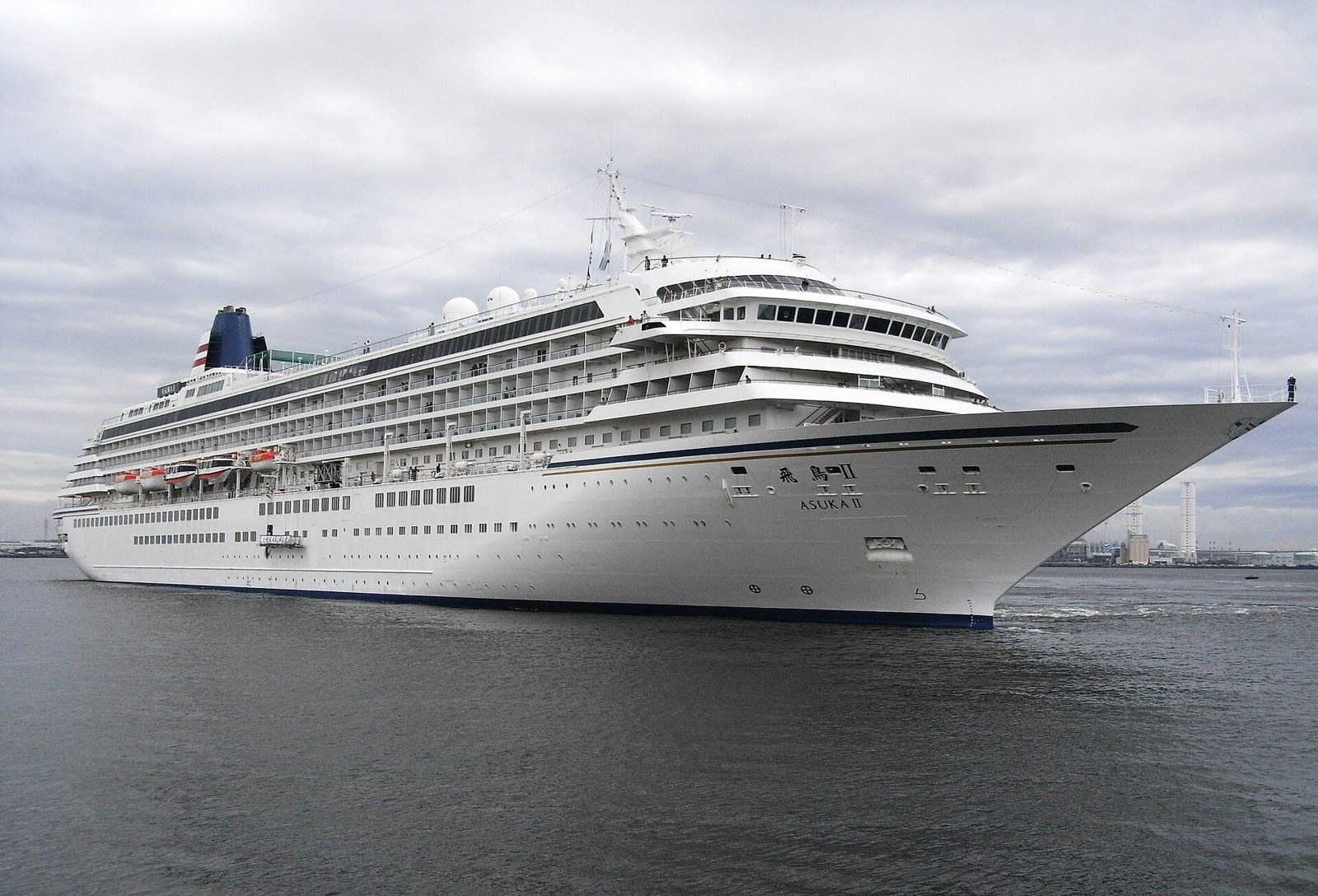
Asuka II has lived two complete luxury careers on opposite sides of the Pacific. Built at Nagasaki in 1990 as Crystal Harmony, she was the first ship of Crystal Cruises, the American luxury line created by Japan's Nippon Yusen Kaisha (NYK) to compete at the very top of the Western cruise market. In 2006, after sixteen years in Crystal service, she was transferred within the NYK group to the parent company's Japanese operation, renamed Asuka II, and became the flagship of the Asuka Cruise brand — a role she has now held for two decades.
At 50,142 GT she was, as of August 2022, the largest cruise ship in Japan. Her story ties together two other ships in this directory: she succeeded the original Asuka, which left NYK in 2006 to become Phoenix Reisen's Amadea, and she was herself joined in 2025 by a purpose-built fleetmate, Asuka III, against whom she now sails as the classic ship of a two-ship fleet.
Key specifications
The dataset records 50,142 GT, a length of 240.96 m, a beam of 29.6 m, a speed of 21 knots and a maximum capacity of 960 passengers. Her own article gives a draught of 7.8 m, eight passenger decks and a crew of 545. Her machinery is diesel-electric: four MAN diesel engines with a combined output of 32,800 kW, built under the Mitsubishi umbrella that also produced the ship herself.
That capacity of about 960 guests in a 50,000-ton hull gives her a space ratio above 50 GT per guest — the arithmetic of the luxury market she was built for, and the reason she could move from American luxury service to Japanese luxury service with her basic arrangement intact.
Design and construction
Crystal Harmony was ordered by NYK for its new Crystal Cruises subsidiary, formed in 1988 after several years of studying the Western luxury market. She was built by Mitsubishi Heavy Industries at Nagasaki as hull 2100 — the builder, engines and much of the outfit coming from within the wider Mitsubishi group, as with her near-contemporary the original Asuka. Preparations were famously thorough: secondary accounts describe yard-built mock-up cabins in which company directors and their families slept, to test the accommodation before the design was frozen.
She was a large ship for the luxury segment of 1990: eight decks of public rooms and cabins planned around under a thousand guests, with the generous balcony provision and low-density public spaces that Crystal made its trademark. Delivered in July 1990 and registered at Nassau, she was, in effect, a Japanese-built statement that the luxury cruise ship had become a global product.
Naming, launch and maiden voyage
Her own article records her launch at Nagasaki on 30 September 1989; the dataset's "launched 1990" is her completion and service-entry year, and the difference is logged in the batch notes. She was completed in June 1990, delivered in July 1990 and christened at Los Angeles by the actress Mary Tyler Moore. Her maiden voyages in summer 1990 introduced Crystal Cruises to the market, beginning with West Coast and Alaska-season cruising.
The name Asuka II dates from 2006. Asuka is written with characters (飛鳥) long used by NYK for its Japanese cruise flagship; when Crystal Harmony took over the flagship role from the original Asuka, she took the name with a Roman numeral II, registered at Yokohama.
Career by operator
The dataset's operator history records only Nippon Yusen Kaisha; her article documents the full two-brand history followed here.
| Period | Name | Operator | Notes |
|---|---|---|---|
| 1990–2006 | Crystal Harmony | Crystal Cruises | First ship of the Crystal fleet; Nassau registry |
| 2006–present | Asuka II | Nippon Yusen Kaisha (NYK Cruises / Asuka Cruise) | Replaced the original Asuka as Japanese flagship; Yokohama registry |
As Crystal Harmony she established Crystal's reputation, sailing worldwide from a North American base in the line's formative years. Retired from the Crystal fleet in 2005, she was transferred to NYK in April 2006, renovated, and re-entered service as Asuka II. In Japanese service she has operated the Asuka programme of domestic and international voyages from Japanese ports, including the brand's annual world cruise — a role that passed to the new Asuka III after Asuka II's final world cruise ended at Yokohama in July 2025, according to Cruise Industry News. Trade reporting in 2026 described NYK planning a further newbuild eventually to replace her; no order had been placed in the sources used, and she remains in service meanwhile.
Onboard character
Asuka II's character is the original Crystal formula carried into a Japanese idiom: very high crew-to-guest ratio, spacious cabins of which a majority have balconies, and formal, service-led luxury rather than resort spectacle. Under Crystal she helped define the 1990s luxury template — large ships for the segment, but with public rooms and dining planned for hundreds rather than thousands.
Under Asuka Cruise the same hardware serves Japanese hospitality: the ship operates in Japanese, for Japanese guests, with programming built around Japanese seasonal travel and long, port-rich voyages. That she could change cultural register so completely without structural change says much about how universal the 1990 luxury template had become — and about the durability of the underlying ship.
Major refits and incidents
Two fires mark her record, both without loss of the ship. On her maiden-voyage deployment in 1990, a fuel leak in an auxiliary engine room caused a fire some 200 miles from Cristóbal, Panama; she drifted without power for about sixteen hours, then reached port under her own power, disembarked her passengers, and was escorted by tug to Curaçao for repairs. The second fire came thirty years later, on 16 June 2020, when smoke was reported from the ship while she lay at Yokohama during the pandemic shutdown; the incident was reported in the Japanese press and the ship was undamaged beyond the affected area.
Her refit history includes a modernisation in drydock at Blohm & Voss, Hamburg, in 1995, the conversion work for her 2006 transfer to Asuka service, and a further refurbishment reported in 2020.
Sister ships and class
Asuka II has no true sister. Crystal Harmony's design was not repeated; Crystal's next ship, Crystal Symphony (1995), was a development rather than a copy. Her relationships are again those of succession: she replaced the 1991 Asuka (now Amadea) in NYK's Japanese service, took her name, and in 2025 was joined by Asuka III, a new Meyer Werft-built fleetmate, alongside whom she now forms the two-ship Asuka fleet.
Fate and where she is now
Asuka II remains in active service with NYK's Asuka Cruise, status "Operating" in the dataset and "In service" in her own article. She is no longer the fleet's newest or largest idea — that is Asuka III — but she is still sailing in her fourth decade, having outlasted most of the luxury fleet of 1990, with a planned successor discussed in trade reporting but not yet ordered in the sources used.
Sources: https://en.wikipedia.org/wiki/List_of_cruise_ships, https://en.wikipedia.org/wiki/MS_Asuka_II, https://cruiseindustrynews.com/cruise-news/2025/06/asuka-iii-to-be-christened-in-yokohama-in-july/