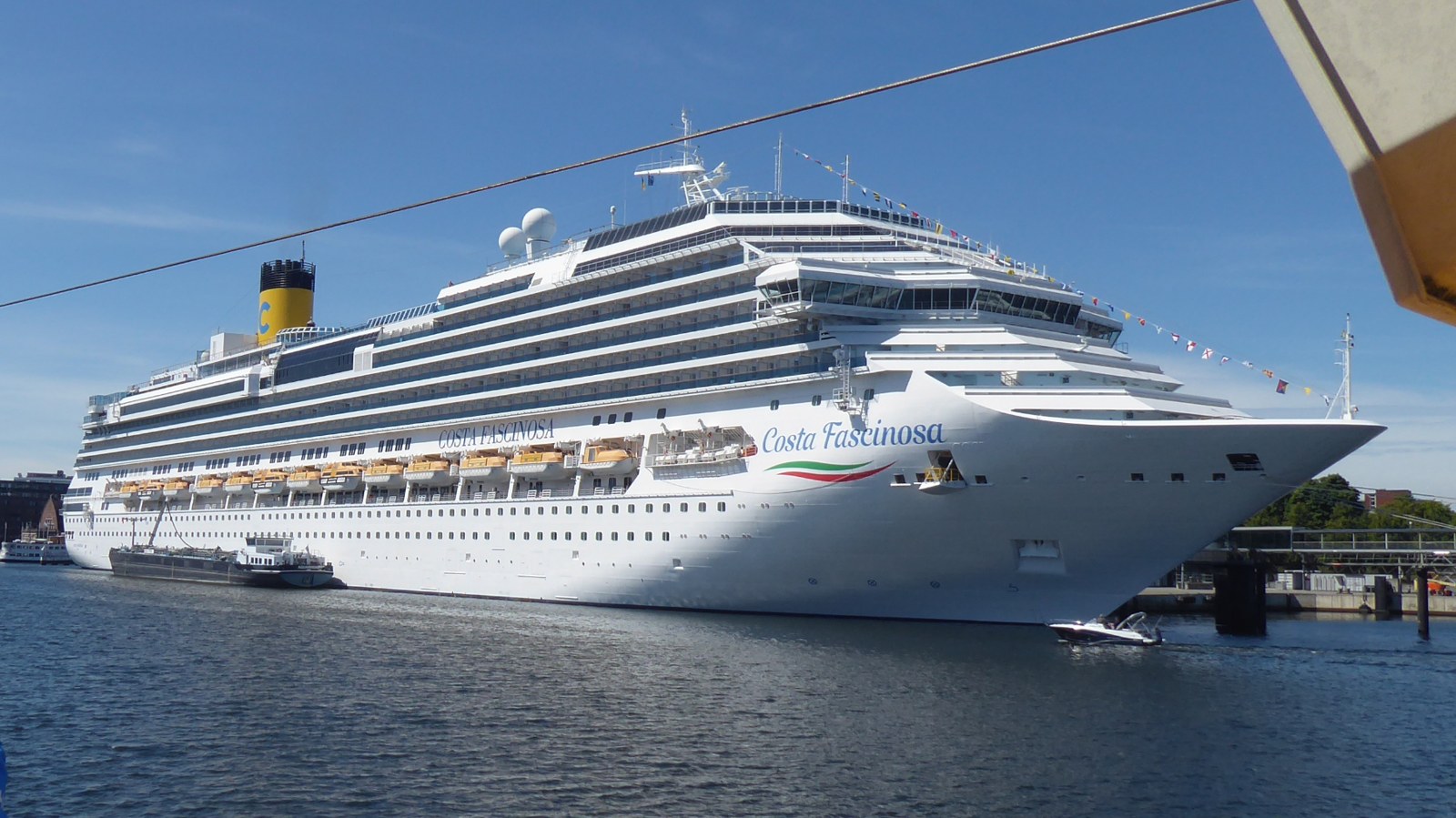
| IMO | 9479864 |
|---|---|
| Gross tonnage | 113,321 GT |
| Length | 289 m |
| Beam | 35.5 m |
| Passenger capacity (max) | 3780 |
| Crew | 1100 |
| Builder | Fincantieri |
| Yard | Fincantieri |
| Launched | 2011 |
| Maiden voyage | 2012-05-06 |
| Class | Concordia-class cruise ship |
| Operator | Costa Cruises |
| Status | Active |
Overview
Costa Fascinosa is a Concordia-class cruise ship built for Costa Crociere, the Italian brand of Carnival Corporation, and delivered in May 2012. She was the last ship built to the Concordia design — a fact inseparable from her timing. She entered service on 6 May 2012, less than four months after her class leader, Costa Concordia, was lost off the island of Giglio on 13 January 2012. No guide to this ship can avoid that context: she is both a routine late example of a successful class and a ship whose debut was overshadowed by the most serious cruise-ship casualty of the modern era.
Before that, she was a flagship — Costa's until Costa Diadema in November 2014, and the sixteenth Costa ship at delivery. At 113,321 GT and up to 3,800 passengers in the dataset, she was the mature form of Costa's 2000s large-ship programme: Italian-flagged, Italian-built, decorated around fascination and the cinema.
Key specifications
The dataset records 113,321 GT, 290.0 m length, 36.0 m beam and a maximum capacity of 3,800. Wikipedia's infobox gives 113,321 GT, 289 m length and 35.5 m beam, a capacity of 3,780 passengers and a crew of 1,100. Contemporary Costa material cited a slightly higher tonnage on completion, around 114,500 GT.
The dataset gives no speed or crew. Wikipedia gives a maximum speed of 23.2 knots, 13 decks, a draught of 8.2 m, and Wärtsilä machinery totalling about 42,000 kW driving two fixed propellers. She has 1,506 cabins in published descriptions — six more than earlier Concordia-class ships, according to Costa material quoted on Wikipedia.
As with all ships in this directory, tonnage is gross tonnage, a volume measure, not a weight.
Design and construction
Costa Fascinosa and her sister Costa Favolosa were ordered in October 2007 as part of a €2.4 billion, five-ship expansion of the Costa fleet between 2009 and 2012, intended to increase Costa's passenger capacity by 50 per cent. Her build cost is recorded on Wikipedia as €510 million. She was built by Fincantieri at its Marghera yard in Venice — the dataset records the builder and yard simply as Fincantieri, and Marghera is the specific yard given in her own article.
The Concordia design derived from a proven Carnival platform: multi-storey atrium, dining rooms amidships and aft, theatre forward, and two pools, the midships one with a retractable cover. “Modified Concordia” reflects changes for the final pair.
Her keel was laid on 3 September 2010. She was launched — floated out — on 29 July 2011, not in 2012 as a simple reading of the dataset's launch year would suggest. She was acquired by Costa on 27 April 2012 in Wikipedia's infobox, with delivery also reported as 5 May 2012, immediately before entry into service.
Interiors were designed in the Costa manner of the period by architect Joseph (Joe) Farcus, whose themed public rooms for Costa and Carnival ships were a defining feature of the group's ships in the 2000s.
Naming, launch and maiden voyage
Her name was not chosen by a naming committee alone. Fascinosa and Favolosa were selected through a public competition, Costa's “Send Us a Sea of Names” project. Wikipedia, citing Cruise Industry News, records 16,000 pairs of names submitted by travel agents and customers, a shortlist of 25 pairs, and more than 42,000 votes on the final selection. The brief was for names evoking magical, glamorous places. Favolosa means “fabulous” in Italian; Fascinosa means “fascinating” or “glamorous.”
She was christened by Elsa Gnudi, according to Wikipedia's infobox. She was launched on 29 July 2011 at Marghera and entered service on 6 May 2012, the dataset's maiden-voyage date, sailing first on a preview cruise before regular service from 11 May 2012.
Career by operator
She has had a single name and a single operator.
| Name | Operator | Period |
|---|---|---|
| Costa Fascinosa | Costa Crociere (Costa Cruises) | 2012–present |
Her early pattern, recorded on Wikipedia, was eastern Mediterranean summers and a South American season from November 2012. She was flagship until Costa Diadema succeeded her in November 2014.
That single-operator simplicity is the point of her career table: unlike the second-hand ships elsewhere in this batch, Costa Fascinosa was ordered, named, built and delivered for Costa, and has remained a Costa ship. This directory does not publish present itineraries.
Onboard character
Her character is cinematic glamour as architecture. Her theme — “things that fascinate,” centred on films, actors and directors — shaped her public rooms. Profiles record an Amarcord atrium invoking Fellini, a Bel Ami theatre, hundreds of original artworks and thousands of prints, and film-named lido and casino — design history, not a current amenity list.
Structurally, character features included a Grand Prix simulator, a pool with a large screen and retractable roof, and the Samsara Spa enclave Costa used across this generation. A gelateria and pizzeria reflected her Italian flag.
The combination — very Italian, very theatrical, very large — is what the final Concordia ships represent in Costa's history, before the line moved to the Dream-derived Diadema and later to still larger designs.
Major refits and incidents
No structural refit on the scale of a lengthening or rebuild is recorded in the sources used; her history is marked instead by two grave external events involving her passengers ashore and aboard during the pandemic period.
On 18 March 2015, while she and MSC Splendida were in port at Tunis, gunmen attacked visitors at the Bardo National Museum. Wikipedia records that several of her passengers were on a tour bus caught in the attack, that five passengers from the ship were killed and eight injured. The attack is part of her documented history and is recorded here plainly, without detail beyond the sourced figures.
In April 2020, 19 crew tested positive after disembarkation; her head doctor died on 16 April and a crew member died in Brazil later that month, per reporting cited on Wikipedia.
She herself was not the subject of the January 2012 Costa Concordia casualty — she was still fitting out at Marghera when it happened — but she entered service in its shadow, and any account of her early career that omitted that fact would mislead.
Sister ships and class
The Concordia class, as built for Costa and Carnival, comprises Costa Concordia (2006, lost 2012), Costa Serena (2007), Costa Pacifica (2009), Costa Favolosa (2011) and Costa Fascinosa (2012), together with Carnival Splendor (2008), built to the same basic design for Carnival Cruise Line. Fascinosa and Favolosa form the final, slightly modified pair, ordered together in 2007 and named together by competition.
She was the last Concordia-class ship built. After her, Costa's large-ship programme moved on, and the class name itself — once a marketing asset — became permanently associated in public memory with the loss of its lead ship, even though the other members of the class continued in ordinary service.
Fate and where she is now
The dataset records Costa Fascinosa as active and operating, and that remains her documented position: in service with her original operator under her original name, the last-built member of her class. No sale, renaming or withdrawal is recorded in the sources used for this guide. Beyond that recorded status, this directory makes no claim about present position or deployment.
Sources: https://en.wikipedia.org/wiki/List_of_cruise_ships, https://en.wikipedia.org/wiki/Costa_Fascinosa