| IMO | 9343132 |
|---|---|
| Gross tonnage | 114,147 GT |
| Length | 289.6 m |
| Beam | 35.5 m |
| Passenger capacity (max) | 3780 |
| Service speed | 20 knots |
| Builder | Fincantieri |
| Yard | Fincantieri |
| Hull number | 6130 |
| Launched | 2006 |
| Maiden voyage | 2007 |
| Class | Concordia-class cruise ship |
| Operator | Costa Cruises |
| Status | Active |
Overview
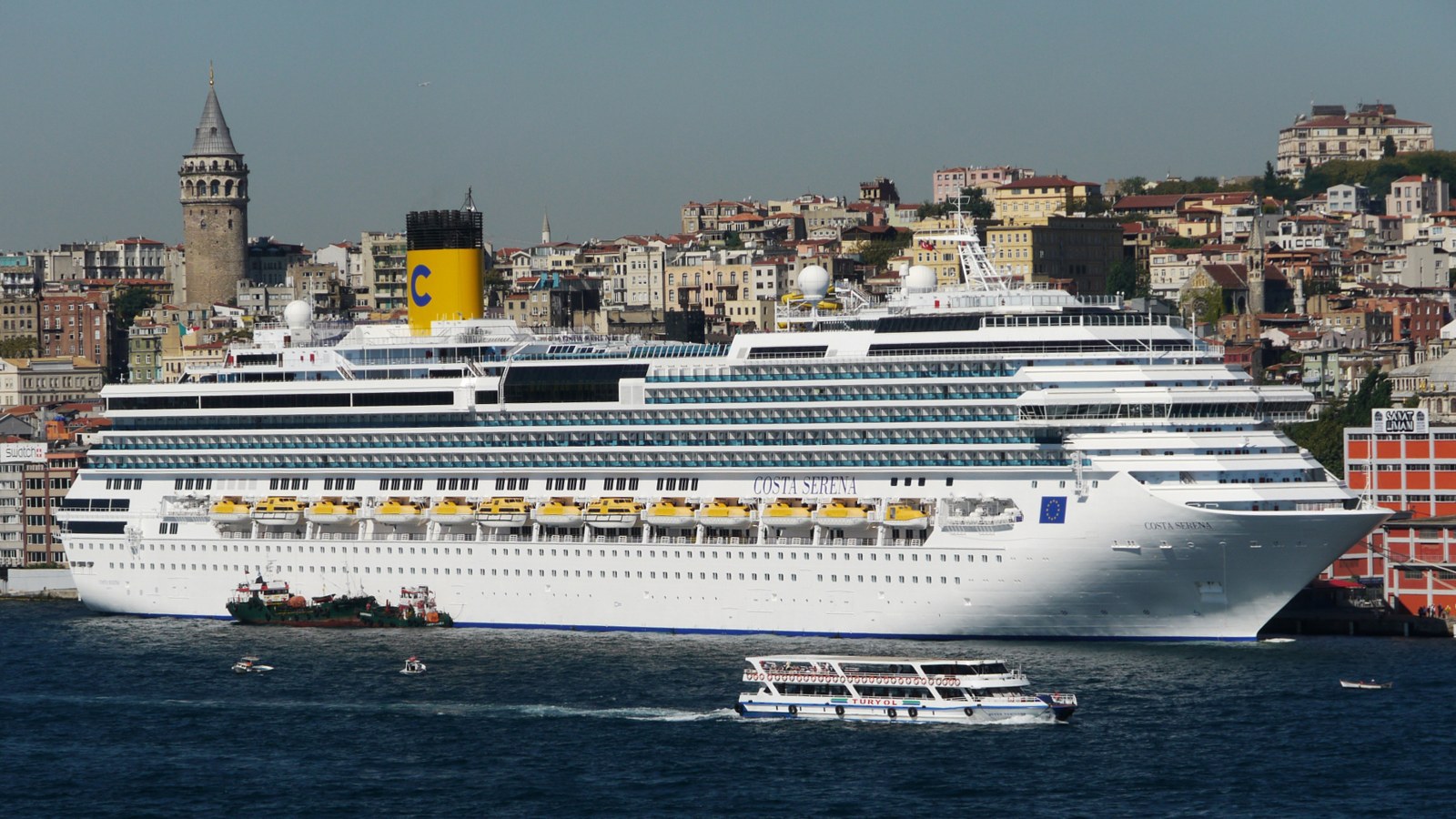
Costa Serena is a Concordia-class cruise ship for Costa Crociere, built by Fincantieri at Sestri Ponente, Genoa, and entered into service in May 2007. She is the second ship of her class, following Costa Concordia (2006), and — after Concordia was wrecked in January 2012 and subsequently scrapped — she is the oldest surviving ship of the class, a status her article states explicitly. That fact alone gives an otherwise conventional fleet ship a particular place in any complete directory: Serena is the senior living example of the design whose lead ship became the most famous cruise-ship casualty of the modern era, a casualty that is part of the class history but not of this hull's own record.
The name Serena was intended to symbolise harmony and serenity. She cost about €450 million (about US $570 million at the time), was ordered on 1 October 2004, and at entry into service she and Concordia were the largest and longest ships in the Costa fleet — a position the class held until Costa Diadema arrived in 2014. She has sailed for Costa under her original name throughout her career, including a long period of deployment in Asia in the 2010s and a period of lay-up during the COVID-19 suspension before returning to service.
Key specifications
The dataset records Costa Serena at 114,147 GT, 289.6 metres long, 35.5 metres in beam, maximum capacity 3,780 passengers, speed 21.5 knots, IMO 9343132, Fincantieri hull 6130, launched and in service in 2007, Concordia class. Her article confirms 114,147 GT (with 87,196 NT and 10,000 DWT), length 289.59 metres and beam 35.5 metres, and a draught of 8.30 metres. It gives capacity as 3,700 passengers in its particulars, against the dataset maximum of 3,780 — the dataset figure matches the 3,780 also given in ship-database accounts of her 1,507 cabins, and the difference is the familiar double-occupancy versus maximum distinction in different sources. Her article lists a crew of 1,100; crew is blank in the dataset by design.
Design and construction
The Concordia class was Fincantieri's early-2000s large-ship platform for Costa, derived from the same design family Carnival used for its Splendor development, built at Sestri Ponente. Serena, yard number 6130, followed Concordia (yard 6122 in the class sequence of references) down the same ways: keel 1 February 2005, launch 4 August 2006, completion 9 March 2007 and delivery in time for a May inauguration.
One design element was distinctive enough to be carried into Serena from the lead ship and enlarged: the Samsara Spa concept, with spa staterooms grouped around the spa and enjoying direct access and a dedicated Samsara restaurant. Contemporary project accounts put the Samsara cabins at 99 on Serena, increased from 67 on Concordia because of demand — an early, dated example of wellness accommodation being designed into a large ship rather than added later.
Naming, launch and maiden voyage
Costa explained the name Serena as a symbol of harmony and serenity, in keeping with the class's classical naming pattern. Her godmother was the French actress Marion Cotillard. The inauguration was held at Marseille, France, on 19 May 2007, with a night-time ceremony in the Old Port, fireworks, performances including the Marseilles Opera Chorus in the detailed CruiseMapper account of the event, and a gala dinner in the ship's main restaurants. Her inaugural cruise departed Marseille on 19 May 2007 in that account; contemporary summaries describe the maiden cruise as sailing from Venice around the Mediterranean shortly after the inauguration. The dataset records only the year, 2007, for both launch and maiden voyage; the launch year is corrected to 2006 in this guide from her article, as logged.
Career by operator
A single operator and a single name throughout.
| Period | Name | Operator |
|---|---|---|
| 2007–present | Costa Serena | Costa Cruises (Costa Crociere) |
She entered service in mid-2007 as, with Concordia, the line's flagship-scale ship. From 2009 she acquired an unusual public profile when she and her crew were the subject of the six-episode National Geographic documentary series Cruise Ship Diaries, filmed aboard her — a record that makes her one of the better-documented large ships of her generation in ordinary working life, as opposed to launch publicity.
Onboard character
Her interior theme, by Carnival-group designer Joe Farcus and his studio in the project accounts, is classical mythology: Greek and Roman gods and heroes supply the names and imagery for bars, lounges and restaurants, with the Pantheon atrium as the centrepiece, main restaurants named Vesta and Ceres in period accounts, the Jupiter Theatre three decks high, and a Grand Bar Apollo. That pagan-classical programme is the Farcus signature at its most literal, and it is the era-defining character of the ship — a large Italian-market vessel decorated as a floating classical pantheon for a brand that sold Mediterranean civilisation as part of the cruise.
Major refits and incidents
This ship's own incident record must be kept separate from her lead sister's. Costa Concordia's grounding and capsizing off Isola del Giglio on 13 January 2012, with the loss of 32 lives, is a class event of enormous consequence — it changed Costa's operations, training and reputation across the fleet, Serena included — but it did not happen to this hull and is not entered as her incident. Directory accuracy requires that distinction.
For Serena herself, secondary summaries of her history record a collision with a water tanker at Naples in 2014 and a COVID-19 outbreak aboard in 2020, noted above, and her participation in a rescue of stranded fishermen in the Arabian Sea in 2023. Those items are stated here at the level of confidence of the summaries available to this guide and flagged for primary-source confirmation at import QA; no detail beyond those summaries is asserted. No fire, grounding or machinery casualty involving Serena is recorded in her own article.
Refit history in the sources used comprises periodic drydocks and the refurbishment preceding her 2023 return to service after lay-up, described in secondary summaries as updating interiors. No lengthening, re-engining or other structural conversion has ever been recorded for this hull; she remains a ship to her 2007 design in all material respects.
Sister ships and class
The Concordia class, all Fincantieri Sestri Ponente ships for Costa except where noted, comprises Costa Concordia (2006, wrecked 2012, scrapped 2017), Costa Serena (2007), Costa Pacifica (2009), Costa Favolosa (2011, modified Concordia) and Costa Fascinosa (2012, modified Concordia). Carnival Cruise Line's Carnival Splendor (2008) was built to a closely related design and is grouped with the class in many references, though treated as her own class in this directory's Carnival pages.
Serena is the second ship and, since 2012, the oldest survivor. The three later Costa sisters remain her closest comparators: same hull form, same propulsion arrangement, interiors varied by ship. Any GT figures quoted for the class at 114,500 in fleet tables are the class rounded figure; her measured figure in both the dataset and her article is 114,147 GT.
Fate and where she is now
Costa Serena is in active service with Costa Cruises under her original name, IMO 9343132, status "Operating" in the dataset, after her pandemic lay-up and 2023 return. No sale or retirement is recorded. Her durable historical identity is that of the oldest surviving Concordia-class ship — a 2007 Fincantieri flagship-scale vessel whose classical-mythology interiors and Samsara spa defined Costa's large-ship product of the late 2000s.
Sources: https://en.wikipedia.org/wiki/List_of_cruise_ships, https://en.wikipedia.org/wiki/Costa_Serena