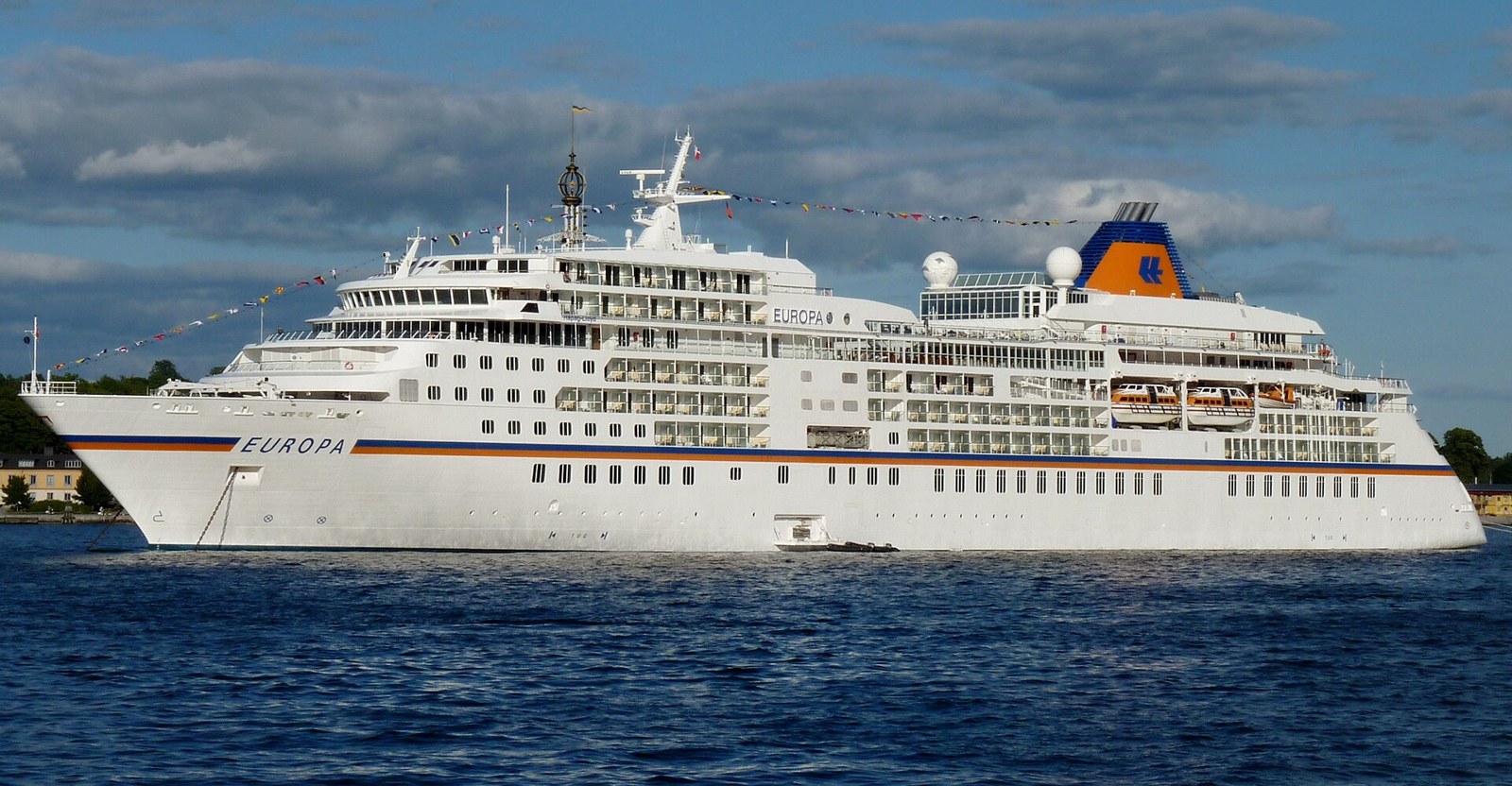
| IMO | 9183855 |
|---|---|
| Gross tonnage | 28,890 GT |
| Length | 198.6 m |
| Beam | 24.0 m |
| Passenger capacity (max) | 408 |
| Service speed | 21.0 knots |
| Builder | Kvaerner Masa-Yards |
| Yard | Hietalahti shipyard |
| Hull number | 495 |
| Launched | 1999 |
| Maiden voyage | 1999 |
| Operator | Hapag-Lloyd Cruises |
| Status | Active |
Overview
MS Europa of 1999 is the sixth ship of her name for Hapag-Lloyd and, by the verdict of the guidebooks, for twelve consecutive years the best cruise ship in the world. Ward's ranking and Berlitz awarded her their top title year after year — a record built on a simple, expensive formula: a ship of 28,890 GT carrying just 408 passengers, all of them in suites, 204 suites in all, served by a crew of about 275. Space, quiet and German service discipline, sold at the very top of the market.
She is also a ship defined against her own predecessor. The previous Europa (1981) was larger and carried more passengers; the 1999 ship deliberately shrank the guest list while keeping the dimensions of a real ocean-going vessel — 198.6 metres, a 21-knot service speed and worldwide range. In an industry racing toward 100,000 tons and 3,000 passengers, Hapag-Lloyd's flagship argued that luxury was a ratio, not a size. The market, and the Berlitz inspectors, agreed.
Key specifications
The dataset gives 28,890 GT, 198.6 metres length, 24.0 metres beam, 408 passengers maximum, 21.0 knots and hull 495 at Kvaerner Masa-Yards' Hietalahti yard in Helsinki — all in exact agreement with the ship's article, down to the yard number. Her passenger accommodation is arranged in 204 suites, most with balconies (168 of 204 in the design description), across 11 decks of which seven are passenger-accessible, with a draught of about 6 metres.
Her space ratio — roughly 70 GT per passenger — is the headline figure: two to three times that of a mainstream large ship, and the arithmetic behind her ratings record. Propulsion is diesel-electric through two ABB Azipods totalling about 13.3 MW of pod power from four MAN B&W engines of 21.6 MW combined — an early and notably successful Azipod installation, chosen in part to eliminate stern vibration in the suites aft.
Design and construction
Ordered on 28 November 1997, she was laid down at Helsinki on 26 June 1998, launched on 4 March 1999 and completed on 9 September 1999. The design, by the Oslo architects Yran & Storbraaten in the design accounts, was that of a luxury vessel in the classical mould: a seven-deck atrium with a piano bar at its base, a grand lounge for evening performance, and public rooms concentrated so that a 408-guest ship still feels like a complete ship rather than a yacht scaled up.
She was among the first cruise ships designed around the ABB Azipod, with the pods specified specifically to reduce vibration toward the stern — where, in a conventional design, the most expensive suites sit directly above the propellers. It is a revealing priority: the propulsion plant was chosen by the accommodation plan. Her equipment list in period references — four 100-seat tenders doubling as lifeboats, 13 zodiacs for expedition-style landings, a golf simulator and driving ranges — shows a ship meant to alternate between grand-tour cruising and expedition-flavoured itineraries without changing character.
Naming, launch and maiden voyage
Europa is Hapag-Lloyd's dynastic name, carried by a line of predecessors stretching back through the famous 1981 ship to the North German Lloyd liner taken into the merged company in 1970 and the pre-war fleet beyond. The 1999 ship is counted the sixth of the name in the company's history. She entered service in September 1999 — period references date her first cruise to 17 September 1999 — replacing her 1981 namesake, which left for Star Cruises and a long second career of her own. The dataset records launch and maiden voyage simply as 1999, consistent with the documented dates.
Career by operator
Hers is another single-operator career in this batch — Hapag-Lloyd Cruises from 1999 to the present — with one corporate change above her: in 2020 Hapag-Lloyd Cruises was sold to TUI Cruises, the TUI–Royal Caribbean joint venture, taking Europa into the TUI orbit without changing her name, flag pattern of operation (registry moved from Nassau to Valletta in 2020, per her article) or market. She has cruised worldwide throughout, the German-language flagship of a brand that trades on continuity.
| Name | Operator | Period |
|---|---|---|
| Europa | Hapag-Lloyd Cruises | 1999–present |
Onboard character
All-suite accommodation is the character. Every one of the 204 suites faces the sea; the two Penthouse Grand Suites add a day room, sauna and balcony; the standard Veranda Suite runs to about 274 square feet — dimensions that were generous in 1999 and remain respectable. Public life centres on the atrium and piano bar, the Grand Lounge, and a dining arrangement built around a 336-seat main restaurant flanked by two small speciality rooms, the Italian Venezian and the Oriental, seating 44 and 32 — speciality dining at a scale and formality the mass market would later adopt and enlarge.
The ship's German character is structural, not decorative: German officers, onboard language German (with English on designated bilingual cruises), tipping included, and a programme of classical music, golf and enrichment that defined the top of the German market for a generation.
Major refits and incidents
A ship that holds a "best in the world" title for twelve years is maintained like one: Europa's documented history is of continuous renewal in periodic drydocks rather than any single transformative refit, and her article records no major casualty, fire or grounding. This guide notes the pattern rather than inventing refit dates. The continuity is itself the story: no rescue conversions, no rebrandings, no arrested-in-Freeport chapters — the quietest career in this batch, by design.
Sister ships and class
Europa is a one-off design with no sister. Her fleet context is Europa 2 (2013), a larger, more contemporary running mate from Chantiers de l'Atlantique, and the Hanseatic expedition ships that joined from 2019. Her true comparison set is the predecessor she replaced — the 1981 Europa, later Saga Sapphire and Blue Sapphire — against which her lower capacity and higher space ratio were a deliberate generational statement.
Fate and where she is now
Europa remains in active service as Hapag-Lloyd Cruises' flagship, as the dataset records — still carrying her dynastic name, still at the top of the German luxury market more than twenty-five years after delivery. No sale, renaming or retirement has been documented; she is the control case against which this batch's busier biographies can be measured.
Sources: https://en.wikipedia.org/wiki/List_of_cruise_ships; https://en.m.wikipedia.org/wiki/MS_Europa_(1999)