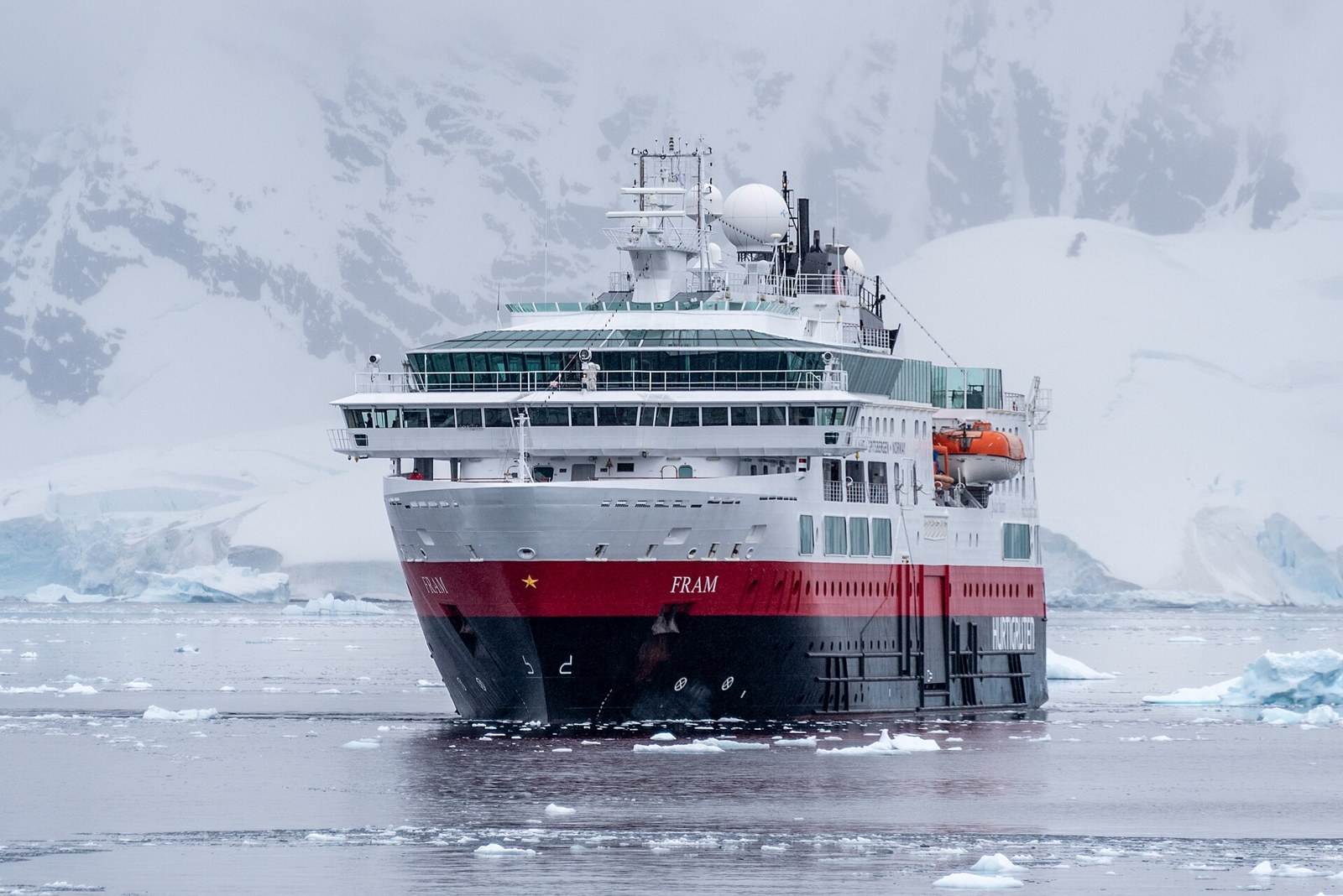
| IMO | 9370018 |
|---|---|
| Gross tonnage | 12,800 GT |
| Length | 114.0 m |
| Beam | 20.2 m |
| Passenger capacity (max) | 318 |
| Service speed | 16.0 knots |
| Builder | Fincantieri |
| Hull number | 6144 |
| Launched | 2007 |
| Maiden voyage | 2007 |
| Operator | Hurtigruten |
| Status | Active |
Overview
Fram is a purpose-built polar expedition ship operated by the Norwegian company Hurtigruten — since the group's expedition rebrand, marketed within its HX expedition operation, though her article still records the operator simply as Hurtigruten. Delivered in 2007, she was Hurtigruten's first newbuild designed from the keel up for expedition cruising rather than for the Norwegian coastal service, and she carried one of the most resonant names in polar history: the original Fram was the ship of Fridtjof Nansen's Arctic drift and Roald Amundsen's South Pole expedition. The modern Fram — the name means "forward" — was built to work both polar regions, Greenland and the Arctic in the northern summer and Antarctica in the southern summer, with an ice-class hull, expedition landing craft and a science-and-lecture programme in place of conventional cruise entertainment.
Key specifications
The dataset records 12,800 GT, 114.0 m length, 20.2 m beam, maximum capacity 318, Fincantieri hull 6144 and 16.0 knots. Her own article gives a tonnage of 12,700 GT, eight decks, ice class 1B and a speed of 13 knots, with capacity stated as 400 passengers on 280 berths; the operator's own specification lists passenger capacity 318 (matching the dataset), 276 beds and a gross tonnage of 11,647. These are real, unresolved variants — tonnage has evidently been restated across her career and the speed figures appear to mix maximum and service values — and they are logged in the batch notes rather than silently harmonised. What is not in dispute is the shape: a compact, ice-strengthened expedition ship of about 114 metres with diesel-electric machinery (four engines, about 8,000 kW in operator data) and capacity in the low hundreds.
Design and construction
Fram was ordered from Fincantieri in September 2005 at a reported cost of €68 million, laid down in 2006 (sources give March and August 2006 in different accounts), launched on 18 November 2006 at Fincantieri's Monfalcone yard — the yard's own press release is headlined "The 'Fram' Launched in Monfalcone" — and handed over in spring 2007. The dataset's "launched 2007" is her delivery year, as logged in the batch notes. The design is a working expedition platform: higher ice class, chart and sounding systems for unsurveyed waters, forward sounding sonar and ice searchlights, an expedition equipment deck, oversized oil-retention capacity for self-sufficiency far from ports, and landing boats of the operator's "Polar Circle" type rather than standard inflatables. Interiors were kept deliberately Scandinavian — light wood, stone and wool — with artefact displays from the Nansen and Amundsen expeditions on the way to the restaurant.
Naming, launch and maiden voyage
The name was the programme: Hurtigruten reached back to the most famous Norwegian exploration ship of all and named its expedition flagship Fram, "forward." She was christened in May 2007 and entered service that year; operator and fleet histories date her maiden expedition season to 2007, on the polar deployment she has worked ever since. The launch itself, on 18 November 2006 at Monfalcone, was marked by a Fincantieri press release, an early sign of how far expedition cruising had travelled from its converted-ship origins: a major Italian yard was now building polar ships to order.
Career by operator
| Period | Name | Operator |
|---|---|---|
| 2007–present | Fram | Hurtigruten (expedition operation now branded HX) |
A single-name, single-group career. Her working rhythm was set at delivery and is structural rather than incidental: Arctic Ocean, Greenland and Iceland in the northern summer, Antarctica in the southern summer, with repositioning voyages between. She is not, and never has been, a ship of the Norwegian coastal route — she belongs wholly to the expedition division that Hurtigruten built around her, later joined by the hybrid-powered Roald Amundsen and Fridtjof Nansen, and now presented under the HX brand; the dataset's operator field (Hurtigruten) remains the owning group, with the brand detail noted here and in the batch notes.
Onboard character
Fram's character is the expedition base camp: comfortable, Nordic and unpretentious, organised around the landscape rather than around the ship. The Qilak observation lounge, with 270-degree panoramic windows on the top deck, is the social centre; two lecture halls (Framheim and Polhøgda) seat the expedition programme of scientists and historians; the restaurant aft is reached past an exhibition of original artefacts from the historic Fram expeditions; and the outside decks — including access to the very bow — are working wildlife platforms. Saunas and outdoor hot tubs complete a distinctly Norwegian idea of luxury: warmth, views and expertise rather than spectacle.
Major refits and incidents
Her recorded incident came early. In December 2007, in her first Antarctic season, Fram lost power and struck a glacier in Antarctica, sustaining damage to her starboard side; contemporary reporting emphasised that the collision did not affect her seaworthiness, and she continued her career after repair. Her major refit was the comprehensive upgrade completed for the 2020 season: new suites and cabins, more environmentally friendly engines, new restaurants and a high-tech science centre, with all public areas remade — in effect a second launch that aligned the 2007 ship with the expedition fleet's newer hybrid ships. Operator-aligned sources also describe a further remodelling in 2022.
Sister ships and class
Fram is a one-off: no sister was built to her design. Her fleet context is generational — she pioneered Hurtigruten's purpose-built expedition line, which continued a decade later with the larger, hybrid-battery Roald Amundsen class — and her namesake context is historical: the wooden Fram of 1892, preserved in Oslo, whose expeditions hers commemorates. Within the dataset she stands among the smaller active hulls, an expedition specialist rather than a class product.
Fate and where she is now
In service as a polar expedition ship for Hurtigruten's expedition operation — the dataset status "active, in service" stands, with the HX brand note above. Nearly two decades after delivery she remains the ship that defined her operator's expedition identity.
Sources: https://en.wikipedia.org/wiki/List_of_cruise_ships, https://en.wikipedia.org/wiki/MS_Fram