| IMO | 9138329 |
|---|---|
| Gross tonnage | 15,067 GT |
| Length | 144.13 m |
| Beam | 21.5 m |
| Passenger capacity (max) | 420 |
| Builder | MTW Schiffswerft GmbH |
| Hull number | 451 |
| Launched | 1996 |
| Maiden voyage | 1997 |
| Operator | Plantours |
| Status | Active |
| All names | Hamburg; C. Columbus |
Overview
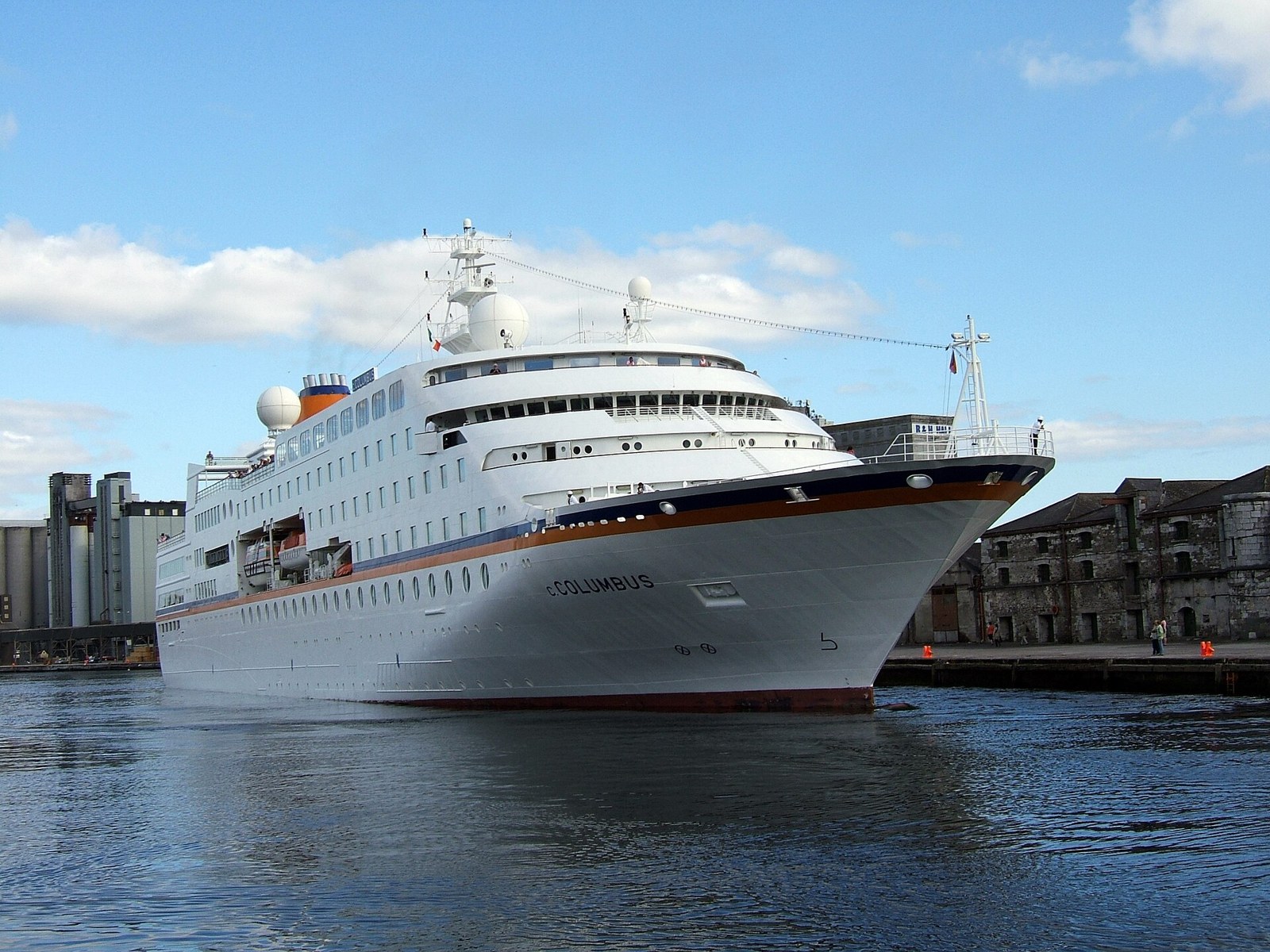
Hamburg is a small German expedition-capable cruise ship with a two-part career neatly divided by a single renaming. Built at Wismar in 1997 as C. Columbus for Hapag-Lloyd Cruises, she spent fifteen years as the German luxury line's versatile small ship — a vessel deliberately built with a shallow draught and an ice-strengthened hull so that she could work rivers, lakes and polar-adjacent waters closed to bigger tonnage. In 2012 she passed to the Bremen operator Plantours and took the name Hamburg, under which she has continued in the same German-speaking, destination-intensive trade. At 15,067 GT and 420 passengers she represents the segment of the industry that megaships cannot serve — and she has outlasted several of the brands that once competed for it. The slug of this page carries her year, 1997, because the industry has recycled ship names — Hamburg and Columbus among them — too often for a name alone to identify a hull.
Key specifications
The dataset's figures match reference sources closely: 15,067 GT, 144.13 m length, 21.5 m beam, 420 passengers maximum. Wikipedia adds a draught of just 5.15 m — the figure that explains her career — a depth of 13.25 m, six decks, ice class GL E2, four Wärtsilä 6L32 engines totalling 10,560 kW driving two controllable-pitch propellers, a speed of 16 knots, and a crew of 170. Her 197 cabins — 63 inside and 134 outside, including eight suites, per the operator's technical data — include only two with balconies, a reminder that she was designed in the mid-1990s, when the balcony was not yet the default unit of cruise accommodation. The dataset records no speed for this hull; the 16-knot figure here is from the ship's Wikipedia particulars.
Design and construction
She was ordered in 1993 and built at Wismar by MTW Schiffswerft GmbH as yard number 451 — the dataset's builder entry, "Meyer Wismar," appears to conflate the Wismar yard with the Meyer group and is flagged in this build's report; the researched builder is MTW Schiffswerft, Wismar. She was laid down on 5 September 1995 and launched on 30 October 1996, being completed on 17 June 1997. (The dataset records 1997 for both launch and maiden voyage; 1997 is the completion year — the launch was in 1996.) The design brief was access: a hull of modest length, very shallow draught for river and lake work — she is one of the few ocean cruise ships to have operated on the Great Lakes and the Amazon — and ice strengthening for northern and southern extremes, with six Zodiac landing craft carried for expedition-style shore excursions in her later configuration.
Naming, launch and maiden voyage
She entered service as C. Columbus — the initial distinguishing her from other Columbus-named tonnage — with a maiden voyage on 29 June 1997. The renaming to Hamburg in 2012, on her transfer to Plantours, took the name of her original operator's home city and of her own first career; it also quietly retired one of the more confusing names in the German fleet. She replaced Plantours' ageing Vistamar in the Bremen line's programme. A ship portrait records that between her May 2012 takeover and June 2017 she completed 161 voyages carrying more than 58,000 passengers under Plantours.
Career by operator
| Years | Name | Operator |
|---|---|---|
| 1997–2012 | C. Columbus | Hapag-Lloyd Cruises |
| 2012–present | Hamburg | Plantours (Plantours & Partner / Plantours Kreuzfahrten) |
Ownership sat for most of her life with Conti Holding of Munich, which chartered her to each operator in turn; in August 2025 the Ligabue Group, Plantours' parent, purchased her from the Conti Group, converting the long-standing charter into ownership. Hapag-Lloyd replaced her in 2012 with Columbus 2 — the ship now known as Oceania's Insignia — ending the first career; the second, under Plantours, has since outlasted it in spirit if not quite yet in years.
Onboard character
Her character is the small German ship as a genre: comfortable but casual in her operator's own phrasing, German-speaking and cosmopolitan, with lectures and destination enrichment in place of production shows, a single restaurant supplemented by a buffet, a heated outdoor freshwater pool, sauna and fitness room, and — by design — none of the apparatus of the modern resort ship: no casino, no waterslides, no 900-seat theatre. With 420 guests the public rooms work as a village square rather than a mall. The design feature that matters most is invisible from the deck: the shallow draught and Zodiacs that let her programme read like an expedition catalogue — Amazon, Arctic, Antarctica, Greenland, the Great Lakes — while remaining, in accommodation and service style, a conventional cruise ship.
Major refits and incidents
Her documented incidents cluster in a difficult 2015. On 30 April 2015 an oil leak caused engine failure and the cancellation of following cruises after passengers disembarked at Tangier; on 5 May a fishing net fouled her propeller off south-east England and she diverted to Southampton for inspection; and on 11 May 2015 she grounded on charted rocks in the Sound of Mull, Scotland, en route to Tobermory, seriously damaging her port propeller, shaft and rudder. The UK Marine Accident Investigation Branch's 2016 report attributed the grounding to weak bridge-team practices and passage planning; the captain was prosecuted for failing the passage plan and failing to report the accident. She was repaired at Belfast and Bremerhaven, was out of service for three months (Plantours chartered Deutschland to cover), and re-entered service on 10 August 2015. Earlier, as C. Columbus, she had collided with a cargo vessel while berthing at La Paz in the Philippines in March 2010, damaging her bow, with no injuries. A significant modernisation followed in spring/early summer 2020, during several weeks docked at Setúbal, Portugal: 42 outside cabins on decks 4 and 5 received electrically lowering "infinity" panoramic windows, the reception area was redesigned, the wine bar was enlarged and a new pool bar was installed, in a programme reported at €20 million.
Sister ships and class
She is a one-off: no sister was built to her design. Her comparisons are functional rather than familial — she belonged to the generation of small, ice-strengthened German-market ships of the 1990s built for worldwide, port-intensive cruising, a niche that larger, balcony-driven designs could not fill and that expedition newbuilds have since colonised at far higher prices. Her uniqueness is part of her longevity: there is no identical replacement tonnage, and her operators have kept her because of it.
Fate and where she is now
The dataset lists her status as active, operated by Plantours, and her fate as operating — formerly Columbus for Hapag-Lloyd. The researched record agrees, with the 2025 ownership note above. Approaching thirty years since her Wismar launch, she remains what she was built to be: the small ship that goes where the big ones cannot. No retirement or sale beyond the reported intra-group ownership change has been announced.
Sources: https://en.wikipedia.org/wiki/List_of_cruise_ships, https://en.wikipedia.org/wiki/MS_Hamburg, https://www.gov.uk/maib-reports/grounding-of-passenger-cruise-ship-hamburg, https://www.cruiseturtle.com/cruise-ships/ms-hamburg-ship-portrait-and-evaluation, http://www.cruisingjournal.com/en/cruise-guide/cruise-lines-guide/plantours-ms-hamburg-in-a-new-guise, https://www.cruisemapper.com/accidents/MS-Hamburg-1012