| IMO | 9682875 |
|---|---|
| Gross tonnage | 226,963 GT |
| Length | 362.12 m |
| Beam | 47.42 m |
| Passenger capacity (max) | 6780 |
| Service speed | 22.0 knots |
| Builder | Chantiers de l'Atlantique |
| Yard | Saint-Nazaire |
| Launched | 2015 |
| Maiden voyage | 2016-05-29 |
| Class | Oasis-class cruise ship |
| Operator | Royal Caribbean International |
| Status | Active |
Overview
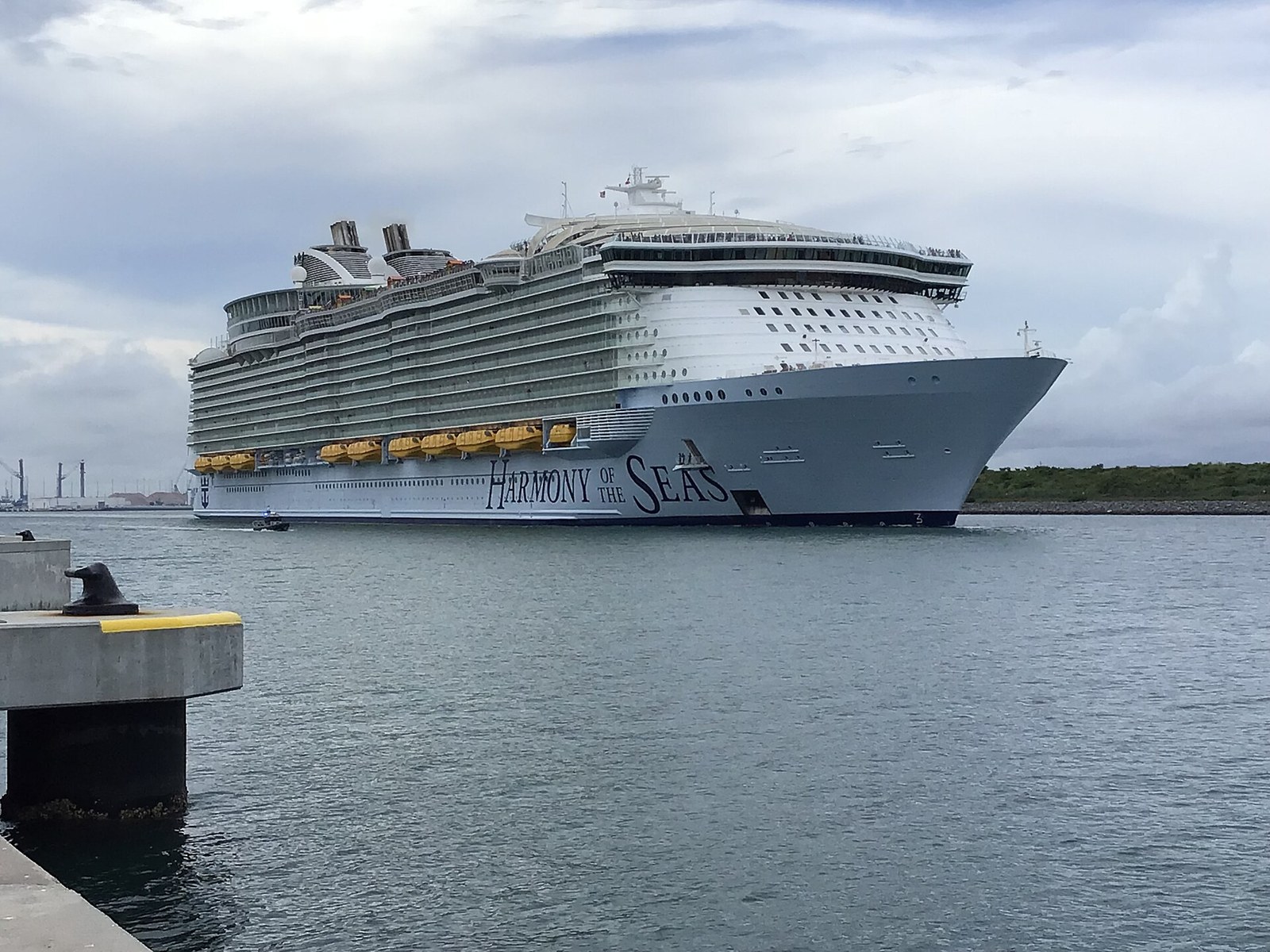
When Harmony of the Seas was delivered in May 2016 she was the largest passenger ship in the world, at 226,963 GT marginally surpassing her sisters Oasis of the Seas and Allure of the Seas. She is the third Oasis-class ship, built not in Finland like the first pair but at Saint-Nazaire in France, and she marks the point at which the Oasis design — a ship split down the middle by open-air "neighbourhoods", with a park of living trees at sea — passed from experiment to mature class standard. She held the world size title until her sister Symphony of the Seas arrived in 2018, and the class itself was eventually overtaken in tonnage by Royal Caribbean's Icon class from 2024. Her career has been a single-operator, single-name affair of continuous large-scale service, and she remains one of the half-dozen largest cruise ships afloat.
Key specifications
The dataset's tonnage of 226,963 GT agrees exactly with her reference article, as does the beam of 47.42 m at the waterline (the article gives a maximum beam of 66 m across the widest fittings). Three dataset entries, however, need prose correction. The length of 330.7 m is not her overall length: the article gives 362.12 m overall, among the longest of any passenger ship. She was not launched in 2016: she was floated out on 19 June 2015, began sea trials on 10 March 2016 and was completed in May 2016. And the dataset's maiden-voyage date of 13 May 2016 is her completion date; her maiden voyage departed Southampton on 29 May 2016. On capacity, the dataset's 6,687 maximum sits close to the article's 6,780 maximum (with 5,479 at double occupancy and a crew of about 2,300). Her yard number at Saint-Nazaire, absent from the dataset, was A34. Six Wärtsilä diesel generators drive three 20 MW ABB Azipod units; 22 knots, the dataset's speed, is her cruising speed, with over 25 knots available.
Design and construction
Royal Caribbean ordered the third Oasis-class ship on 27 December 2012, after the first two had proved the radical split-superstructure concept in service. Construction at Chantiers de l'Atlantique (then STX France) took about 32 months from keel-laying on 9 May 2014 to delivery on 12 May 2016, at a reported cost of US$1.35 billion. Harmony refined the class rather than reinventing it: she is slightly larger than the Turku-built pair, adopted efficiency measures including an air-lubrication system of bubbles along the hull to reduce drag, waste-heat recovery and LED lighting throughout, and was claimed to be about 20 per cent more energy-efficient than her sisters. She was handed over on 12 May 2016 and sailed from Saint-Nazaire on 15 May before crowds reported at some 70,000 people.
Naming, launch and maiden voyage
She has carried the one name throughout, continuing Royal Caribbean's "…of the Seas" convention and the class's vocabulary of harmonious abstractions — Oasis, Allure, Harmony, Symphony. Floated out on 19 June 2015, she reached Southampton on 17 May 2016 and worked two short preview cruises before her official maiden voyage on 29 May 2016, a sailing to Barcelona, her first home port. The preview cruises were widely reported as troubled — unfinished work, cold water, unopened attractions and long waits — a reminder of the schedule pressure on a ship of this complexity; by the maiden voyage, passengers and press reported the ship complete and performing as intended.
Career by operator
| Period | Name | Operator |
|---|---|---|
| 2016–present | Harmony of the Seas | Royal Caribbean International |
A single line conceals a career of unusual scale and stability. After her inaugural Mediterranean season she crossed the Atlantic in late October 2016 to US home waters, where Oasis-class ships have since rotated through the largest Caribbean cruise programmes in the industry. She has never been sold, chartered out, renamed or transferred within the group — in a directory full of ships with four or five identities, Harmony of the Seas is the control case: a flagship built for one brand, worked intensively by that brand, and maintained at the top of its fleet hierarchy even as newer and slightly larger sisters arrived.
Onboard character
The Oasis concept, which Harmony inherited and polished, divided the ship into themed neighbourhoods, the two most famous being open to the sky along a canyon cut through the superstructure: Central Park, planted with thousands of living plants and trees, and the Boardwalk, a nostalgic seaside promenade with a working carousel. Around them sit the Royal Promenade, the Entertainment Place and the pool and sports zone, where Harmony added the class's most photographed feature, the Ultimate Abyss — a pair of dry slides dropping ten decks at the stern — alongside waterslides that the first two sisters had lacked. With twenty dining venues and a 1,400-seat theatre reported at delivery, the ship's character is that of a resort district that happens to move: the sea is a backdrop, and the design effort goes into making 6,000-plus guests disperse themselves comfortably across distinct districts rather than crowd a single deck.
Major refits and incidents
Her most serious incident came early. On 13 September 2016, during a safety drill at Marseille, a lifeboat broke loose and fell from the fifth deck, killing one crew member and injuring four others — the gravest event of her career in the sources consulted. Two further tragedies were individual rather than structural: a crew member reported overboard in December 2018, after which the US Coast Guard suspended its search, and a teenage passenger who fell from a balcony while trying to enter a cabin in January 2019. In refit terms the ship has been maintained through the class's normal cycle of drydockings; a larger "amplification"-style modernisation has been reported for the mid-2020s, but no refit on the scale of her construction has yet defined her.
Sister ships and class
The Oasis class comprises Oasis of the Seas (2009) and Allure of the Seas (2010) from Turku, then Harmony (2016), Symphony of the Seas (2018), Wonder of the Seas (2022) and Utopia of the Seas (2024) from Saint-Nazaire, with a further ship planned. Each successive unit has been marginally the largest cruise ship in the world at delivery, until the Icon class took the title in 2024. Harmony occupies the pivotal middle position: the first French-built ship of the class, the first to exceed 226,000 GT, and the template from which the later, still larger sisters were developed.
Fate and where she is now
Harmony of the Seas remains in active service with Royal Caribbean International, a decade after delivery, with no sale, transfer or retirement in prospect in the sources consulted. Her long-term fate will be determined by the economics of the very largest ships — a class with an exceptional record of longevity so far — and on present evidence she has the bulk of her career still ahead of her.
Sources: https://en.wikipedia.org/wiki/List_of_cruise_ships; https://en.wikipedia.org/wiki/Harmony_of_the_Seas