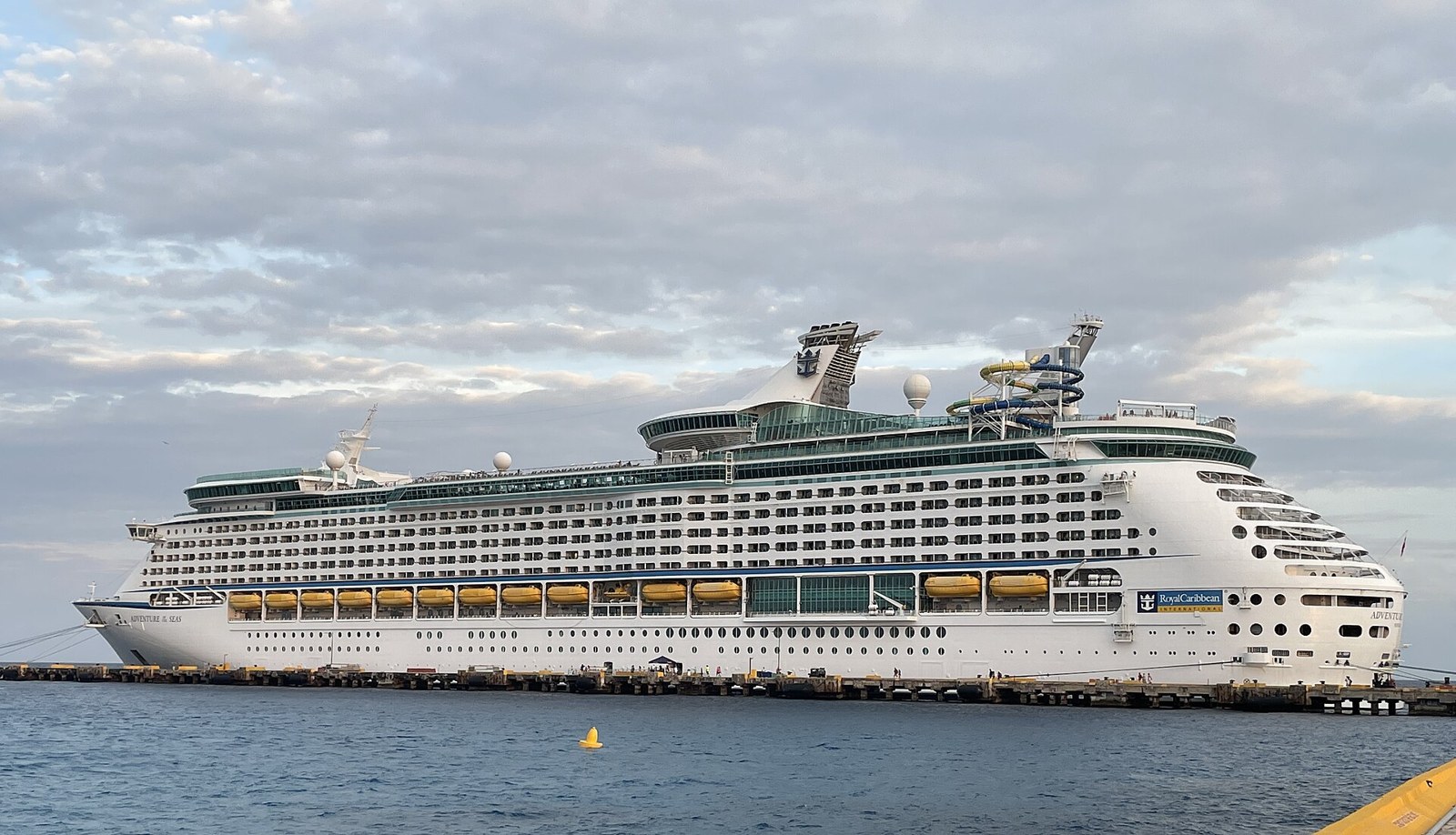
| IMO | 9167227 |
|---|---|
| Gross tonnage | 137,276 GT |
| Length | 311.0 m |
| Beam | 49.1 m |
| Passenger capacity (max) | 3807 |
| Service speed | 22.5 knots |
| Builder | Kvaerner Masa-Yards |
| Yard | Perno shipyard |
| Hull number | 1346 |
| Launched | 2001 |
| Maiden voyage | 2001 |
| Class | Voyager-class cruise ship |
| Operator | Royal Caribbean International |
| Status | Active |
Overview
Adventure of the Seas is the third of Royal Caribbean International's five Voyager-class ships, the class that at the turn of the century redefined how large a cruise ship could be and what it could carry. Delivered in 2001 from Finland, she entered service at a moment when the Voyager design — with its internal shopping and entertainment street, ice rink and rock-climbing wall — was the benchmark against which every rival megaship was measured. She has spent her whole career with a single operator and under a single name, which makes her hull history unusually simple for a ship of her size and age: the interest lies not in renamings but in how a first-generation megaship has been repeatedly updated to stay in front-line service for a quarter of a century.
Key specifications
The dataset records Adventure of the Seas at 137,276 GT, 311.0 m long with an extreme beam of 49.1 m, a maximum passenger capacity of 3,807 and a service speed of 22.5 knots. Her registered tonnage has been quoted higher in later sources — Wikipedia's ship article gives 138,193 GT — reflecting the extra enclosed volume and added staterooms of her refits; the dataset figure is the as-delivered measure and is retained in the spec box above. The same article records a crew of about 1,185, a figure the dataset leaves blank. Propulsion is diesel-electric, with three ABB Azipod units and four bow thrusters — the podded arrangement that became standard on large cruise ships of her generation — and the hull carries twelve passenger decks.
Design and construction
Adventure of the Seas was ordered on 24 April 1997 as part of Royal Caribbean's Voyager programme and built by Kvaerner Masa-Yards at its Perno (Turku New) shipyard in Finland, as hull 1346, at a reported cost of about US$500 million. Her keel was laid on 17 June 1998. The Voyager design was a deliberate step change: instead of arranging public rooms around a conventional atrium, the naval architects cut a four-deck-high, roughly 120-metre interior boulevard — the Royal Promenade — through the centre of the ship, lined with shops, cafés and bars and overlooked by promenade-view staterooms with bay windows. That single idea, pioneered on Voyager of the Seas in 1999, is the design feature that defines the class and the ship.
Naming, launch and maiden voyage
The ship was launched on 5 January 2001 and completed on 26 October 2001. She was christened on 10 November 2001 in New York — in the weeks after the September 11 attacks, Royal Caribbean chose representatives of New York's emergency services among the naming party, a gesture widely reported at the time. Her maiden voyage followed on 18 November 2001. The dataset records only the year, 2001, for both launch and maiden voyage; the precise dates above come from the ship's own reference article.
Career by operator
There is only one line in this ship's career table, which is itself the point: she is a one-operator, one-name hull.
| Period | Name | Operator |
|---|---|---|
| 2001–present | Adventure of the Seas | Royal Caribbean International |
Her early deployment pattern was typical of the class: Caribbean cruising, including long spells based at San Juan, Puerto Rico, interspersed with European seasons in the Mediterranean, the Baltic and Northern Europe, and calls in Canada and New England. Those are deployment patterns of record, not a statement of any present itinerary. Through successive fleet programmes she remained a front-line Voyager-class unit rather than being cascaded to a secondary brand — the treatment Royal Caribbean reserves for hulls it intends to keep.
Onboard character
The era-defining spaces are the ones built in at Turku. The Royal Promenade turned the inside of the ship into a street, with staterooms overlooking it — a layout copied across the industry ever since. The Voyager class also normalised activities once thought impossible at sea: a full-size ice-skating rink that doubles as a television studio, a rock-climbing wall mounted on the funnel, an inline-skating track and a nine-hole miniature golf course. Against that, the three-deck main dining room and the theatre kept the formal architecture of the classic cruise ship. Adventure is therefore best read as a hybrid: a resort ship wrapped around a recognisably traditional dining-and-show core.
Major refits and incidents
The ship was first refurbished in 2009, then received "Royal Advantage" upgrades in April 2014, including an outdoor movie screen, digital signage, ship-wide Wi-Fi and new concierge and Diamond lounges. Her largest early refit was the US$61 million programme of 2016, planned to add the Perfect Storm waterslides, a FlowRider surf simulator, the Splashaway Bay children's aqua park and more than 100 new staterooms. Hurricane Matthew's damage to the Grand Bahama Shipyard at Freeport in October 2016 curtailed that programme: the ship left dry dock on schedule in November 2016 without several planned features, the aqua park and slides were completed in the following weeks, and the deferred items — including the Izumi restaurant, additional staterooms and a suites lounge — were finished in a further 30-day dry docking beginning 31 January 2018. A later Royal Amplified modernisation was scheduled for 2020 and postponed when the industry shut down for the COVID-19 pandemic. No major casualty — fire, grounding or collision — is recorded for this hull in the sources consulted.
Sister ships and class
The Voyager class comprises five ships, all built in Finland: Voyager of the Seas (1999), Explorer of the Seas (2000), Adventure of the Seas (2001), Navigator of the Seas (2002) and Mariner of the Seas (2003). The first three form the original sub-group; Navigator and Mariner are a slightly enlarged second generation. On delivery the class were the largest passenger ships in the world by tonnage, a title they held until the arrival of Cunard's Queen Mary 2 and then Royal Caribbean's own Freedom class.
Fate and where she is now
There is no fate to record beyond continued service: the dataset lists the hull as active and operating for Royal Caribbean International, under her original name, more than two decades after delivery. She is a Phase 1 (active fleet) page in this directory, and her record will change only when Royal Caribbean sells, transfers or retires her.
Sources: https://en.wikipedia.org/wiki/List_of_cruise_ships; Adventure of the Seas, Wikipedia (ship article, incl. DNV-derived infobox); Ship Technology, "Adventure of the Seas Voyager Class Cruise Ship"; Travel Weekly, "Royal Caribbean curtails Adventure of the Seas renovation" (2016); Royal Caribbean Blog, refurbishment schedule report (2017).