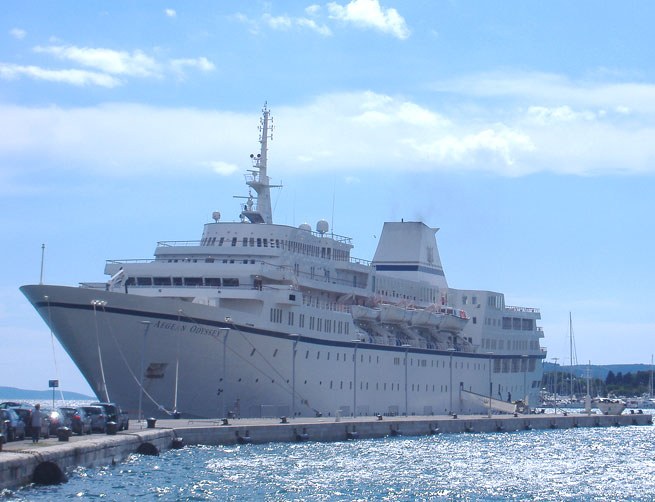
| IMO | 7225910 |
|---|---|
| Gross tonnage | 11,906 GT |
| Length | 140.5 m |
| Beam | 20.8 m |
| Passenger capacity (max) | 380 |
| Crew | 180 |
| Service speed | 18 knots |
| Builder | Damen Shipyards Galați |
| Hull number | 617 |
| Launched | 1972 |
| Maiden voyage | 1973 |
| Operator | Voyages to Antiquity |
| Status | Active |
| All names | Aegean Odyssey; Aegean I; Aegean Dolphin; Dolphin; Alkyon; Narcis |
Overview
Aegean Odyssey is a small cruise ship with an unusually long and varied past. She began life not as a cruise ship at all but as Narcis, a roll-on/roll-off ferry built in Romania for Israel's Zim Lines, and she spent her first twelve years carrying vehicles and passengers before a Greek buyer converted her for Mediterranean cruising. Under a succession of names — Aegean Dolphin and Aegean I among them — she worked for Greek operators and on charter to Renaissance Cruises, before a period of lay-up threatened to end her career altogether.
Her rescue came in 2009, when cruise veteran Gerry Herrod founded the one-ship company Voyages to Antiquity around her. Substantially rebuilt, with passenger numbers cut sharply to create a more spacious, lecture-led ship for travellers interested in Mediterranean history and archaeology, she re-entered service in 2010 as Aegean Odyssey.
Key specifications
The dataset records Aegean Odyssey at 11,906 GT and 140.5 metres long with a 20.8-metre beam — firmly in the small-ship category, and small enough, as her later career showed, to pass through the Corinth Canal, whose width defeats almost every modern cruise ship. Her IMO number, 7225910, has stayed with the hull through every name and flag change since 1973.
Wikipedia's article on the ship gives a closely matching set of figures — 11,906 GT and 140.51 metres — and adds the details the dataset leaves blank: a service speed of about 18 knots, a post-rebuild capacity of around 380 passengers, and a crew of about 180. Those later figures describe the ship as rebuilt for Voyages to Antiquity, not the far denser ferry and early cruise configurations she sailed in earlier in her life, when she carried as many as 570 passengers.
Design and construction
The ship was built at Galați, on the Danube in Romania, by the yard the dataset lists as Damen Shipyards Galați — in her building era the Galați naval shipyard, Șantierul Naval Galați. She was hull number 617. The keel was laid on 18 June 1971, according to Wikipedia, and the ship was completed on 22 August 1973 as a ro-ro ferry for Zim Navigation (Zim Lines).
As a ferry she was a working vessel, designed for vehicle decks and short crossings rather than for leisure. That origin explains much about her later character: a relatively narrow, shallow-draught hull, eight decks (seven accessible to passengers after conversion), and twin-screw diesel propulsion. The conversion to a cruise ship in 1988 — after her sale to Greek interests — involved rebuilding the vehicle spaces into cabins and public rooms, a transformation repeated and deepened in the major 2009–2010 rebuild for Voyages to Antiquity.
One dating point needs care. The dataset lists her launch year as 1973, the year of her completion and delivery. Wikipedia records her launch a year earlier, on 18 June 1972, with completion following in August 1973. The distinction is logged in the batch notes; the spec box above follows the dataset.
Naming, launch and maiden voyage
She entered service in 1973 under the name Narcis — a flower name in keeping with her original owner's ferry fleet. The name Aegean Odyssey, by contrast, was chosen half a lifetime later to describe exactly what the ship was being rebuilt to do: slow, port-intensive voyages around the Aegean and the wider Mediterranean in the company of historians and archaeologists.
There was no single famous naming ceremony in her early life that survives in the readily available record. Her most significant re-launch, in effect, was her return to service from the shipyard at Ermoupoli, on the Greek island of Syros, in the spring of 2010, when the rebuilt ship began operating for Voyages to Antiquity in May of that year under her present name.
Career by operator
Few ships in this directory have changed hands and names as often. The chain below is built from the dataset's name and operator fields, expanded with the dated name sequence in the ship's Wikipedia article, which fills two gaps the dataset's prose-style name field omits — Alkyon (1985–86) and Dolphin (1989–90).
| Name | Operator / owner | Years |
|---|---|---|
| Narcis | Zim Lines (Zim Navigation) | 1973–1985 |
| Alkyon | Dolphin Hellas Shipping | 1985–1986 |
| Aegean Dolphin | Dolphin Hellas | 1986–1989 |
| Dolphin | Dolphin Hellas | 1989–1990 |
| Aegean Dolphin | Dolphin Hellas / Epirotiki era | 1990–1996 |
| Aegean I | Chartered to Renaissance Cruises; later Golden Sun Cruises | 1996–2010 |
| Aegean Odyssey | Voyages to Antiquity | 2010 onwards |
After her ferry years with Zim, she was sold in 1985–86 to Dolphin Hellas and converted to a cruise ship in 1988. In 1996 she became Aegean I while chartered to Renaissance Cruises, afterwards operating for Golden Sun Cruises. A 2005 sale to Louis Hellenic Cruise Lines fell through amid legal problems and the ship was laid up, until Voyages to Antiquity bought her in 2009. In some summer seasons (2013 and 2015, per Wikipedia) she was operated in connection with the Turkish agency Etstur on Greek-islands tours.
Onboard character
The defining feature of Aegean Odyssey as rebuilt is subtraction. Cutting capacity from around 570 to around 380 passengers turned a dense, converted ferry into a deliberately spacious small ship. The cinema was removed and replaced by a lecture hall — the clearest possible statement of the Voyages to Antiquity idea, in which expert guest lecturers on history, archaeology and ancient civilisations were the entertainment, and shore excursions to classical sites were the point of the voyage.
New dining areas were created in the rebuild, and accommodation was rearranged into larger staterooms and suites, some with balconies. Her small size remained her greatest asset: she could enter harbours too small for mainstream cruise ships, work the island-dotted Adriatic and Aegean closely, and thread the Corinth Canal. Contemporary reviews describe a traditional, quietly elegant small ship — a library, unhurried public rooms and an educational programme, rather than casinos or spectacle.
Major refits and incidents
The two conversions dominate her refit history: the 1988 conversion from ro-ro ferry to cruise ship, and the substantial 2009–2010 rebuild at Ermoupoli, Syros, for Voyages to Antiquity, which reduced capacity, replaced the cinema with a lecture hall and created new dining spaces.
No major casualty — fire, grounding or collision — is recorded against the ship in the sources used for this guide. Her most precarious episode was commercial rather than nautical: the failed 2005 sale and the lay-up that followed, from which the Voyages to Antiquity purchase rescued her. Any earlier incident history from her ferry years is not documented in the article consulted.
Sister ships and class
The dataset assigns her no class, and she is best understood as a one-off: a Galați-built ro-ro ferry of the early 1970s, designed for Zim's ferry services rather than as part of a named cruise-ship class. She has no true sister ships in cruise service. Her real peer group is the generation of small, second-hand tonnage — converted ferries and early purpose-built cruise ships — that Greek operators kept working in the Mediterranean long after larger fleets had moved on, and of which she is one of the last survivors in anything like her original trade.
Fate and where she is now
The dataset records her status as active, operating for Voyages to Antiquity, and Wikipedia likewise lists her as in service. Her fate, unusually for a ship launched in the early 1970s, is therefore not the breakers' yard but continued small-ship service under the name she took in 2010 — the fourth decade-spanning identity of a hull that has been a ferry, a Greek island cruiser, a charter ship and, finally, a floating lecture hall for the ancient world.
Sources: https://en.wikipedia.org/wiki/List_of_cruise_ships; https://en.wikipedia.org/wiki/Aegean_I