| IMO | 8902333 |
|---|---|
| Gross tonnage | 23,287 GT |
| Length | 174.0 m |
| Beam | 24.0 m |
| Passenger capacity (max) | 650 |
| Service speed | 22.0 knots |
| Builder | IHI Corporation |
| Hull number | 2987 |
| Launched | 1990 |
| Maiden voyage | 1990 |
| Operator | New Century Cruise Line |
| Status | Active |
| All names | Aegean Paradise; Hainan Empress; Happy Dolphin; Delphin Voyager; Cruise One; Orient Venus |
Overview
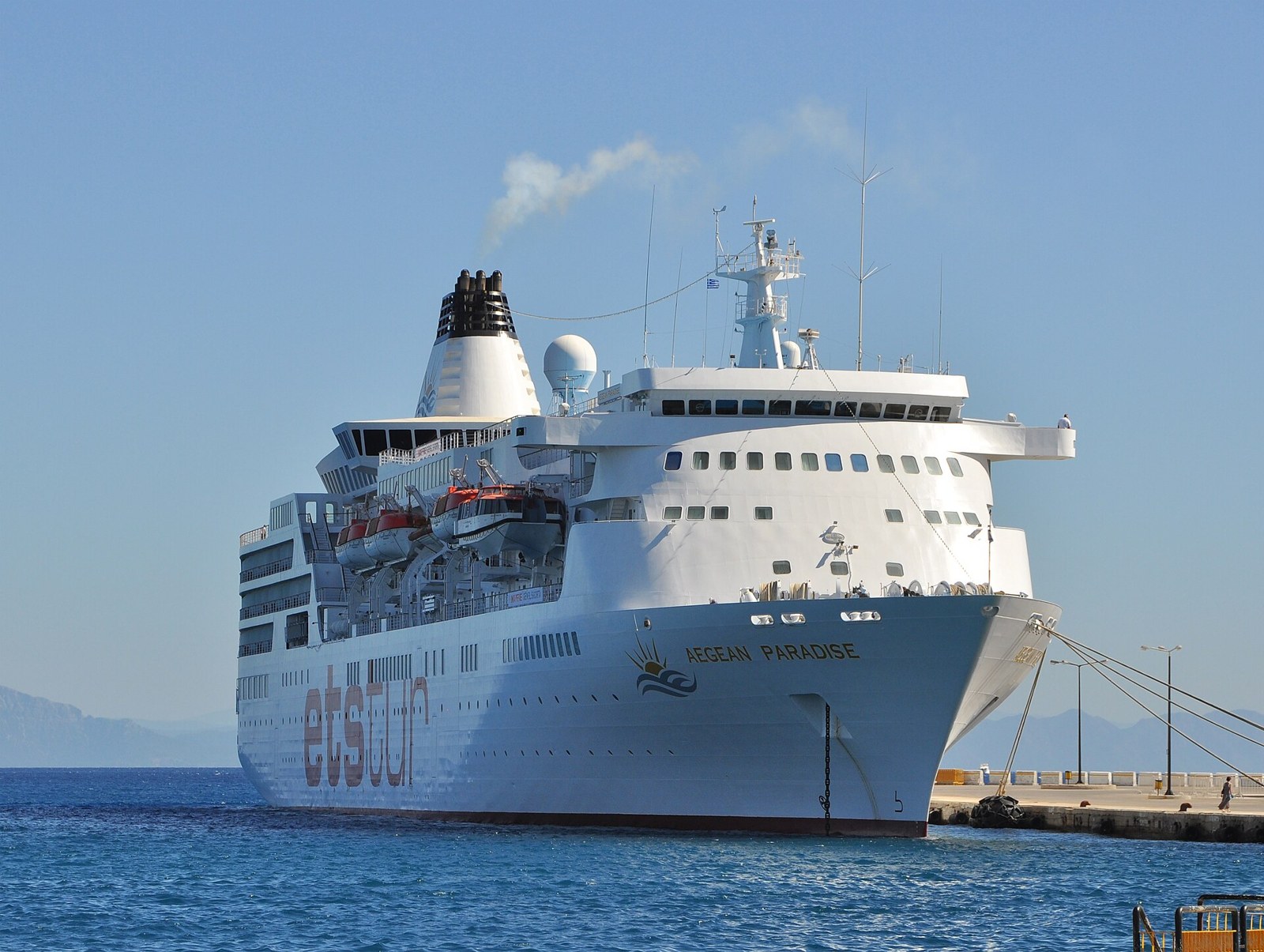
Aegean Paradise is a small Japanese-built cruise ship of 23,287 GT that has lived one of the most travelled second-hand careers of any hull in this directory. Built in 1990 for the Japanese market as Orient Venus, she was never a headline ship for a major Western line. Instead, her significance lies in how completely she illustrates the cascade market in cruising: a purpose-built ship for one country's domestic trade, sold on to a Greek-backed venture, rebuilt in Greece, passed through a rapid sequence of charters and short-lived brands in Europe and China, and finally bought for casino-and-short-cruise service in Southeast Asia. Few ships of her size have carried so many names in so few decades, which makes her an unusually clear case study in how a sound hull can outlive a string of operators.
Key specifications
The dataset records 23,287 GT, a length of 174.0 m, a beam of 24.0 m, a maximum capacity of 650 and a speed of 22.0 knots, with IHI Corporation as builder and hull number 2987. The capacity figure deserves a caution: 650 is modest for a ship of this tonnage and appears to reflect a particular configuration rather than every berth ever sold on board. No crew figure, class or yard name is given in the dataset, and none is invented here. Tonnage is GT, a measure of enclosed volume rather than weight. Her dimensions place her firmly in the small-ship tier of the early 1990s, closer in scale to a large ferry-derived cruiser than to the 70,000 GT ships then becoming the industry standard.
Design and construction
The ship was built in Japan by IHI Corporation and entered service in 1990. She was designed for Japan Cruise Line's domestic market, a trade that prized a self-contained, hotel-style ship for short sea voyages rather than the port-intensive pattern of Caribbean cruising. Contemporary descriptions of the original Orient Venus characterise her as a three-star-plus product aimed at the Japanese home market. Her second life began with a substantial rebuilding in Greece after her 2005 sale: the conversion, carried out around 2006, significantly modified her from her original form, upgrading her accommodation and public spaces for European charter work. That Greek rebuild is the defining construction event of her career — it turned a Japanese domestic ship into a vessel that Greek, German-charter, Chinese and Spanish operators could each present, however briefly, as their own.
Naming, launch and maiden voyage
The dataset gives both launch and maiden voyage as 1990, under the name Orient Venus, the only name she carried in Japanese service. No separate christening ceremony for this hull is documented in the sources used for this guide, and none is claimed. Her later names were commercial renamings rather than ceremonial launches: Cruise One from 2005, Delphin Voyager on charter from 2007, Hainan Empress in 2011, Happy Dolphin later in 2011, and Aegean Paradise from 2012, the name she still carries. The present name was adopted for a Turkish-market season cruising to the Greek islands, a deployment that explains a name with no connection to either her Japanese origins or her eventual Asian employment.
Career by operator
The dataset's names field lists only Aegean Paradise, but its own fate note preserves the earlier names, and trade reporting fills in the operators. The sequence below follows those sources; exact handover months for the shortest charters are hedged where reporting differs.
| Name | Operator / charterer | Period |
|---|---|---|
| Orient Venus | Japan Cruise Line | 1990–2005 |
| Cruise One | First Cruise Line (First Cruise One Corp., Restis Group) | 2005–2007 |
| Delphin Voyager | Delphin Kreuzfahrten (charter) | 2007–2010 |
| Hainan Empress | Hainan Cruise Enterprises (charter) | 2011 |
| Happy Dolphin | Quail Cruises / Happy Cruises (charter) | 2011 |
| Aegean Paradise | Etstur (charter) | 2012–2015 |
| Aegean Paradise | New Century Cruise Line | 2015–present |
She was sold in September 2005 to First Cruise One Corp., controlled by Greece's Restis Group, and rebuilt in Greece. Chartered to Germany's Delphin Kreuzfahrten as Delphin Voyager from April 2007, she was caught in that company's insolvency in October 2010 and spent time laid up at Perama. A short Chinese charter as Hainan Empress ran from early 2011 to about May 2011, followed by a charter to Quail/Happy Cruises as Happy Dolphin, which also collapsed in 2011, leaving her laid up at Piraeus. In 2012 she was chartered to Turkish operator Etstur and renamed Aegean Paradise. In July 2015 Seatrade Cruise News reported her sale for US$22.89 million to Kingston Maritime, part of Hong Kong's New Century group, as its third cruise ship alongside Leisure World and Amusement World — the operator the dataset records as her current one.
Onboard character
Her onboard character was set twice. As Orient Venus she was a modest, self-contained Japanese cruise ship. The Greek rebuild of about 2006 re-made her for the European charter market, and secondary descriptions present a compact, no-frills ship: dining rooms, lounges, a pool deck and casino space on a small footprint. The casino element became central in her New Century service, where her role in Southeast Asian short-cruise and gaming traffic mattered more than destination cruising. This guide makes no claim about her present-day venue list, which changes with each operator and refit.
Major refits and incidents
The major refit of her career is the Greek conversion of about 2006, which followed her sale out of Japanese service and significantly altered her interior arrangement. No major casualty — fire, grounding or collision — is documented for this hull in the sources used. Her record is instead one of commercial disruption: two of her charterers, Delphin Kreuzfahrten in 2010 and Quail/Happy Cruises in 2011, became insolvent while she was in their service, each time leaving the ship laid up in Greece while her owners found the next employment. Those episodes, rather than any physical incident, are the defining interruptions of her career, and they explain the speed of her renamings in 2010–2012.
Sister ships and class
The dataset lists no class for this ship, and she is treated here as a one-off build rather than as a member of a named series. No sister ship trading under a related design has been identified in the sources used. That individuality is part of her story: unlike the standardised classes ordered in pairs and quartets by the major groups, she was a single hull built for a single national market, and everything that followed — the rebuild, the charters, the cascade of names — flowed from owners adapting a unique ship rather than redeploying one of a fleet of sisters.
Fate and where she is now
The dataset records her as active, operated by New Century Cruise Line, and trade reporting supports a long second career in Southeast Asia after the 2015 purchase. Beyond that status, this guide makes no claim about her present deployment: where a small, elderly, frequently re-sold ship is working at any given moment is precisely the kind of fact that rots, and the directory's evergreen rule excludes it. What is permanent is the shape of her career — a 1990 Japanese newbuild that survived the failure of two charterers, carried six names, and was still valuable enough in 2015 for a Hong Kong group to pay almost US$23 million for her as a going concern.
Sources: https://en.wikipedia.org/wiki/List_of_cruise_ships, https://www.seatrade-cruise.com/shipbuilding-equipment/hong-kong-s-new-century-buys-third-cruise-ship-for-23m, https://marinesource.com/boats-for-sale/listing_print.cfm?listingnmb=100839673