| IMO | 9112789 |
|---|---|
| Gross tonnage | 38,557 GT |
| Length | 193.34 m |
| Beam | 27.6 m |
| Passenger capacity (double) | 1382 |
| Passenger capacity (max) | 1940 |
| Service speed | 20.0 knots |
| Builder | Kvaerner Masa-Yards |
| Yard | Perno shipyard |
| Hull number | 1337 |
| Launched | 1996 |
| Maiden voyage | 1996-06-01 |
| Operator | Aquilon Shipping Co |
| Status | Active |
| All names | Astoria Grande; AIDA; AIDAcara |
Overview
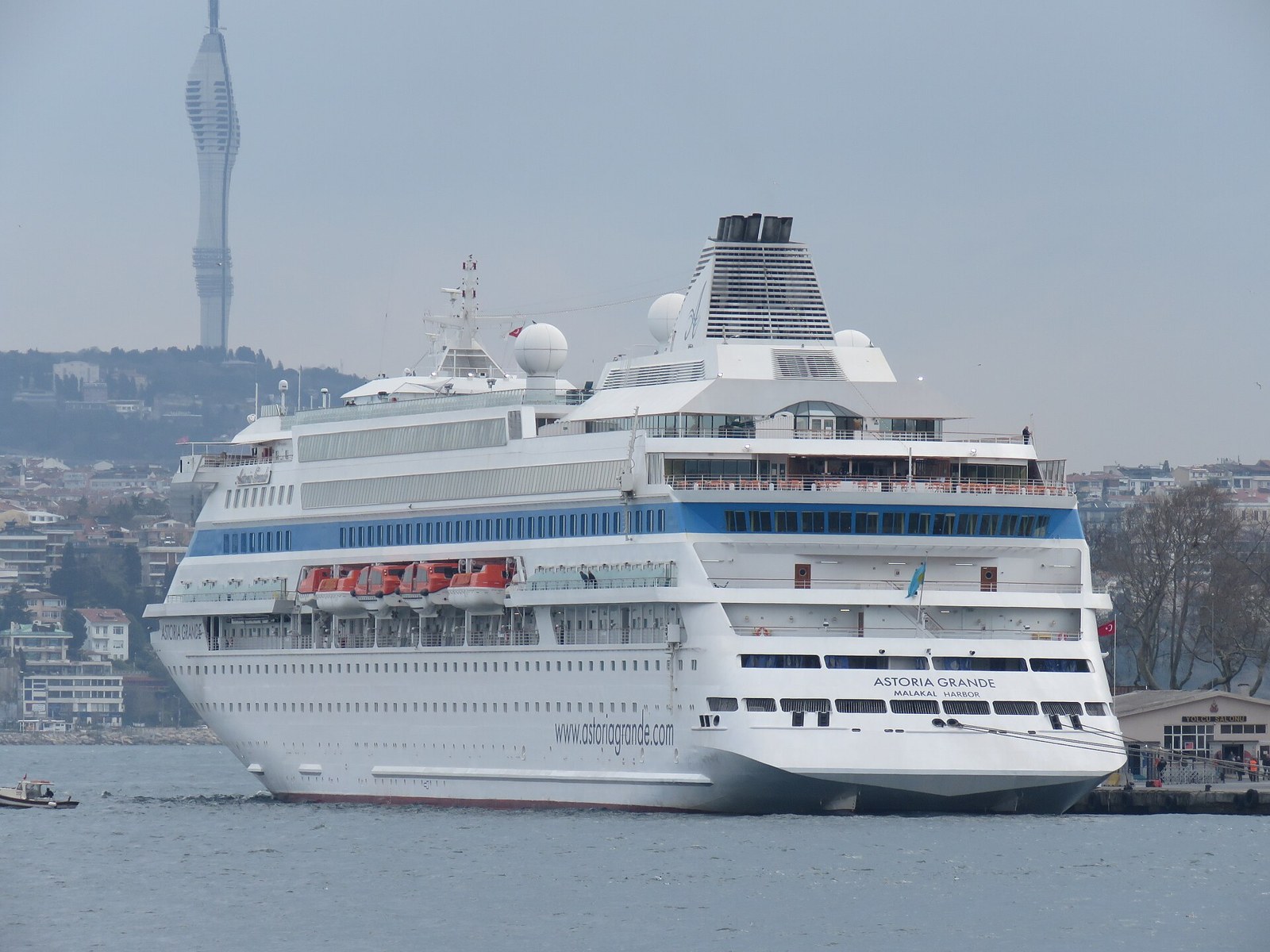
Astoria Grande is the ship that launched AIDA Cruises. Delivered in 1996 as AIDA — often styled the "Clubschiff," the club ship — she was the first vessel built for the German brand and the prototype for the informal, resort-style cruising that AIDA later scaled into one of Europe's largest fleets. Renamed AIDAcara in 2001, she spent 25 years with AIDA, latterly as one of its small-ship "Selection" vessels, before the pandemic ended her German career. Sold in 2021 to Russian interests and renamed Astoria Grande, she began a second career aimed at the Russian market. Her arc — pioneering newbuild, elderly fleet favourite, pandemic-era disposal, reinvention under a new flag and market — compresses the whole life cycle of the modern cruise ship into one 38,557 GT hull.
Key specifications
The dataset records 38,557 GT, a length of 193.34 m, a beam of 27.6 m, a maximum capacity of 1,339, a speed of 20.0 knots, builder Kvaerner Masa-Yards at the Perno shipyard, Turku, and hull number 1337. Published sources give a passenger capacity of 1,186 at double occupancy within that maximum, and a crew of about 360. Her published building cost was DM 300 million. The dataset lists no class for her; she was a one-off prototype rather than the lead ship of a series. Tonnage is GT, a volumetric measure. By the standards of 1996 she was a mid-size ship; by the standards of the fleet she left in 2021, she was a small one — a change in relative scale that shaped her final AIDA years.
Design and construction
The ship was built by Kvaerner Masa-Yards at Turku, Finland, as yard number 1337. Her keel was laid on 11 September 1995, she was launched on 16 February 1996, and she was completed on 4 June 1996. She is diesel-electric, with MAN B&W diesel generating sets driving two electric motors of a combined 21,720 kW in published sources. The design brief was the radical part: Seetours International, AIDA's then parent, set out to bring the freedom of a land-based club resort to sea, targeting first-time cruisers in the German market. The ship was arranged accordingly, with open-seating restaurants dominated by buffet service — trade histories record that over 90 per cent of her original restaurant capacity was self-service — instead of the fixed-seating, formal dining pattern that still defined cruising in the mid-1990s. In size and hardware she was unremarkable; in product design she was the prototype of a brand.
Naming, launch and maiden voyage
She entered service in June 1996 under the name AIDA, the brand itself carried as the ship's name. She was christened at Warnemünde on 7 June 1996 by Christiane Herzog, wife of the then German President Roman Herzog, according to Cruise Industry News reporting of her 30th anniversary. The dataset records her maiden voyage as 1996-06-01; published references date her completion to 4 June 1996 and the christening to 7 June, so the dataset's 1 June figure should be treated as approximate. In December 2001 she was renamed AIDAcara, as AIDA adopted the practice of giving its ships individual names prefixed with the brand — the name under which she spent most of her career. The name Astoria Grande was adopted in 2021 by her new owners.
Career by operator
| Name | Operator | Period |
|---|---|---|
| AIDA | AIDA Cruises | 1996–2001 |
| AIDAcara | AIDA Cruises | 2001–2021 |
| Astoria Grande | Aquilon Shipping Co. | 2021–present |
With AIDA she cruised principally in the Mediterranean, the Caribbean, the Canary Islands and northern Europe in her early years, later ranging to South America and the Middle East, and in early 2017 she undertook her first full world cruise — a notable assignment for the fleet's smallest and oldest ship, and a sign of her following among repeat passengers. In her final AIDA years she sailed as part of the line's "AIDA Selection" grouping of smaller ships offering longer, port-intensive itineraries. She never resumed service after the 2020 pandemic shutdown. On 23 June 2021 Carnival Corporation announced her sale to an undisclosed buyer; the purchaser emerged as the Russian company Aquilon Shipping, ownership passed through associated companies (the dataset records operator Aquilon Shipping Co.; Wikipedia lists Aquilon as owner 2021–22 and Goodwin Shipping Ltd. from 2022), and she returned to service in early 2022 under the Astoria Grande name for the Russian market.
Onboard character
Her enduring character is the original club-ship idea: casual dress, open seating, buffet-led dining, sports and activity programming, and an absence of the formal rituals — captain's cocktail parties, fixed sittings, dress codes — that German first-time cruisers of the 1990s associated with ocean travel and avoided. Lars Clasen, president of Seetours International, described the aim in a 2002 interview as bringing the "freedom of land-based" resorts on board. Physically she is a compact ship of eleven decks, nine for passengers, with a single main pool area rather than the multi-venue decks of later AIDA ships. That compactness, a limitation in her early years, became her selling point in the Selection era, when AIDA marketed her precisely as the small, familiar alternative to its 70,000–124,000 GT newer ships. This guide does not list her present-day venues under her current operator.
Major refits and incidents
Wikipedia records a refit in 2005, during her AIDA career; no further major reconstruction is documented, and her 2021 change of ownership involved refurbishment for her new market in secondary reporting. No major casualty is recorded for this hull in the sources used. Her most dramatic episode was operational rather than physical: she was caught in the general fleet shutdown of March 2020, after which she, unlike most of her fleetmates, never returned to service for AIDA. Her sale in June 2021 cancelled fourteen planned sailings scheduled between October 2021 and March 2022. Those facts, rather than any incident at sea, mark the turning point of her career.
Sister ships and class
She has no true sisters. AIDA was a one-off prototype, and AIDA's growth was achieved with new designs — the smaller AIDAvita and AIDAaura of 2002–03 (themselves a pair), then the seven-ship Sphinx class from 2007. In the fleet's internal family, however, she was grouped in her last years with AIDAvita, AIDAaura and AIDAmira in the "AIDA Selection" programme of smaller ships, and directory readers most often look for her alongside those vessels. The dataset lists no class for her, which is correct: she is a prototype, and every later AIDA ship is her successor rather than her sister.
Fate and where she is now
The dataset records her as active under Aquilon Shipping Co., and she remains in service under the name Astoria Grande for a Russian-market operation in which she is the operator's only cruise ship. Trade reporting in October 2024 noted that her owners had listed her for sale at an asking price reported between US$40–50 million, which illustrates the unusual economics of her second career: a 1996 hull, too small for the Western majors, can still command a substantial price where she is the only available ship of her kind. Whatever her next sale brings, her historical position is fixed — she is the first AIDA ship, and the floating proof of the club-ship concept on which a major European brand was built.
Sources: https://en.wikipedia.org/wiki/List_of_cruise_ships, https://en.wikipedia.org/wiki/Astoria_Grande, https://cruiseindustrynews.com/cruise-news/2026/10/astoria-grande-former-aidacara-marks-30-years/