| IMO | 5050866 |
|---|---|
| Gross tonnage | 10,216 GT |
| Length | 156.0 m |
| Beam | 19.6 m |
| Builder | Mitsubishi Heavy Industries Kobe Shipyard & Machinery Works |
| Hull number | 858 |
| Launched | 1954 |
| Maiden voyage | 1954 |
| Status | Preserved |
| Preserved at | Zhanjiang, China |
| All names | Hai Shang Cheng Shi; Brazil Maru; Toba Brazil Maru; Zhanjiang |
Overview
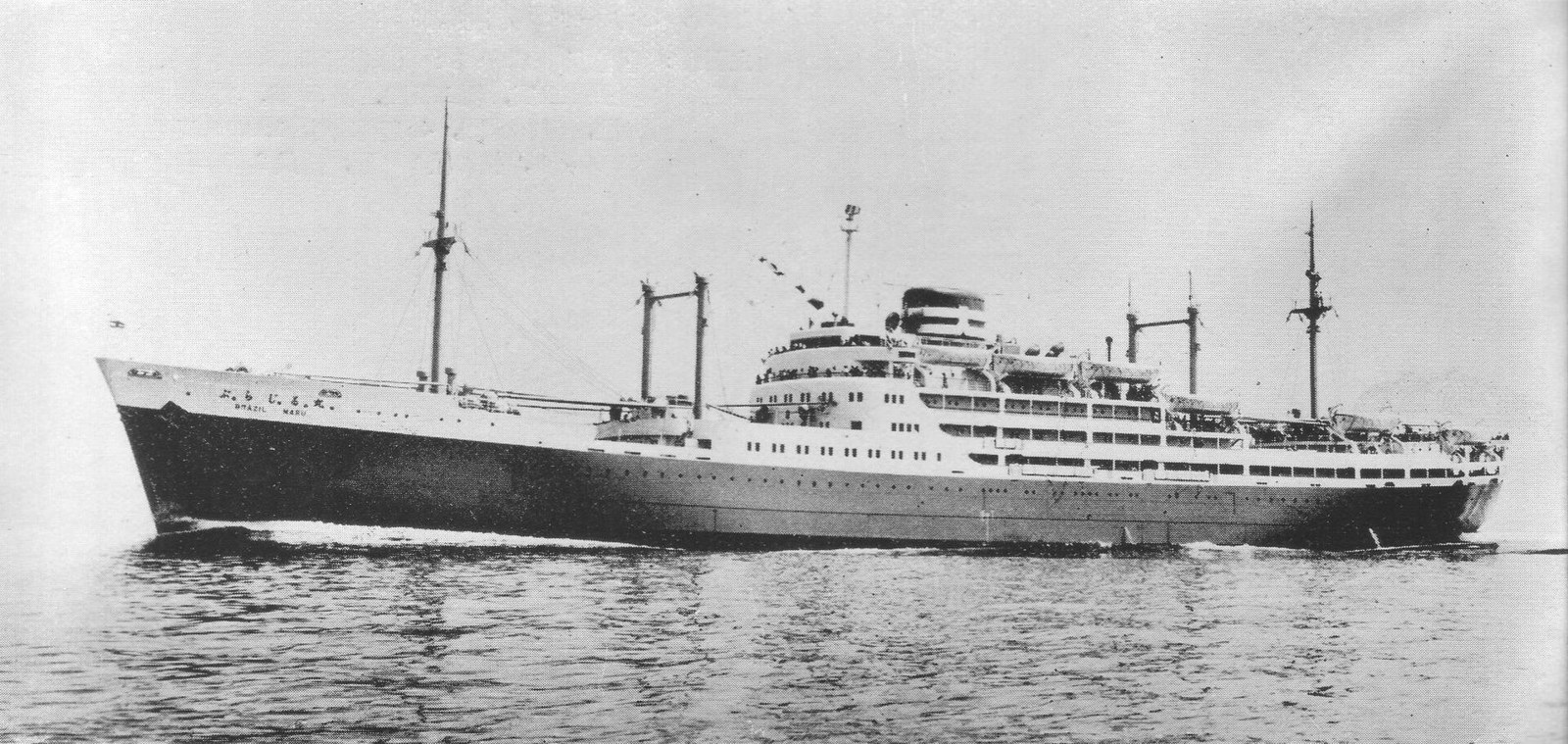
Brazil Maru is a Japanese cargo liner of 1954, built for Osaka Shosen's emigrant service from Kobe to South America, and one of the very few postwar emigrant ships to survive into preservation. In twenty years at sea she made 58 long-distance voyages and carried about 67,000 passengers on the South America route, of whom 16,204 were emigrants beginning new lives in Brazil and Argentina. Retired in 1974, she spent twenty-two years as the museum ship Toba Brazil Maru at Toba, Japan, attracting some ten million visitors; sold for scrap in 1996, she was rescued, beached at Zhanjiang in China in 1998 as the tourist attraction Hai Shang Cheng Shi — "Maritime City" — and remains there, closed in recent years but, as of reporting in August 2025, the subject of a major renovation project. She is a ship whose second and third lives have now lasted far longer than her first.
Key specifications
The dataset records a tonnage of 10,216, a length of 156.0 m, a beam of 19.6 m, Mitsubishi's Kobe yard hull 858, and IMO 5050866, with capacity, crew and speed blank. The tonnage figure needs the label this directory's liner-era pages always require: it is gross register tonnage, GRT, not modern GT. Her article supplies the rest: as built she measured 10,100 GRT with 9,882 DWT, a single Shin-Mitsubishi Kobe Sulzer 10RSD76 diesel of 9,000 bhp on one screw, a service speed of 16.25 knots, a crew of 118, and accommodation for 982 passengers — just 12 in first class, 68 in second and 902 in third, the dormitory emigrant trade in a single line of figures. The dataset's names list is also incomplete: it ends at Zhanjiang, omitting Hai Shang Cheng Shi, the name she has carried since 1998.
Design and construction
Brazil Maru was a cargo liner, not a cruise ship: a motor ship designed to carry freight and a large number of emigrant passengers on a fifty-day-class route, and to convert her third-class dormitory space to cargo stowage on the homeward voyage, when emigrant demand ran the other way. Osaka Shosen ordered her after the 1952 San Francisco Peace Treaty allowed Japan to resume organised emigration to South America as national policy, and after stopgap conversions of three cargo ships had shown the demand. Her construction contract was signed on 10 October 1953; she was laid down on 27 October 1953 at the Shin-Mitsubishi Heavy Industries Kobe Shipyard, launched on 6 April 1954 and completed and delivered on 10 July 1954. She was powered by the first production example of her builder's new Sulzer-type diesel, a detail her yard's own history records with pride. Her near-sister Argentina Maru followed in 1958, and a third ship, Sakura Maru, doubled as a floating trade fair.
Naming, launch and maiden voyage
She was launched and delivered as Brazil Maru, named for the destination that defined her service and home to the largest Japanese community outside Japan. The name itself was an inheritance: an earlier Osaka Shosen Brazil Maru had been lost in the war, and the 1954 ship was the second generation of the name in the company's South America fleet. Twenty days after completion she sailed on her maiden voyage from Kobe on 30 July 1954, carrying 603 emigrants for Brazil among 896 people on board in the account given in her article. The voyage took 44 days and called at Nagoya, Yokohama, Los Angeles, through the Panama Canal to Cristóbal, La Guaira, Belém, Recife, Rio de Janeiro and Santos, ending at Montevideo and Buenos Aires — a single sailing that maps the whole Japanese emigration story of the 1950s.
Career by operator
| Name | Operator / owner | Period |
|---|---|---|
| Brazil Maru | Osaka Shosen KK | 1954–1963 |
| Brazil Maru | Nihon Ijusen KK (chartered back to Osaka Shosen) | 1963–1970 |
| Brazil Maru | Mitsui O.S.K. Lines | 1970–1974 |
| Toba Brazil Maru | Toba Brazil Maru Tourist Company (museum, Toba) | 1974–1996 |
| Zhanjiang | Zhanjiang Maritime City Tourism and Entertainment | 1997–1998 |
| Hai Shang Cheng Shi | Zhanjiang Maritime City Tourism and Entertainment (attraction, Zhanjiang) | 1998–present |
The dataset leaves operator history blank for this hull; the chain above is from her article. Her sea career fell as Japan's economic miracle emptied the emigrant trade: sailings fell below 1,000 emigrants a year in the 1960s, she was refitted at Kobe in August 1965 — halving her passenger capacity to 360 in cabin and economy classes, adding the comforts of the tourist trade and raising her measurement to 10,216.6 GRT — and thereafter ran the route only three times a year. Transferred to the merged Mitsui O.S.K. Lines in 1970 (Osaka Shosen had merged with Mitsui in 1964), she was tried, unsuccessfully, on cruises from Japan to Shanghai, laid up in 1973, given one final Shanghai cruise, and withdrawn in February 1974.
Onboard character
Her onboard character changed completely with her trade. As built she was a ship of dormitories: 902 third-class berths against 80 cabin berths, a working emigrant carrier whose public rooms served communities in transit for six weeks at a time. The 1965 rebuild civilised her for tourists — dormitories became four-, six- and eight-berth cabins, air-conditioning and a swimming pool were added, and cabin and economy classes each gained their own dining room, smoking room and lounge, in the pattern described by the Last Ocean Liners account of the Mitsui-OSK trio. As Toba Brazil Maru her character became didactic: exhibition spaces including a "Marine Corner" of ship models and a "Brazil Corner" on Brazilian nature and culture, a restaurant, games and shopping, with her wheelhouse and engine room preserved as in service. The through-line is adaptability — a hull plain enough to be an emigrant dormitory, a cruise ship and a museum in turn.
Major refits and incidents
Her one major sea-service refit is the August 1965 Kobe conversion described above, which changed her capacity, her measurement and her market in a single docking. Her later conversions — to a moored museum at Toba in 1974, refitted by her original builders, and to the Hai Shang Cheng Shi attraction at Zhanjiang in 1998, with new facilities and restaurants inserted but her exterior and wheelhouse left largely intact — were refits of purpose rather than of machinery. No casualty at sea is recorded in her article, and none is claimed here; her documented deterioration came ashore, in the Zhanjiang years, when poor management and lack of maintenance left her visibly dilapidated in photographs from 2012, with damaged lifeboats and heavy rust, before maintenance work was observed in 2018. Her Toba closure on 30 January 1996, after the Japanese asset bubble burst, and her sale to Shanghai breakers that February are commercial events, but they came closer to ending her than anything in her twenty years at sea.
Sister ships and class
Her running mate was Argentina Maru (1958), a similar but slightly larger ship of 10,983 tons in the figure given in her article's account, built for the same Osaka Shosen South America service; Sakura Maru, designed to double as a floating exhibition ship, completed the postwar trio. The dataset records no formal class for Brazil Maru, and none is claimed. The three ships were, in effect, the last Japanese emigrant liners: when the trade died, none of the trio had a second sea career of consequence, and only Brazil Maru survives — preserved twice over, in two countries, which makes her the trio's archive as well as its last hull.
Fate and where she is now
Her fate is preservation — twice rescued and, at the time of the latest reporting used, under renovation. Sold to Shanghai breakers in 1996, she was bought in 1997 by the chairman of Zhanjiang Maritime City Tourism and Entertainment, renamed Zhanjiang, beached at Zhanjiang, Guangdong, in 1998 and reopened as Hai Shang Cheng Shi. The dataset's fate note — "Beached as a restaurant in Zhanjiang, China, currently closed" — matches her article's position that the attraction has closed, though the hull remains extant and visible on satellite imagery at Zhanjiang. In 2020 the ship appeared as a location in the Chinese television series The Bad Kids. In August 2025 local reporting announced a 100-million-yuan renovation to right, reinforce and rebuild her as part of a wider revival of Zhanjiang's historic waterfront, with preliminary work reported launched on 1 August 2025.
Visit her today
Brazil Maru — as Hai Shang Cheng Shi, the "Maritime City" — is beached at Zhanjiang, Guangdong Province, China, the preserved location recorded in the dataset. Visitors should understand her present state honestly: the attraction has been reported closed in recent years, with the ship dilapidated in the 2010s, subject to some maintenance by 2018, and announced in August 2025 as entering a major renovation intended to reopen her as part of Zhanjiang's historic and cultural waterfront. No opening hours or official visitor site are asserted here, because none is confirmed in the sources used; anyone travelling to see her should verify locally whether the renovation has reopened the ship before making the journey. What can be seen from the waterfront is the hull itself — exterior and wheelhouse largely intact from her liner years — which, for a 1954 Japanese emigrant ship, is reason enough for the trip. Her first museum career, as Toba Brazil Maru at Toba, Japan (1974–1996), is closed and cannot be visited.
Sources: https://en.wikipedia.org/wiki/List_of_ocean_liners, https://en.wikipedia.org/wiki/MV_Brazil_Maru, https://lastoceanliners.com/line/mitsui-osk-lines?l=MOL