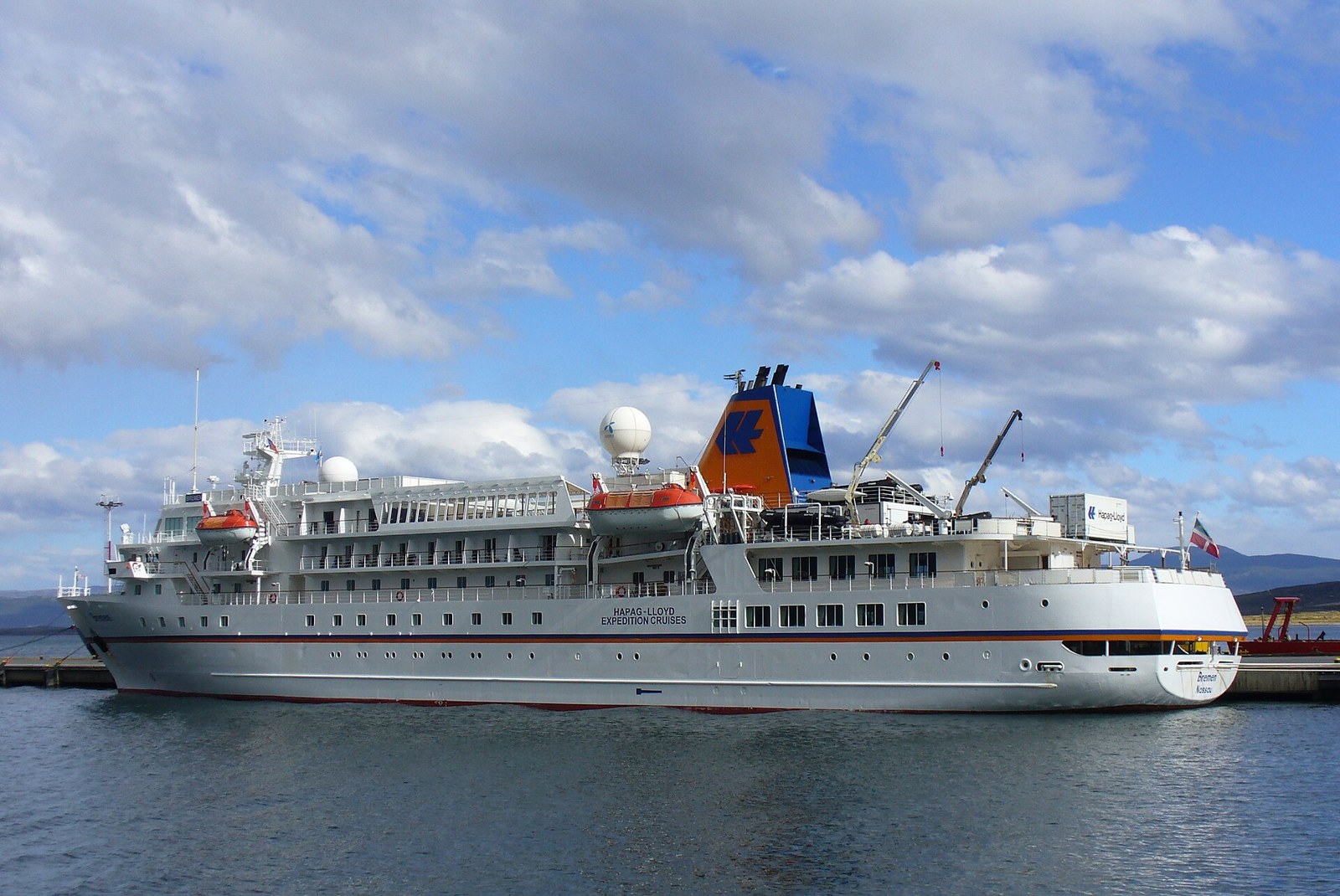
| IMO | 8907424 |
|---|---|
| Gross tonnage | 6,752 GT |
| Length | 111.0 m |
| Beam | 17.0 m |
| Passenger capacity (max) | 155 |
| Service speed | 16.0 knots |
| Builder | Mitsubishi Heavy Industries |
| Hull number | 1182 |
| Launched | 1990 |
| Maiden voyage | 1990 |
| Operator | 66expeditions |
| Status | Active |
| All names | Seaventure; Bremen; Frontier Spirit |
Overview
Bremen is a small expedition cruise ship built for the polar and expedition market, and for most of her career she was the expedition flagship of Germany's Hapag-Lloyd Cruises. At just 6,752 GT and carrying a maximum of 164 passengers, she belongs to a completely different world from the large resort ships that dominate cruising: a compact, ice-strengthened vessel designed to take a small number of guests into the Antarctic, the Arctic and other remote waters that bigger ships cannot reach.
She was not built as Bremen. The ship was completed at Kobe, Japan, in 1990 as Frontier Spirit for Frontier Cruises, a joint venture aimed at the top end of the expedition market. When that venture wound down, Hapag-Lloyd — one of the partners behind it — acquired the ship in April 1993 and renamed her Bremen, reviving one of the most prestigious names in German shipping. She then spent 27 years as Hapag-Lloyd's expedition workhorse before being sold on and renamed Seaventure, the name she carries today.
Key specifications
The dataset figures in the box above define the ship: 6,752 GT, 111.0 m long and 17.0 m in the beam, with a maximum capacity of 164 passengers and a speed of 16.0 knots. Contemporary Hapag-Lloyd material put her passenger complement at around 155–164 guests served by roughly 100 crew, an unusually high crew-to-guest ratio that reflected her luxury expedition positioning. She has seven decks in total, six of them for passengers, and a shallow draught of about 4.8 m that lets her work close inshore where larger vessels cannot go.
Her defining technical feature is her ice class. She was built to the highest ice classification awarded to passenger vessels — described by Hapag-Lloyd as E4, equivalent to 1A Super — which made her, at the time of her launch, a full classification higher than any existing expedition vessel.
Design and construction
Bremen was built by Mitsubishi Heavy Industries at its Kobe yard in Japan, yard number 1182. She was laid down on 26 January 1990, launched on 20 June 1990 and completed in July 1990. Cruise Industry News has described her as arguably the original purpose-built expedition cruise ship, and the first new expedition vessel built since 1974.
Her expedition specification went well beyond ice class. She was built with a double-bottom hull, strengthened propeller shafts and bow, and additional ice protection on her rudders. Propulsion is by two Daihatsu diesel engines of 2,427 kW each, driving two shafts with controllable-pitch propellers, supplemented by a bow thruster. Rather than tenders in the conventional sense, she carries a fleet of motorised Zodiac inflatables — twelve in Hapag-Lloyd service — which are the real working boats of an expedition ship, used for landings and wildlife viewing. She also has a helicopter deck and fin stabilisers, an unusual comfort feature on a ship of this size and era.
Naming, launch and maiden voyage
The ship entered service in late 1990 as Frontier Spirit, sailing her first cruise under the Frontier Cruises banner from Guam. Frontier Cruises was a joint venture whose partners included NYK, Hapag-Lloyd, Salen Lindblad and Mitsubishi interests, and the ship was conceived as the most luxurious expedition vessel ever built. The venture did not last: in 1992 the operation passed to the SeaQuest Cruises brand, and in April 1993 Hapag-Lloyd acquired the ship outright as SeaQuest closed down.
Renamed Bremen, she took a name with deep resonance in German maritime history — the name of the great North German Lloyd express liners, including the 1929 Blue Riband winner. The dataset records the renaming year, 1993, as her launch year; her physical launch at Kobe in fact took place on 20 June 1990, under her original name.
Career by operator
| Years | Name | Operator |
|---|---|---|
| 1990–1993 | Frontier Spirit | Frontier Cruises (later SeaQuest Cruises) |
| 1993–2020 | Bremen | Hapag-Lloyd Cruises |
| 2020–present | Seaventure | Scylla AG (chartered to Polar Latitudes and Iceland ProCruises); sold to 66expeditions in 2024 |
Under Frontier and SeaQuest she pioneered high-end expedition cruising, including a successful Northwest Passage transit in 1992 — she was the 53rd ship, and only the fourth passenger vessel, to complete it, under Captain Heinz Aye, after an attempt the previous year had been abandoned because of pack ice. With Hapag-Lloyd from 1993 she settled into a bilingual German-market expedition programme built around Antarctica in the southern summer and the Arctic, Greenland, the Amazon and other expedition regions in the northern summer, repeating the Northwest Passage in 2006 with the help of satellite ice imagery.
In January 2019 Hapag-Lloyd announced her sale to Swiss operator Scylla AG, with handover planned for May 2021 as new expedition tonnage joined the Hapag-Lloyd fleet. She was renamed Seaventure in 2020 and chartered out seasonally — to Polar Latitudes for the Antarctic season and Iceland ProCruises in the northern summer. In 2024 she was sold again, to the Chinese company 66expeditions, which took her over in May 2025.
Onboard character
Bremen was an expedition ship first and a cruise ship second, and her onboard character followed from that. Accommodation was all outside-facing: a small number of cabins and two suites, most with panoramic windows and a handful with private balconies, spread over the passenger decks. Public life centred on a single restaurant, a lounge used for the lectures and briefings that structure an expedition day, and extensive open deck from which to watch wildlife and scenery.
The atmosphere was that of a travelling field station with hotel service attached: an expedition team of lecturers and naturalists, Zodiac cruising and shore landings as the daily programme, and a largely German-speaking guest list, with some sailings operated bilingually in German and English. That formula — small ship, expert staff, ice-class hull — defined the modern luxury expedition ship, and Bremen was one of its templates.
Major refits and incidents
Her most serious incident came in March 2001, when a rogue wave in the South Atlantic smashed a window on the bridge, caused heavy damage and left the ship adrift without propulsion for about two hours. The episode later featured in the television documentary series Killer Waves and the BBC's Horizon programme on freak waves.
In 2003 she discovered a previously uncharted island in Antarctic waters; it was named Bremen Island (Bremeninsel) after her in 2004. In July 2018, during a shore excursion in Svalbard, a polar bear injured a crew member leading a landing party and was shot dead by another crew member; Hapag-Lloyd described the shooting as an unavoidable act of self-defence, and the injured crew member was evacuated by helicopter.
Her post-Hapag-Lloyd refit for the 2021–22 expedition season reduced her Antarctic capacity to around 139–155 guests, creating a more spacious ship for her charter work as Seaventure.
Sister ships and class
Bremen has no sister ships. She was a one-off design built for Frontier Cruises, and no second vessel of the type was ordered. Her significance lies not in a class but in the type she established: a small, ice-classed, Zodiac-equipped luxury expedition ship, a template that much larger fleets of expedition newbuilds would later follow.
Fate and where she is now
The ship remains in service, but no longer as Bremen and no longer for Hapag-Lloyd. Renamed Seaventure in 2020 and handed over to Scylla AG in 2021, she spent several seasons on charter to expedition operators including Polar Latitudes and Iceland ProCruises. In 2024 she was sold to the Chinese company 66expeditions, and the new owner took over in May 2025. The Bremen name, meanwhile, has not been carried by a Hapag-Lloyd ship since her departure.
Sources: https://en.wikipedia.org/wiki/List_of_cruise_ships, https://en.wikipedia.org/wiki/MS_Bremen, https://www.cruiseindustrynews.com/cruise-news/20892-new-vessel-brings-polar-prowess-to-polar-latitudes.html