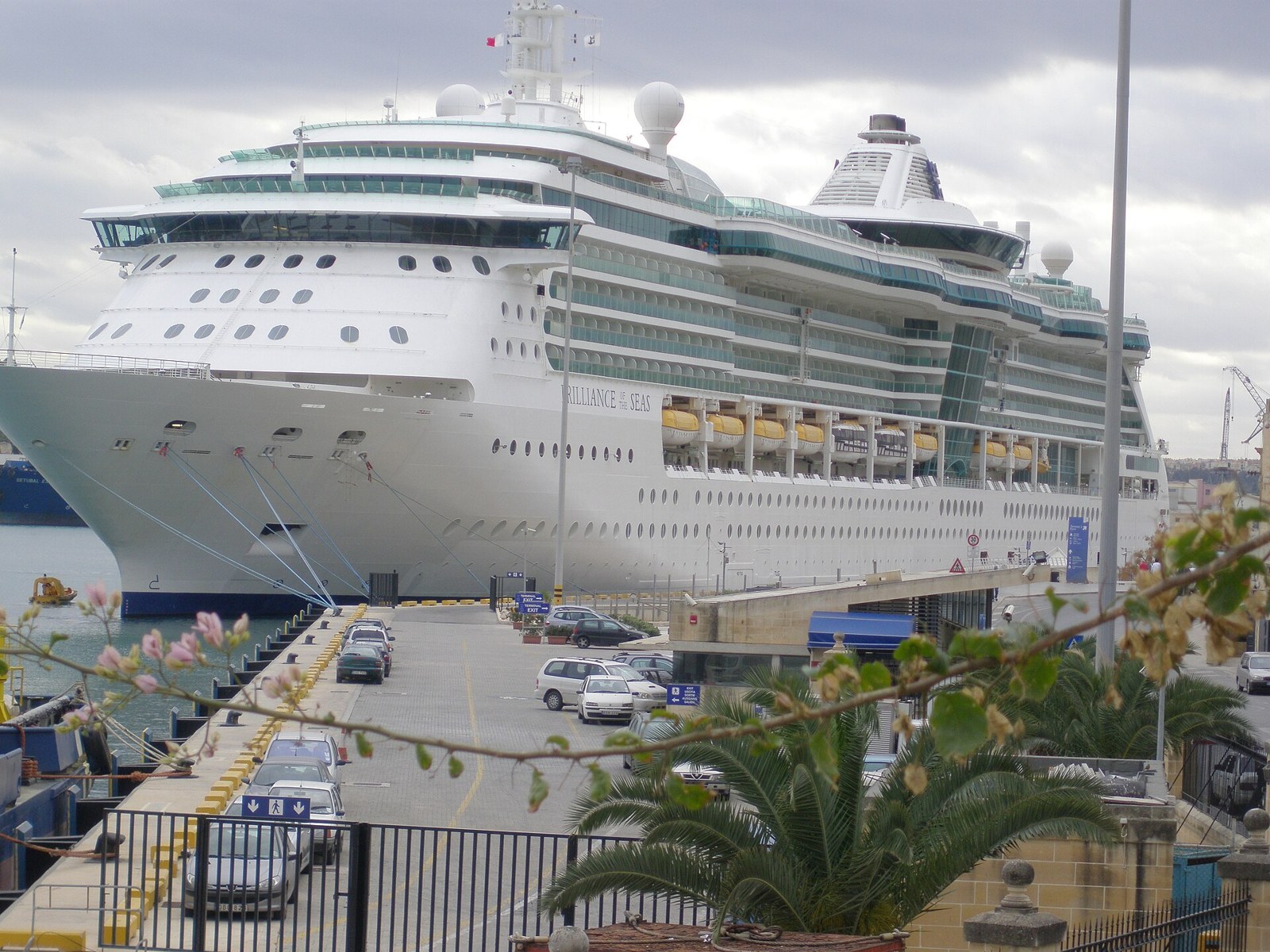
| IMO | 9195200 |
|---|---|
| Gross tonnage | 90,090 GT |
| Length | 293.95 m |
| Beam | 39.8 m |
| Service speed | 25.0 knots |
| Builder | Meyer Werft |
| Yard | Papenburg |
| Hull number | 656 |
| Launched | 2002 |
| Maiden voyage | 2002 |
| Class | Radiance-class cruise ship |
| Operator | Royal Caribbean International |
| Status | Active |
Overview
Brilliance of the Seas is the second ship of Royal Caribbean International's Radiance class, delivered by Meyer Werft in 2002. The Radiance ships were the deliberate counterweight to the line's own Voyager-class megaships: smaller, built to the Panamax form factor so they could transit the Panama Canal, wrapped in glass, and powered by gas turbines — an unusual and much-publicised machinery choice. Brilliance has had an eventful career by the standards of a one-operator ship, including a violent storm-heeling incident in the Mediterranean in 2010 and the still-discussed disappearance of a passenger in 2005. She remains in Royal Caribbean service under her original name.
Key specifications
The dataset records 90,090 GT, a beam of 39.8 m and a speed of 25.0 knots, with capacity and crew fields blank. The ship's reference article, drawing on the DNV vessel register, gives a length of 292 m (the dataset's 293.95 m appears to be a different measurement convention ), capacity of 2,140 passengers at double occupancy and 2,543 maximum, and a crew of 848. The 39.8 m beam is the maximum figure, over the bridge wings; the hull beam at the waterline is about 32.2 m, which is what fits her to the Panama Canal locks. She has twelve decks and a draught of about 8.5 m. Her machinery is her signature: two General Electric LM2500+ gas turbines of 20.5 MW each in a combined gas-turbine-electric plant, driving two ABB Azipods of 19.5 MW each, with three bow thrusters.
Design and construction
The ship was ordered on 9 April 1998 and built by Meyer Werft at Papenburg as hull 656, at a reported cost of about US$350 million; her keel was laid on 25 June 1998 and she was launched on 1 December 2001. The Radiance design put the sea itself at the centre of the ship: the class carries more than three acres (about 12,000 m²) of exterior glass, glass-walled exterior lifts, a two-level main dining room with glass on both sides, and a retractable glass roof over the solarium pool. Structurally the ships were sized to Panamax — the largest hull that could still use the original Panama Canal locks — trading the Voyager class's sheer volume for itinerary flexibility, including Alaska, where the class has always been heavily deployed.
Naming, launch and maiden voyage
Launched at Papenburg on 1 December 2001, the ship was delivered on 5 July 2002 and christened at Harwich, England, on 13 July 2002 by her godmother Marilyn Ofer. Her maiden voyage began on 19 July 2002, a seven-night Norwegian fjords cruise. The dataset records launch and maiden voyage by year only: 2002. During her sea trials in June 2002 a fishing net fouled her propellers and had to be cleared by divers — a minor mishap that opens her incident record.
Career by operator
| Period | Name | Operator |
|---|---|---|
| 2002–present | Brilliance of the Seas | Royal Caribbean International |
A single-operator career. The dataset's operator-history field adds "Royal Caribbean Group", the parent, but operation has been Royal Caribbean International throughout (with periods under the group's UK subsidiary as registered operator, a corporate detail that changed nothing commercially). Her deployment history is exactly what the Panamax, glass-heavy design was built for: Alaska and other scenic cruising, the Caribbean, the Mediterranean and Northern Europe, transatlantic repositionings and Panama Canal transits between them. Those are career patterns of record, not a current itinerary.
Onboard character
The Radiance class's character is light and outward-looking where the Voyager class is inward and urban. Brilliance offers sea views from almost every public room, exterior glass lifts running up the ship's sides, and a nine-deck atrium — the Centrum — later adapted during refurbishments as a vertical performance space for aerial acts. The class also introduced the first self-levelling billiard tables at sea, a much-quoted detail of the original design. A rock-climbing wall on the funnel keeps the Royal Caribbean activity signature, but the ship's register is calmer than her bigger sisters': she was built for scenery, and it shows.
Major refits and incidents
The ship has been through the fleet's standard revitalisation cycle, gaining speciality restaurants and refreshed public spaces in dry dockings during the 2010s. Two later technical episodes stand out: in March 2024 a propulsion problem developed during a South Pacific cruise, which was cancelled mid-voyage, with the following cruise also cancelled for repairs; propulsion problems are a known class issue, also affecting her sister Radiance of the Seas in 2023.
Her defining incident came on 11 December 2010. In very heavy weather in the eastern Mediterranean, off Alexandria, with winds gusting to about 80 mph, a freighter's manoeuvre ahead forced Captain Erik Tengelsen to slow below the speed at which the ship's stabilisers remained effective; Brilliance heeled violently from side to side for several minutes. Passengers were thrown from beds, furniture and two grand pianos broke loose, windows and mirrors smashed, and 138 passengers required medical treatment, two with broken bones. Royal Caribbean ultimately refunded every passenger's fare in full. A later lawsuit by the husband of a Scottish passenger who fell into a coma days afterwards and died attributed her death to head injuries sustained in the incident.
The ship is also associated with one of cruising's most publicised cases: the disappearance of George Allen Smith on 5 July 2005, during his honeymoon, while the ship was between Greece and Turkey. Blood was found in and outside his cabin; the case led to an FBI investigation and a United States congressional inquiry, and remains a reference point in cruise-ship safety-law debate. On a happier note, on 26 February 2025 the ship rescued eleven people from a vessel in distress in the Gulf of Mexico.
Sister ships and class
The Radiance class comprises four Meyer Werft ships: Radiance of the Seas (2001), Brilliance of the Seas (2002), Serenade of the Seas (2003) and Jewel of the Seas (2004). Two further ships of the design were planned and cancelled. All four built ships remain in Royal Caribbean service — the class has never been broken up, sold down or renamed.
Fate and where she is now
The dataset lists the hull as active and operating for Royal Caribbean International as Brilliance of the Seas, her only name, more than twenty years after delivery. She is a Phase 1 (active fleet) page in this directory.
Sources: https://en.wikipedia.org/wiki/List_of_cruise_ships; Brilliance of the Seas, Wikipedia (ship article, incl. DNV register data, heeling incident and 2024 propulsion cancellation); Radiance-class cruise ship, Wikipedia (class design and glass/Panamax characteristics).