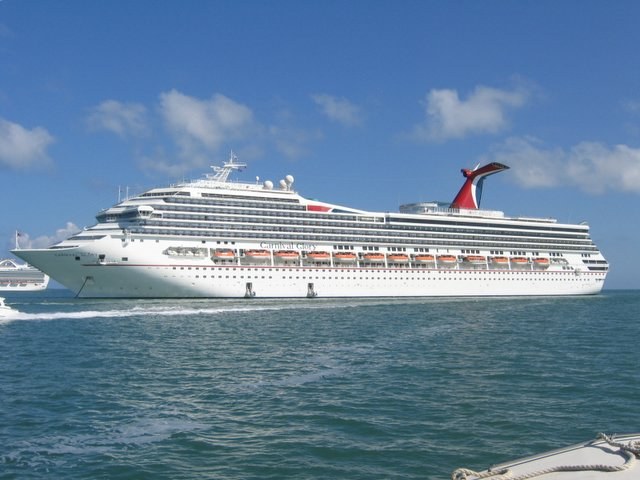
| IMO | 9198367 |
|---|---|
| Gross tonnage | 110,000 GT |
| Length | 290.2 m |
| Beam | 35.3 m |
| Passenger capacity (max) | 2980 |
| Service speed | 22.5 knots |
| Builder | Fincantieri |
| Hull number | 6058 |
| Launched | 2003 |
| Maiden voyage | 2003-11-01 |
| Class | Conquest-class cruise ship |
| Operator | Carnival Cruise Line |
| Status | Active |
Overview
Carnival Glory is the second ship of Carnival Cruise Line's Conquest class, delivered by Fincantieri in 2003. She is a near-twin of the lead ship Carnival Conquest, built to the same stretched Destiny-derived design at the same Monfalcone yard, and she has followed the same one-operator career. Two things mark her out in the class record: her godmother was Dr Sally Ride, the first American woman in space, who christened her at Port Canaveral in July 2003; and in December 2019 she was one of the two ships in the widely reported low-speed collision at Cozumel, when Carnival Legend struck her stern as she lay docked.
Key specifications
The dataset records 110,000 GT, a length of 290.2 m, a beam of 35.3 m, a capacity of 2,980 passengers and a speed of 22.5 knots. Her reference article agrees on tonnage, capacity and speed, and records thirteen decks, six Wärtsilä engines giving 63,400 kW of installed power in a diesel-electric plant driving two propellers, and a crew of about 1,150 — a field the dataset leaves blank. As built she carried, among her headline features, two pools, a 214-foot waterslide, six whirlpools and a spa of some 13,300 square feet — figures quoted in class-era descriptions of the design rather than a current amenities list.
Design and construction
The ship was ordered on 4 August 1998, on the same contract round as her lead sister, and built by Fincantieri at Monfalcone, Italy, as hull 6058, at a reported cost of about US$500 million. She was floated out of her building dock on 30 October 2002 (some summaries date her launch to 2003, the year of her delivery; the dataset records launch as 2003) and delivered on 27 June 2003. Interiors were again by Carnival's architect Joe Farcus, this time on the theme of colour itself: public rooms were named and decorated as a kaleidoscope, with the ship's palette changing from space to space — a lighter conceit than her sister's Impressionism but executed in the same full-strength Farcus manner.
Naming, launch and maiden voyage
The ship crossed the Atlantic without passengers after delivery and began her maiden voyage from Port Canaveral on 14 July 2003 — the date in the dataset. Her christening ceremony followed at Port Canaveral on 19 July 2003, after a pre-inaugural cruise, with Dr Sally Ride as godmother; one contemporary account records that the champagne bottle failed to break at the first attempts and a mechanised release was used to complete the ceremony. The naming date falling after the maiden voyage is unusual but is what the sources record: she sailed first, and was named in her homeport days later.
Career by operator
| Period | Name | Operator |
|---|---|---|
| 2003–present | Carnival Glory | Carnival Cruise Line |
One operator, one name. Her deployment history covers the main Carnival homeport circuit: she opened at Port Canaveral, moved to Miami in 2009 when Carnival Dream took her place there, and has also sailed from New York, Norfolk and New Orleans in different seasons — the standard rotation of a Conquest-class unit. In September 2021 she was chartered to the United States Federal Emergency Management Agency (FEMA) as an accommodation ship at New Orleans for front-line and relief workers after Hurricane Ida — a charter of the ship's hotel capacity, not a change of operator or name. These are career facts of record, not a current itinerary.
Onboard character
Glory is the "colours" ship of the Conquest class: Farcus built her decorative scheme around colour itself, so the sequence of lounges, bars and restaurants reads as a tour through a paint box — the reverse of the hushed elegance of premium-ship design, and deliberately so. In arrangement she is pure Conquest class: atrium amidships, show lounge forward, twin dining rooms aft, Lido pools and buffet at the centre, and the class's added steakhouse above the Lido. Refurbishments have layered newer fleet venues over that frame, but the ship's identity — a big, bright, high-energy mainstream ship of the early 2000s — is unchanged since 2003.
Major refits and incidents
The ship underwent Carnival's Fun Ship 2.0 refurbishment in November 2012, introducing new bars and lounges and renovating cabins and public areas, followed by a further refurbishment in 2017. Her principal incident came on 20 December 2019 at Cozumel, Mexico: Carnival Legend, manoeuvring to dock, struck the already-berthered Carnival Glory in the stern. Six passengers aboard Glory received minor injuries, and Glory's stern dining area was damaged; she was repaired and returned to service. Incident databases also record a series of passenger overboard and balcony-fall cases across her career — individual tragedies of a kind common to large ships, none of which involved the ship's own safety systems failing. No fire or grounding is recorded for the hull.
Sister ships and class
The Conquest class comprises five Fincantieri Monfalcone ships: Carnival Conquest (2002), Carnival Glory (2003), Carnival Valor (2004), Carnival Liberty (2005) and Carnival Freedom (2007). Glory is the second of the five; the 2019 Cozumel collision linked her record with that of Carnival Legend, a Spirit-class ship, which struck her. All five Conquest-class ships remain in Carnival service under their original names.
Fate and where she is now
The dataset lists the hull as active and operating for Carnival Cruise Line as Carnival Glory, her only name. More than twenty years after delivery she remains a front-line unit of the class she helped establish. She is a Phase 1 (active fleet) page in this directory.
Sources: https://en.wikipedia.org/wiki/List_of_cruise_ships; Carnival Glory, Wikipedia (ship article, incl. 2019 Cozumel collision); CruiseMapper, Carnival Glory ship profile (Fun Ship 2.0 refit and FEMA charter); Castles of the Seas, Carnival Glory construction and naming notes.