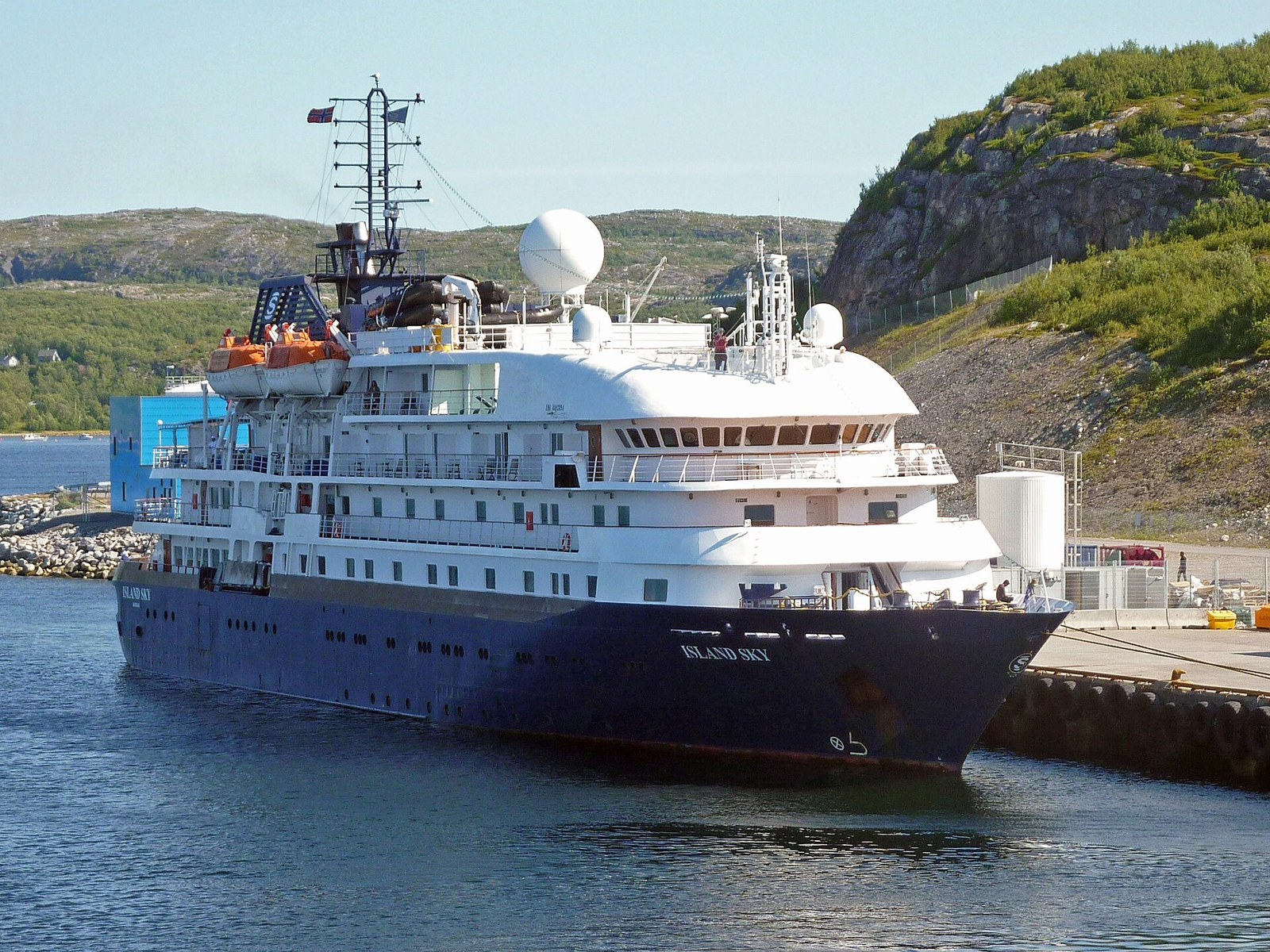
| IMO | 8802894 |
|---|---|
| Gross tonnage | 4,200 GT |
| Length | 90.0 m |
| Beam | 14.0 m |
| Passenger capacity (max) | 118 |
| Crew | 70 |
| Builder | Nuovi Cantieri Apuania |
| Hull number | 1147 |
| Launched | 1992 |
| Maiden voyage | 1992 |
| Class | Renaissance-class cruise ship |
| Operator | Noble Caledonia |
| Status | Active |
| All names | Island Sky; Renaissance Eight; Renai II; Sky |
Overview
Island Sky is a 4,200 GT, 118-guest expedition-style cruise ship owned and operated by London-based Noble Caledonia, and one of the most successful second careers in small-ship cruising. She began life in 1992 as Renaissance Eight, the last of Renaissance Cruises' eight near-identical Italian-built ships, each carrying barely a hundred guests in all-suite luxury. When Renaissance collapsed in 2001 the little ships scattered across the industry, and this one passed through the names Renai II and Sky before becoming Island Sky in 2004 and eventually the dedicated ship of Noble Caledonia, a British operator built around exactly her kind of vessel. She achieved a footnote of maritime history in July 2021, when she became the first cruise ship to visit Scotland since the onset of the COVID-19 pandemic. More than thirty years after launch she remains in active service, which for a ship of her size and era is a considerable achievement.
Key specifications
Nuovi Cantieri Apuania at Marina di Carrara, Italy, built her as hull 1147. The dataset's figures — 4,200 GT, 90.0 m in length, 14.0 m in beam — are the registered particulars of the ship and are consistent across registry-derived sources. The dataset leaves capacity blank; her operator states a maximum of 118 guests, with a crew of just over 70 — figures worth pausing on, because a 4,200-ton ship could physically carry far more people, and the Renaissance design's whole point was not to. She is registered at Nassau, Bahamas. Her speed is not recorded in the dataset and is modest by design; ships of her type are built for access and economy, not pace. Her draught of about 4.3 m, recorded in registry-derived data, is the specification that explains her career: she can go where almost no other cruise ship can.
Design and construction
The Renaissance class was a considered bet on smallness. In the early 1990s, as the industry standardised on ever-larger ships, Renaissance Cruises ordered eight compact vessels from the Carrara yard, each with all-suite accommodation, a yacht-like profile and the ability to use harbours closed to mainstream tonnage. Island Sky, as Renaissance Eight, was the final ship of the series, entering service in 1992. The class's virtues turned out to be perfectly matched to the market that emerged after Renaissance itself failed in 2001: expedition and destination-focused small-ship cruising, in which a shallow draught, a small guest count and a fleet of inflatable landing craft matter more than theatres and casinos. The eight sisters dispersed to luxury, expedition and even private-yacht roles, and several remain in service today — a longevity record few classes of any size can match.
Naming, launch and maiden voyage
She was launched in 1992 as Renaissance Eight, following her class's numbering scheme, and entered service that year for Renaissance Cruises. Her later names trace her years in the wilderness after 2001: Renai II from 2001, Sky from 2003, and Island Sky from 2004 — the name she has now carried for over twenty years, longer than all her earlier identities combined. Under Noble Caledonia the "Sky" suffix became a fleet signature, shared with her sisters Caledonian Sky and Hebridean Sky as the company progressively reunited members of the class under its own banner.
Career by operator
| Period | Name | Operator |
|---|---|---|
| 1992–2001 | Renaissance Eight | Renaissance Cruises |
| 2001–2003 | Renai II | (post-Renaissance ownership; laid up / charter market) |
| 2003–2004 | Sky | (charter market) |
| 2004–present | Island Sky | Noble Caledonia (dedicated ship of the fleet; ownership consolidated under Noble Caledonia interests by 2010) |
The first career, with Renaissance, placed her in the premium small-ship market the class was designed for. The Renaissance collapse of 2001 — one of the cruise industry's landmark failures — left her, like her sisters, looking for work under abbreviated names. Her stabilisation came with the Island Sky identity and her association with Noble Caledonia, the British small-ship specialist founded on cultural and expedition-style voyages, for whom she became the dedicated, defining vessel; she has also been seasonally chartered to expedition operators such as Quark Expeditions, which built a fly-cruise programme around her from 2017. Registry records show her registered ownership in the care of Noble Caledonia from 2010. Her July 2021 call at Lerwick, Shetland, with 66 guests aboard on a UK coastal cruise, made her the first cruise ship to visit Scotland since the pandemic closed its ports — a distinction reported by the BBC and Cruise Industry News.
Onboard character
Noble Caledonia describes its two core ships as among the most comfortable and friendly small ships in the world, and the formula is the Renaissance formula preserved: unusually large suites for the ship's size, spacious public rooms and outside decks, and an atmosphere the operator compares to a private yacht rather than a scaled-down liner. With a maximum of 118 guests and a crew of over 70, service is personal in a way no large ship can reproduce. She carries Zodiac landing craft for shore access in remote places. The experience is deliberately gentle — lectures, excursions and scenery rather than spectacle — and the ship's long, loyal following among British small-ship travellers is built on exactly that restraint. In onboard terms she is a preserved example of early-1990s luxury thinking, when the industry's most expensive product per guest was not size but space.
Major refits and incidents
Her refit history is one of renewal for successive owners rather than a single famous conversion: the Renaissance sisters were refurbished as they passed to new operators, and Noble Caledonia has maintained Island Sky through periodic refits across her long tenure, including the work that prepared her for expedition charter employment in polar regions. No fire, grounding or casualty defines her in the sources consulted. Her notable public moment was a positive one — the July 2021 Lerwick call described above, which opened post-pandemic cruising in Scotland. A detailed drydock chronology is against operator records before publication.
Sister ships and class
The Renaissance class numbered eight ships, built at Carrara in the early 1990s as Renaissance One through Eight. Her closest relationships are within Noble Caledonia's own fleet: Caledonian Sky is the former Renaissance Six (hull 1145) and Hebridean Sky the former Renaissance Seven (hull 1146) — the two hulls built immediately before hers, making the three ships literal consecutive sisters that the market separated for a decade and one British operator progressively brought back together. The remaining sisters found homes across luxury and expedition cruising and as private yachts, one of the most complete survival records of any cruise class of their era.
Fate and where she is now
Island Sky remains in active service with Noble Caledonia, the dataset and operator agree, still working the small-ship programmes she was, in effect, designed for thirty years ago. A 4,200-ton ship launched in 1992 has no business surviving into the age of 230,000-ton megaships — yet her size, once a commercial eccentricity, became her protection: she occupies a niche the big ships cannot enter, and on present evidence she will go on occupying it.
Sources: https://en.wikipedia.org/wiki/List_of_cruise_ships; https://en.wikipedia.org/wiki/MS_Island_Sky; Noble Caledonia, fleet pages, https://www.noble-caledonia.co.uk/vessels/fleet/