| IMO | 7032997 |
|---|---|
| Gross tonnage | 14,717 GT |
| Length | 142.12 m |
| Beam | 21.9 m |
| Service speed | 23.0 knots |
| Builder | Chantiers de l'Atlantique |
| Hull number | 123 |
| Launched | 1971 |
| Maiden voyage | 1971 |
| Operator | Black Sea Cruises |
| Status | Active |
Overview
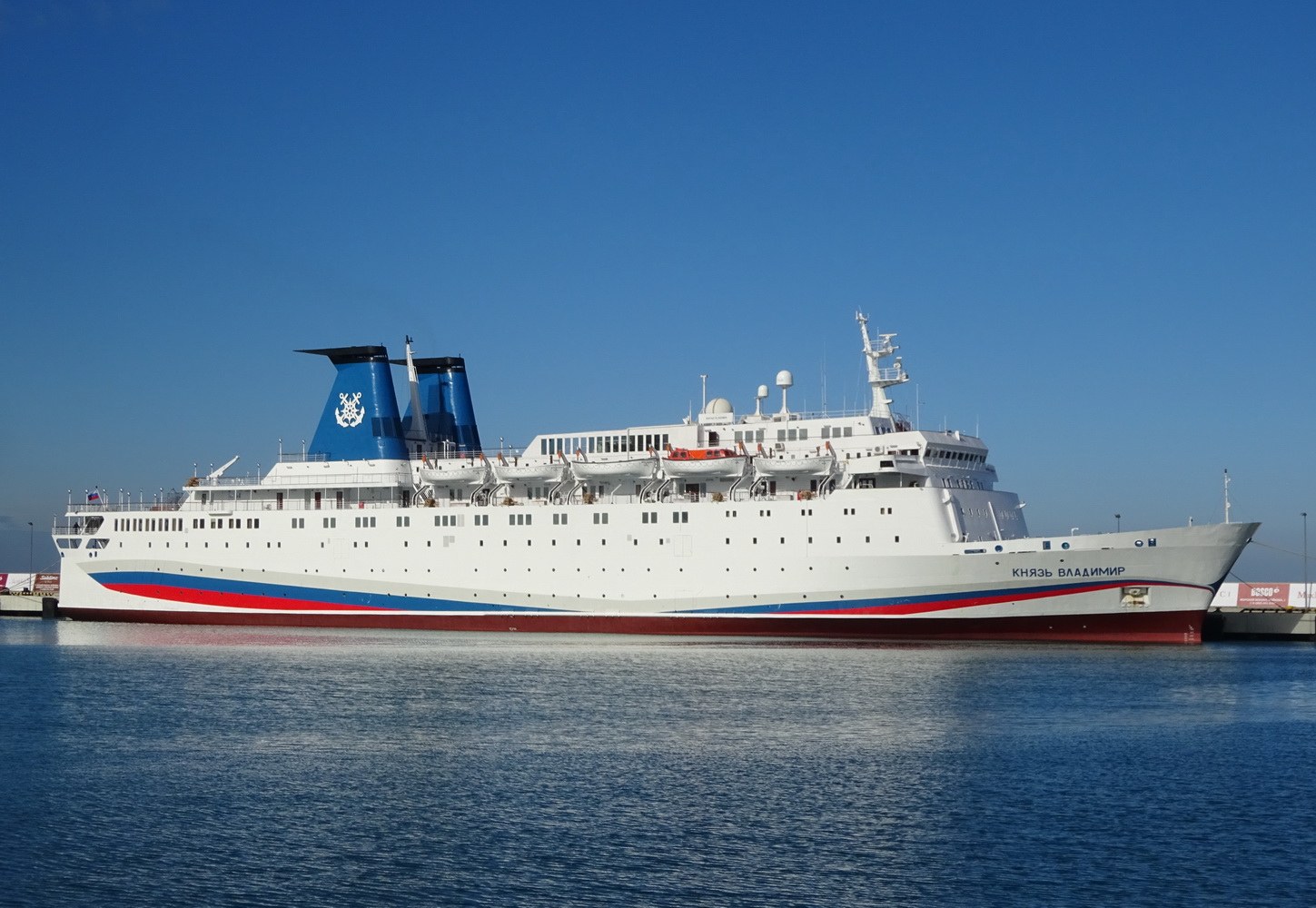
Knyaz Vladimir — "Prince Vladimir" — is one of the great survivors of European passenger shipping. Built in France in 1971 as the car ferry and cruise ferry Eagle for Britain's Southern Ferries, she was rebuilt into a full-time cruise ship in 1981 and then passed through a succession of famous Mediterranean operators: Paquet, Chandris, Festival Cruises and Israel's Mano Maritime, under the names Azur, The Azur, Eloise, Royal Iris and Roy Star. In 2017, after a lay-up in Greece, she was bought for a Russian state-backed venture, renamed Knyaz Vladimir and put to work on Black Sea cruises from Sochi — becoming, improbably, Russia's only ocean cruise ship of her era. She is also historically notable as the last surviving ship ever owned by the Greek giant Chandris Lines, and the last survivor of a trio of near-sister ferries built at Nantes.
Key specifications
The dataset records her at 14,717 GT, 142.12 m long with a 21.9 m beam and a speed of 23.0 kn. Two cautions apply to those figures. First, her own ship article gives a service speed of 18 knots, so the 23.0 kn dataset figure should be read as. Second, after a later reclassification her tonnage was restated as 9,159 GT with 2,085 DWT — a reminder that a ferry hull rebuilt and re-measured several times over carries more than one legitimate tonnage figure, and that the 14,717 GT figure is the one carried by shipparade-derived listings for her cruise-ship configuration. The article-derived capacity is 770 passengers with a crew of 325 in her later configuration, though those figures are not in the dataset and varied considerably across her ferry, cruise and Black Sea careers.
Design and construction
She was built at Nantes, France, as yard number 123. The dataset names the builder as Chantiers de l'Atlantique; her own article names the yard as Chantiers Dubigeon of Nantes — the discrepancy is logged in the batch notes, and the Dubigeon attribution is the better-sourced one, Dubigeon being the Nantes yard whose hull number sequence matches. She was launched on 16 October 1970 and completed on 16 May 1971. As built she was a car/cruise ferry in the early-1970s pattern: drive-through vehicle decks below, passenger accommodation above, intended for a long multi-port ferry itinerary rather than pure cruising. That ferry DNA — a sturdy, relatively small hull with car decks that could later be filled in with cabins — is precisely what allowed her to be rebuilt so radically a decade later and to keep finding work for half a century.
Naming, launch and maiden voyage
She entered service in 1971 as Eagle for Southern Ferries, a P&O subsidiary, on a new six-day Southampton–Lisbon–Tangier car and cruise ferry service. The name Knyaz Vladimir, adopted in 2017, honours Prince Vladimir, the medieval ruler of Kievan Rus' — a deliberately patriotic choice for a ship bought to restart Russian domestic cruising. Her intermediate names were mostly commercial: Azur and The Azur evoked the Côte d'Azur trade she was built into, Royal Iris was a Mano Maritime fleet name, and Roy Star was a short-lived Mano rename applied when cruising stopped in 2014. The brief 2004 name Eloise was carried between the Festival Cruises collapse and her Mano debut.
Career by operator
| Years | Name | Operator |
|---|---|---|
| 1971–1975 | Eagle | Southern Ferries |
| 1975–1987 | Azur | Nouvelle Cie. de Paquebots (Paquet Cruises) |
| 1987–1994 | The Azur | Chandris Lines |
| 1994–2004 | The Azur, then Eloise | Festival Cruises |
| 2005–2014 | Royal Iris | Mano Maritime |
| 2014–2017 | Roy Star | Mano Maritime (laid up from late 2014) |
| 2017– | Knyaz Vladimir | Black Sea Cruises |
The Southern Ferries route proved unsuccessful and she was sold in 1975 to Paquet's Nouvelle Compagnie de Paquebots, repainted white and renamed Azur for Mediterranean cruise-ferry work. In 1987 Paquet sold her to Chandris Lines, whose Fantasy Cruises arm renamed her The Azur and painted the traditional Chandris blue funnel with its white chi. As Chandris wound down its cruise brands she passed in 1994 to Festival Cruises, sailing from Venice and Genoa until Festival's 2004 bankruptcy left her under arrest at Gibraltar. Mano Maritime bought her at the bankruptcy sale for over US$10 million, renamed her Royal Iris — with a smiling yellow fish painted on her hull sides — and cruised her in the eastern Mediterranean until 2014, when Mano stopped her service, renamed her Roy Star and laid her up at Chalcis. In January 2017 it was reported that Russia's Sovfracht and Rosmorport venture would buy her — the price was reported at about €11.2 million — for a new Sochi-based company, Black Sea Cruises; she entered Russian service on 11 June 2017 under the Russian flag, registered at Sochi.
Onboard character
In her cruise-ship form she was a ship of the classic Mediterranean school: modest in size, white-hulled, with tiered aft decks and a pool added at the stern during the 1981 conversion, when cabins were built into the former car decks and her ferry fittings were stripped out. Mano's Royal Iris configuration carried three swimming pools, two night clubs and a discotheque, a casino, a cinema and a sauna — the full 1980s–90s Mediterranean cruise package rather than the mega-ship amenity race. That era-defining character, a converted ferry offering traditional cruising to a loyal regional market, is what she kept, in essence, through every rename.
Major refits and incidents
The defining refit was the 1981 Paquet reconstruction that converted her from ferry to full-time cruise ship, filling the car decks with cabins and adding a stern pool. A small fire broke out aboard on 21 June 2005 while she was anchored off Samos as Royal Iris; the crew extinguished it quickly. Her 2017 return to service followed refurbishment for the Black Sea venture. No other major casualty is recorded in her own article.
Sister ships and class
She was one of three near-identical Nantes-built sisters. Her siblings had darker fates: one was the Fred. Olsen ferry Bolero, and the other was Scandinavian Star, the ferry lost to a notorious fatal fire in 1990 while under another name. Knyaz Vladimir is the last of the three still extant, and the last surviving ex-Chandris ship.
Fate and where she is now
The dataset records her as active with Black Sea Cruises, and that was her position through her Sochi seasons. Her own article, however, now lists her status as out of service and records that in March 2026 Rosmorport sold her to the Moscow company Razvitie Goroda LLC, with Black Sea Cruises to be voluntarily liquidated after sustained losses — the article attributes the collapse of the venture to the Black Sea operating areas no longer being economically usable. That post-dataset development is logged in the batch notes; on the article's evidence she is a laid-up, sold hull awaiting her next chapter rather than an operating cruise ship.
Sources: https://en.wikipedia.org/wiki/List_of_cruise_ships; https://en.wikipedia.org/wiki/MS_Knyaz_Vladimir