| IMO | 9846249 |
|---|---|
| Gross tonnage | 31,283 GT |
| Length | 150.0 m |
| Beam | 28.3 m |
| Passenger capacity (double) | 245 |
| Crew | 215 |
| Builder | Vard Group |
| Yard | Tulcea; Søviknes Verft; Saint-Nazaire; Tulcea County |
| Hull number | 887 |
| Launched | 2020 |
| Maiden voyage | 2021 |
| Operator | Ponant Cruises |
| Status | Active |
Overview
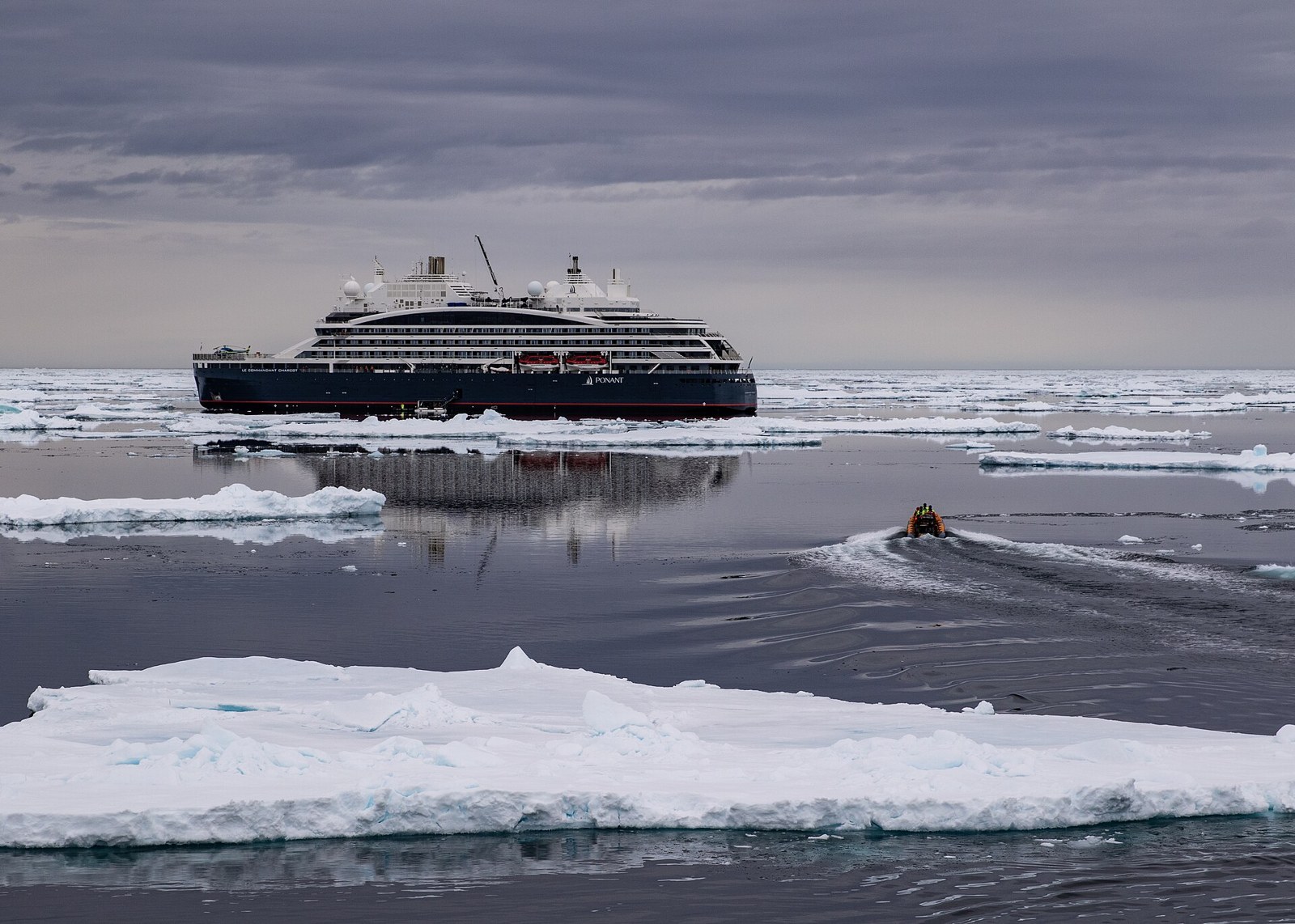
Le Commandant Charcot is an icebreaking cruise ship operated by the French company Compagnie du Ponant, and by most measures the most capable passenger ship ever built. She is rated Polar Class 2 — several grades above the ice strengthening of any other cruise vessel — and is a true icebreaker, designed to reach destinations such as the geographic North Pole that no other passenger ship can attempt. At the same time she is a luxury ship in the Ponant mould, with a small passenger complement and a hotel standard closer to a grand hotel than an expedition workhorse. Delivered in 2021, she is named for Jean-Baptiste Charcot, the French doctor, scientist and polar explorer who commanded France's early Antarctic expeditions and died at sea off Iceland in 1936. The dataset's dates require care: it lists her launch as 2017, the year her construction contract was announced, and her maiden voyage as 29 July 2021, which was in fact her delivery date; both points are taken up below and in the batch notes.
Key specifications
The dataset records Le Commandant Charcot at 31,757 GT, 150.0 metres long and 28.0 metres in beam, built by the Vard Group as hull 887 with IMO number 9846249. Her registered figures are close but not identical: 31,283 GT and a beam of 28.3 metres, with a draught of 10 metres reflecting her icebreaking hull form. Her ice class is Polar Class 2, with additional Bureau Veritas icebreaker notations for bow and stern operation. Installed power is unusually large for a 150-metre ship: six Wärtsilä dual-fuel engines (four 14-cylinder and two 10-cylinder 31DF units) feeding a diesel-electric plant and two ABB Azipod units of 17 MW each, supplemented by a 5 MWh battery bank that lets her run for periods with engines stopped. Open-water speed is 15 knots. Capacity, blank in the dataset, is 270 passengers in 135 cabins on the builder's figures, with a crew of 187.
Design and construction
The ship was built in two countries. Vard's Tulcea yard in Romania built the hull, while final outfitting took place at Vard Søviknes in Norway. The keel was laid in December 2018 and the hull was launched in March 2020, leaving Romania on 29 March and arriving at Søvik on 28 April 2020. Reported cost was NOK 2.7 billion. The design concept — developed as the first electric-hybrid cruise icebreaker with LNG propulsion — combines a Polar Class 2 hull capable of breaking multi-year ice, a double-acting operating profile reflected in her stern icebreaker notation, LNG fuel with battery hybridisation to cut emissions and allow silent, engine-off running, and scientific facilities including laboratories for operational oceanography. In June 2021 she reached the Arctic for the first time on sea and ice trials, and she was completed and delivered on 29 July 2021.
Naming, launch and maiden voyage
Jean-Baptiste Charcot — "the gentleman of the poles" — led the French Antarctic expeditions of 1903–05 and 1908–10, wintered in the Antarctic, charted stretches of its coast, and lent his name to Charcot Island; Ponant had already named an earlier ship for his expedition vessel Pourquoi-Pas. Naming the line's most ambitious ship for Charcot was a statement that the vessel belonged to the lineage of exploration, not merely of tourism. The hull's actual launch came in March 2020 at Tulcea, an industrial milestone rather than a ceremony, in the first weeks of the pandemic. After delivery at the end of July 2021 the ship sailed from Norway to Svalbard and onward, reaching the geographic North Pole on 6 September 2021 on her first polar expedition — the first French ship to do so — which served in practice as her maiden-voyage statement: this ship had been built to do exactly that.
Career by operator
The ship has carried one name for one operator throughout her short career:
| Period | Name | Operator |
|---|---|---|
| 2021–present | Le Commandant Charcot | Ponant (Compagnie du Ponant) |
Her early career reads as a sequence of polar firsts rather than a conventional cruise programme. In December 2021 she carried passengers from Ushuaia to the Weddell Sea to watch the total solar eclipse of 4 December from the Antarctic ice pack. In February 2022 she cut a channel through second-year ice in Stange Sound for the British Antarctic Survey's RRS Sir David Attenborough. In July 2022 she accompanied the research vessel Kronprins Haakon to the North Pole, and in June 2024 she joined the multinational Arctic exercise Operation Tugaalik. On 12 September 2024, during a transarctic crossing, she became the first ship ever to reach the northern pole of inaccessibility — the Arctic Ocean point farthest from any land — passing the north magnetic pole the next day and the geographic North Pole on 15 September.
Onboard character
The character of Le Commandant Charcot is the deliberate fusion of two ships: a working icebreaker — heavy plant, ice navigation bridge, Zodiac fleet, helicopters carried for expedition operations, and laboratories hosting embarked researchers — and a French luxury hotel of just 135 cabins, with an indoor pool, panoramic restaurants and lounges, and interiors finished to the standard of Ponant's luxury fleet. She is described as the only cruise ship designed to embark scientists as part of her normal complement, giving passengers contact with live polar research as part of the onboard programme. The result is a ship whose defining onboard experience is capability made visible: watching multi-year ice break against a Polar Class 2 bow from a warm observation lounge is the entertainment, and everything else supports it.
Major refits and incidents
A ship delivered in 2021 has had no refit of record, and Le Commandant Charcot's entry under this heading is instead her list of operational milestones, covered in the career section above: the 2021 North Pole arrival, the 2022 ice-channel collaboration with Sir David Attenborough, and the 2024 pole-of-inaccessibility first. No casualty, fire, grounding or other damaging incident involving the ship appears in the sources consulted. Her technical teething period, such as it was, took place in the public arena of ice trials in June 2021, which the ship completed before delivery the following month.
Sister ships and class
Le Commandant Charcot has no sister ships. She is a one-off design, built to a specification — Polar Class 2, LNG-hybrid, luxury capacity — that no other owner has so far ordered. Within the Ponant fleet she sits above the four Boréal-class ships and the six smaller Ponant Explorers expedition ships, all of which are ice-strengthened expedition vessels of much lower polar class. If she has relatives, they are conceptual: the new generation of Polar Class 6 expedition ships from other lines, which she exceeds by four ice-class grades. Any future sister would require another owner willing to fund an icebreaker's construction and running costs on a 270-passenger revenue base; none has been announced.
Fate and where she is now
Le Commandant Charcot is in active service with Ponant, listed as operating in the dataset, and at the height of her early career. Her first three years established the two roles she was built for — luxury polar cruising at the extreme edge of the navigable world, and practical support to polar science — and her record of firsts (first French ship to the North Pole, first ship of any kind to the Arctic pole of inaccessibility) already gives her a secure place in the history of passenger shipping. For this directory she stands as the limiting case of the expedition-cruise era: the point at which a cruise ship stopped being a visitor to the ice and became, in capability, an icebreaker that happens to carry passengers.
Sources: https://en.wikipedia.org/wiki/List_of_cruise_ships; https://en.wikipedia.org/wiki/Le_Commandant_Charcot