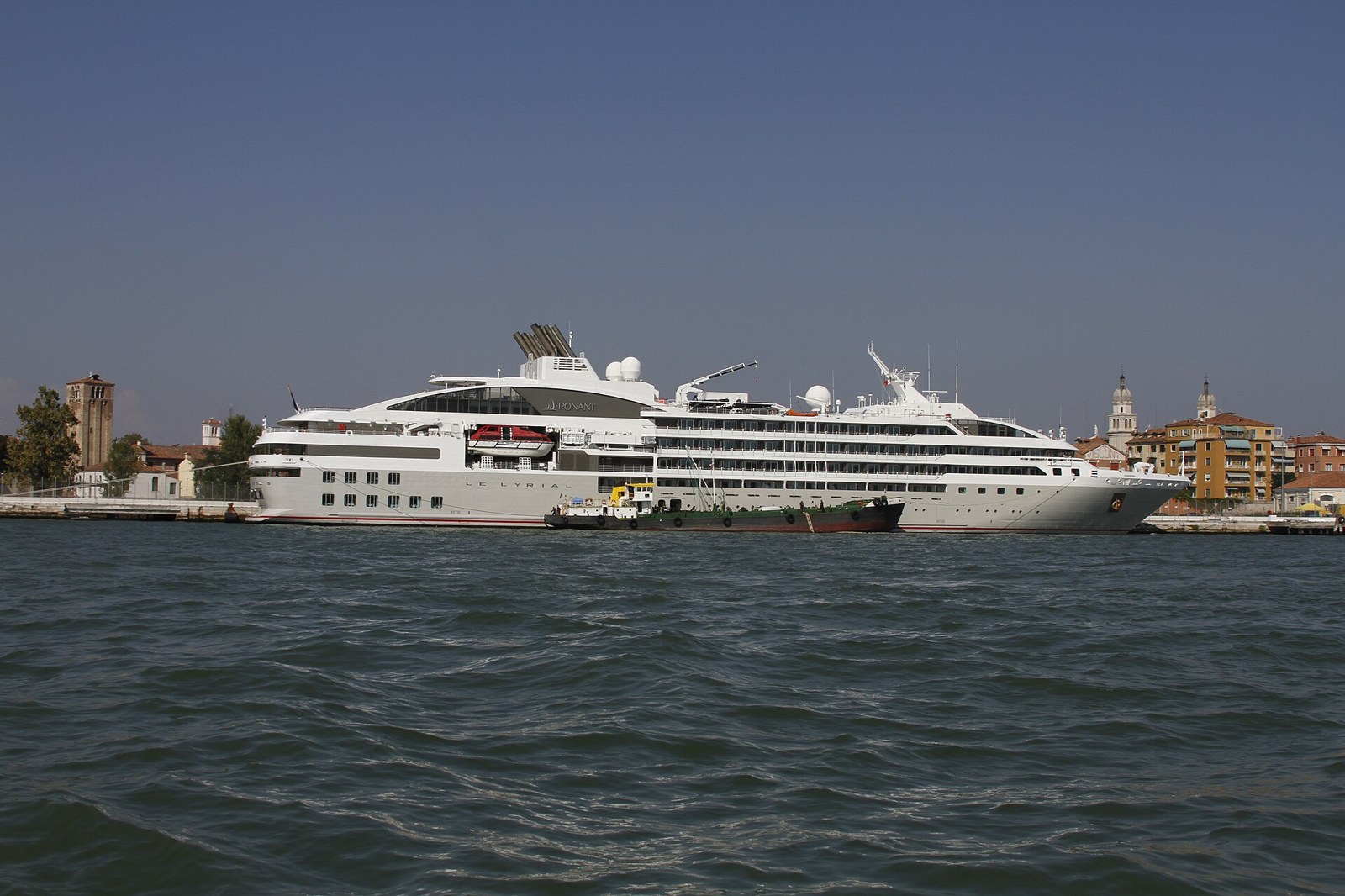
| IMO | 9704130 |
|---|---|
| Gross tonnage | 10,992 GT |
| Length | 147.1 m |
| Beam | 18.0 m |
| Passenger capacity (double) | 224 |
| Passenger capacity (max) | 264 |
| Service speed | 16.0 knots |
| Builder | Fincantieri |
| Hull number | 6230 |
| Launched | 2015 |
| Maiden voyage | 2015 |
| Operator | Ponant Cruises |
| Status | Active |
Overview
Le Lyrial is a small luxury cruise ship built for Compagnie du Ponant, the French operator now styled simply as Ponant, and delivered in April 2015. She is the fourth and last of the Boréal class — the series of near-identical 10,000-ton ships, beginning with Le Boréal in 2010, that transformed Ponant from a niche French operator into one of the defining luxury-expedition brands. At 142 metres and a maximum of 264 passengers, she was conceived as a private-yacht-scale ship with an ice-strengthened hull, able to combine conventional luxury cruising with expedition work in polar and remote regions. She sails under the French flag with registry at Mata Utu in Wallis and Futuna, the offshore registry used by the Ponant fleet, and her name refers to the constellation Lyra — le lyrial evoking the lyre — in the northern sky.
Key specifications
The dataset records Le Lyrial at 10,992 GT, 142.1 metres long and 18.0 metres in beam, with a maximum capacity of 264 passengers, a service speed of 16 knots, built by Fincantieri as hull number 6230 with IMO number 9704130. Published figures for the ship vary slightly by source — her article gives 10,700 GT and a length of 142 metres, while Ponant's own fleet listing has grouped the class at 10,944 GT — differences of measurement and rounding typical for this class rather than of substance. She has seven decks, a draught of about 4.8 metres, twin propeller shafts, accommodation in 122 cabins and suites, and a crew of about 139–140. The figures describe the classic small luxury ship of the 2010s: roughly a tenth the tonnage of a contemporary megaship, with a passenger-to-crew ratio better than two to one.
Design and construction
The contract for a fourth Boréal-class ship was announced by Fincantieri and Ponant on 16 July 2013, the order having been placed in 2012. Fincantieri built her at its Ancona yard on Italy's Adriatic coast, as it had her three sisters — the dataset's hull number is 6230. The keel was laid in 2014 and the ship was launched and delivered in the spring of 2015; Fincantieri handed her over on 11 April 2015. The design she inherited was by then well proven: a sleek, yacht-like hull with ice strengthening for polar itineraries, a high proportion of balcony accommodation, and public rooms scaled to a single-sitting, single-restaurant style of service. For Le Lyrial specifically, the accommodation was refined — she carries 122 cabins and suites, all with sea views and 94 percent with private balconies, including an entire deck given over to suites, some of them larger than the equivalent rooms on her older sisters.
Naming, launch and maiden voyage
Ponant's Boréal-class ships carry names drawn from the sky and the sea winds — Le Boréal for the north wind, L'Austral for the south, Le Soléal for the sun — and Le Lyrial completes the set with the constellation Lyra, the lyre, visible in the northern hemisphere. The name keeps the class's celestial theme while giving the fourth ship an identity of her own within a run of near-identical hulls. Delivered on 11 April 2015, she made her inaugural cruise in May 2015. The dataset records both launch and maiden voyage simply as 2015, which the fuller record supports: this was a ship delivered on schedule by a yard building its fourth example of the design, and her entry into service was a routine fleet addition rather than an event — the class's story had been written by her sisters, and Le Lyrial's role was to complete it.
Career by operator
Le Lyrial has served a single operator under a single name:
| Period | Name | Operator |
|---|---|---|
| 2015–present | Le Lyrial | Ponant (Compagnie du Ponant) |
Her career has followed the Ponant pattern for the Boréal class: expedition and luxury cruising that mixes polar seasons — the class is ice-strengthened and works in both Arctic and Antarctic programmes — with cultural and coastal cruising in the traditional luxury markets. She has remained in the fleet through the company's ownership changes at group level (Ponant passed from CMA CGM to Bridgepoint and then to Groupe Artémis), none of which altered her name, flag or role. The dataset lists her operator history as "Ponant Cruises; Ponant", reflecting the brand's restyling rather than any change of operator in substance.
Onboard character
The onboard character of the Boréal class, and of Le Lyrial as its final expression, is French luxury at yacht scale. The essentials are space per passenger, a very high crew ratio, and understatement: 122 cabins for a maximum of 264 guests, nearly all with balconies; a single-deck suite enclave; refined, contemporary interiors rather than themed decoration; and a strong culinary identity rooted in French gastronomy, matched to the company's French-flag, French-officered identity. Expedition capability is built in rather than bolted on — the strengthened hull and expedition staff let the same ship that serves a formal dinner in temperate waters land passengers by Zodiac in polar regions. That dual personality, luxury ship and expedition platform in one small hull, is precisely what the class was designed to prove, and Le Lyrial, as the last and slightly most refined of the four, is its settled form.
Major refits and incidents
No major casualty, fire, grounding or collision involving Le Lyrial appears in the sources consulted, and her Wikipedia article records no incidents section material at all — a clean record now spanning a decade of worldwide expedition service. Secondary industry sources report routine refurbishment work in the early 2020s, with a refit dated 2021 or 2022 depending on the source, consistent with the normal drydock cycle for a ship of her age and market, but no structural alteration, lengthening or capacity change has been reported, and her published particulars remain those of the ship as built. In a fleet context her most significant "event" remains her delivery itself, which closed out the Boréal-class programme in 2015.
Sister ships and class
Le Lyrial is the fourth of four Boréal-class sisters built by Fincantieri at Ancona: Le Boréal (2010), L'Austral (2011), Le Soléal (2013) and Le Lyrial (2015). The class shares hull form, dimensions and machinery, with interior and suite arrangements evolving slightly from ship to ship; Le Lyrial's enlarged suites mark the end of that evolution. The class as a whole was Ponant's breakthrough design, and it set the template the company then developed in two directions — downward to the smaller Ponant Explorers class from 2018, and upward, in capability if not directly in lineage, to the Polar Class 2 icebreaker Le Commandant Charcot in 2021. The dataset leaves Le Lyrial's class field blank; the class attribution here follows the ship's own article.
Fate and where she is now
Le Lyrial remains in active service with Ponant, listed as operating in the dataset, as one of the four Boréal-class ships that still form the backbone of the company's luxury-expedition fleet. At ten years old she is in mid-career: young enough to have many seasons ahead, senior enough to be a settled, known quantity in a fleet that has since added newer expedition tonnage. Her place in this directory is as the completion of a class — the ship that closed the series which redefined what a 10,000-ton cruise ship could be, pairing the manners of a French luxury hotel with a hull built to work among ice.
Sources: https://en.wikipedia.org/wiki/List_of_cruise_ships; https://en.wikipedia.org/wiki/Le_Lyrial; https://en.wikipedia.org/wiki/Compagnie_du_Ponant