| IMO | 8914219 |
|---|---|
| Gross tonnage | 1,489 GT |
| Length | 88.55 m |
| Beam | 11.9 m |
| Passenger capacity (max) | 64 |
| Service speed | 14.0 knots |
| Builder | SFCN |
| Launched | 1991 |
| Maiden voyage | 1991 |
| Operator | Ponant Cruises |
| Status | Active |
Overview
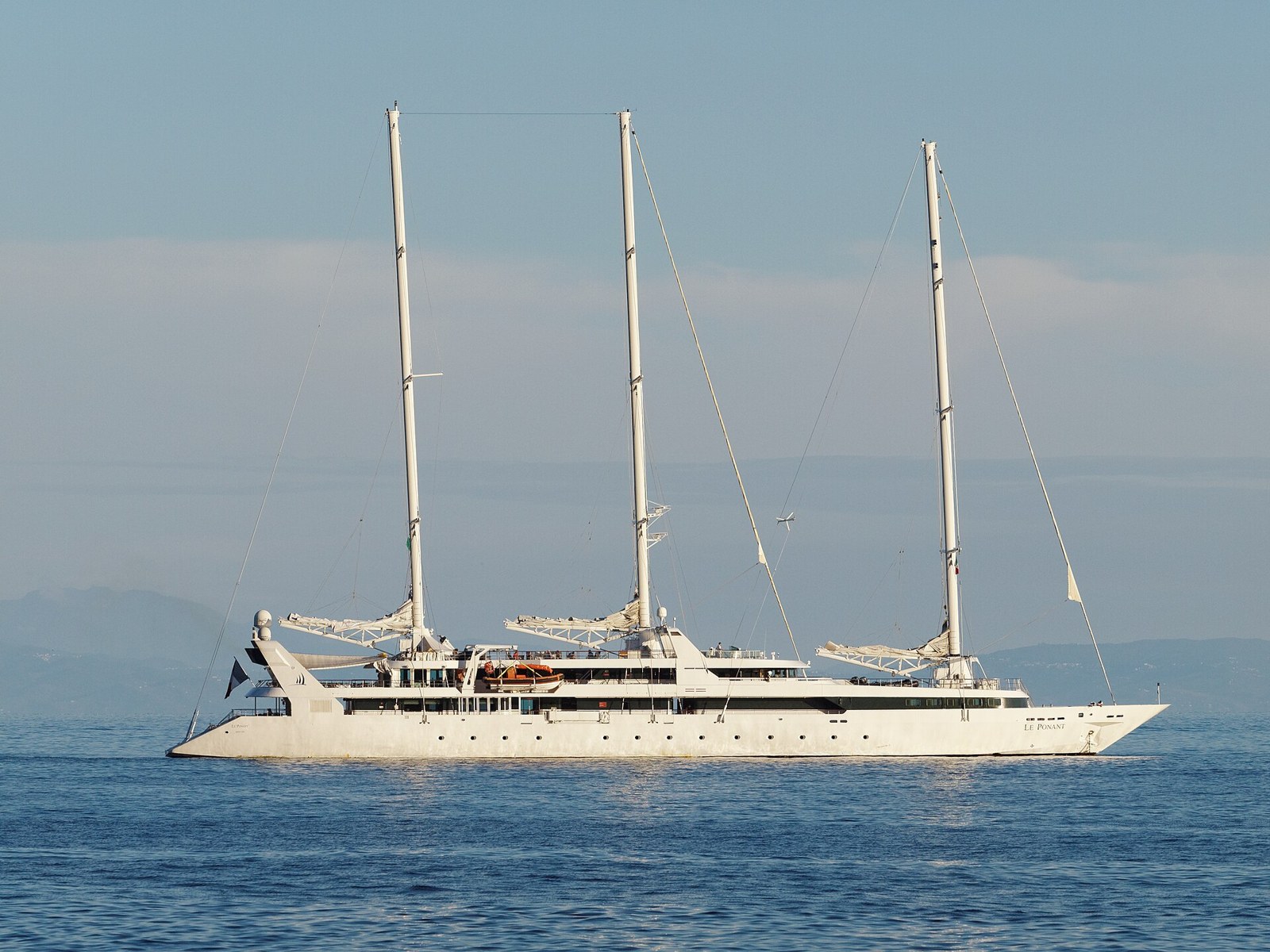
Le Ponant is the founding ship of Ponant, the French cruise line established in 1988 by officers of the French Merchant Navy, and she remains the most distinctive vessel in its fleet: a three-masted sailing barque of just 1,489 GT in the dataset, carrying a few dozen guests under sail and auxiliary power. She was, at her launch in 1991, presented as the first French cruise ship of the modern era, and she defined the idea — luxury yachting under commercial sail — on which the whole company was built. Three decades on, the fleet around her has grown to large (by Ponant standards) motor yachts and an icebreaker, but Le Ponant is still in service, still sailing, and still the ship whose name the company itself carries.
Key specifications
The dataset records IMO 8914219, 1,489 GT, a length of 88.55 m, a beam of 11.9 m, a maximum capacity of 64 and a speed of 14.0 knots. The capacity figure is best understood as 64 guests in 32 cabins, with published descriptions of the ship commonly giving 32 staterooms and a crew in the low thirties. The tonnage appears in some published sources as 1,489 GT and in others as 1,189 in older references. The 14.0-knot dataset speed is a powered figure; as a sailing vessel her performance under canvas varies with conditions, which is rather the point of her. The dataset gives no builder; the ship was built in 1991 by the SFCN yard at Villeneuve-la-Garenne, France.
Design and construction
Le Ponant is a three-masted barque: square sails on the fore and main masts in the classic barque arrangement, with a modern auxiliary diesel-electric plant for calms, manoeuvring and schedule-keeping. Her design brief, from a company founded by merchant-navy officers, was deliberately romantic — a return to sail for paying passengers at a luxury standard, with computer-assisted sail handling allowing a small crew to work a rig that a nineteenth-century barque would have needed many more hands to manage. At 88.55 m she is large for a passenger sailing vessel yet tiny beside any motor cruise ship, and her shallow dimensions let her use harbours and anchorages closed to the rest of the cruise industry. Construction in France, for a French owner, under the French flag, was itself part of the founding statement of the line.
Naming, launch and maiden voyage
"Ponant" is an old French nautical term for the west — and for the westerly wind — and the ship gave the company its name and its identity. She was launched and entered service in 1991, the dataset recording both launch and maiden voyage in that year; no more precise maiden-voyage date is given in the sources consulted, and this guide does not invent one. She was the first ship of the line, preceding the motor yacht Le Levant (1999) and Le Diamant (2004), and for her first eight years she was effectively the entire company afloat.
Career by operator
| Name | Operator | Period |
|---|---|---|
| Le Ponant | Compagnie du Ponant / Ponant Cruises | 1991–present |
The dataset's operator history — "Ponant Cruises; Ponant" — reflects a rebranding of the same company rather than a change of owner-operator: founded as Compagnie du Ponant, later shortened to Ponant. Around her, the company changed hands — acquired by CMA CGM, headquartered in Marseille from 2006, sold to Bridgepoint Capital in 2012 — and grew from one sailing ship to a fleet of luxury motor yachts, but Le Ponant herself has never been sold, renamed or chartered away in the sources consulted. Her employment has remained what it was designed to be: small-group luxury cruising under sail. A major refurbishment is reported in secondary coverage as having taken place in 2019.
Onboard character
With 32 cabins, Le Ponant offers the most intimate experience in the Ponant fleet and one of the most intimate in commercial cruising anywhere. Published descriptions of the ship emphasise the small scale of everything: two restaurants (a main dining room serving French cuisine and a more informal outdoor venue), two lounges — one for entertainment, one arranged as a lecture and reading space — and decks where the working of the ship, the setting and trimming of sails, is itself the principal spectacle. The era-defining idea is the absence of the apparatus of modern cruising: no casino floor, no waterpark, no thousand-seat theatre. Luxury here means space per guest, French service and gastronomy, and the motion and sound of a sailing ship. It is the template from which the whole French luxury-yacht cruise market grew.
Major refits and incidents
One incident dominates her record, and it made world news. On 4 April 2008, while sailing without passengers from the Seychelles toward the Mediterranean, Le Ponant was seized by Somali pirates in the Gulf of Aden. All 30 crew members aboard were taken hostage. The ship was monitored by French and Canadian naval forces, and on 12 April the crew were released unharmed after a ransom — reported at about US$2.15 million — was paid by the owner. French helicopters then tracked the pirates ashore to the village of Jariban, where commandos disabled their vehicle, captured six men and recovered part of the ransom; the six were flown to Paris for trial, where four were later convicted of piracy and two acquitted. The episode became a defining case in the modern law and practice of maritime piracy. No comparably serious incident, and no major structural refit, is recorded for the ship in the sources consulted.
Sister ships and class
Le Ponant is a one-off. No sister was ever built to her design, and the dataset leaves the class field blank accordingly. The ships that followed her in the Ponant fleet — Le Levant, Le Diamant, the four Boreal-class sisters, the Explorer class and Le Commandant Charcot — are all motor vessels, each larger than the last. Her true peer group is international rather than corporate: the small class of large commercial sailing cruise ships built in the late twentieth century, of which she is among the smallest and, in service with her original operator under her original name, among the most faithful to the original idea.
Fate and where she is now
The dataset records Le Ponant as active with Ponant, and the line's own fleet listings agree: more than three decades after her launch she remains in service as the fleet's founding ship, a working sailing vessel rather than a preserved relic. In a directory full of renamings, she is a study in continuity — one name, one operator, one role, interrupted in the public record by a single dramatic week in April 2008. Whatever her eventual fate, her historical position is secure: she launched a company, a brand and a style of cruising, all three of which still bear her name.
Sources: https://en.wikipedia.org/wiki/List_of_cruise_ships, https://en.wikipedia.org/wiki/Compagnie_du_Ponant, https://en.wikipedia.org/wiki/List_of_ships_attacked_by_Somali_pirates_in_2008